

Phone addiction has become one of the biggest problems in digital wellness.
People download screen-time apps.
Set daily limits.
Turn off notifications.
Switch their phones to grayscale.
And promise themselves they’ll stop scrolling before bed.
But there’s one problem.
Most of those solutions still live on the same device people are trying to use less.
Now a new company called Pause is taking a different approach.
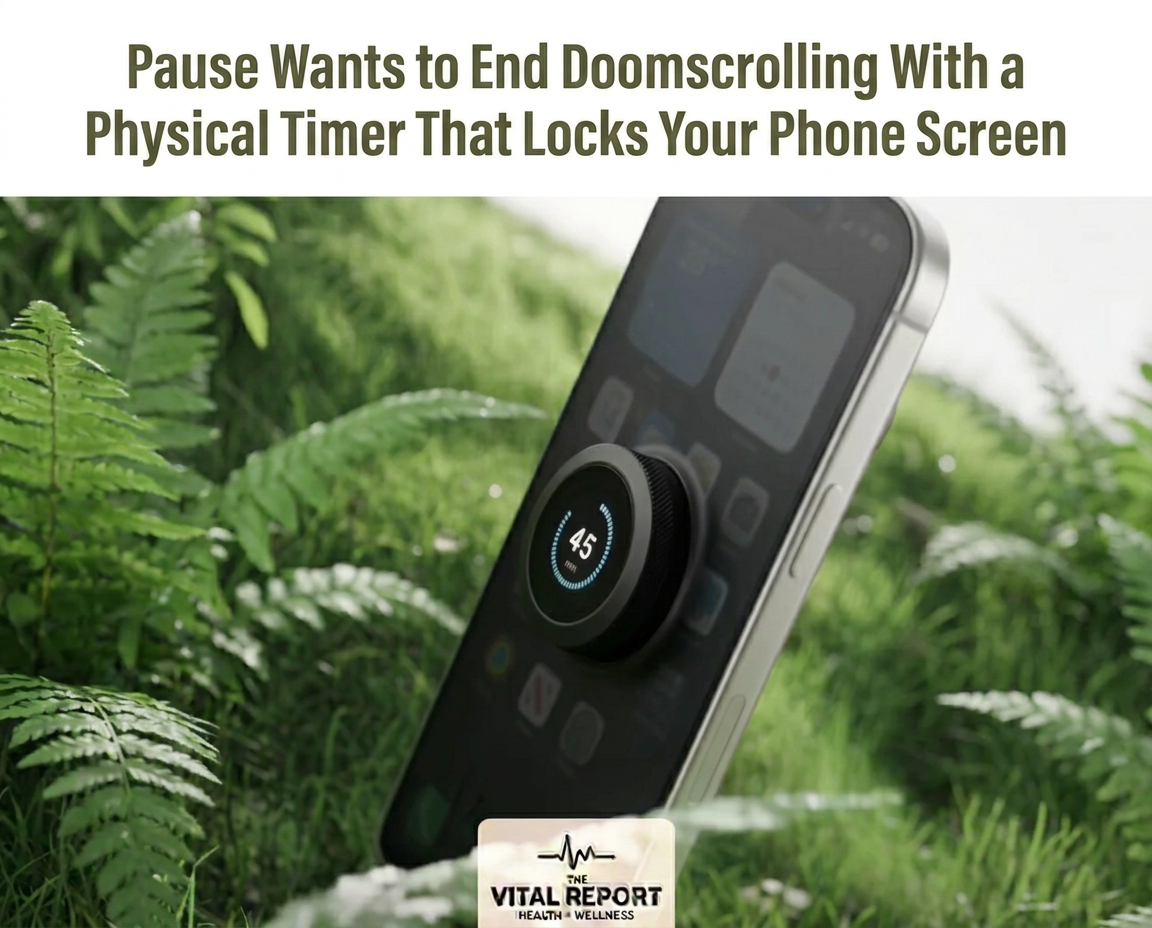
Instead of creating another app to block Instagram, TikTok, or other distractions, Pause has developed a physical screen timer that attaches directly to an iPhone and prevents users from removing it until a selected period ends.
The device uses a timer-controlled magnetic sealing system called MagSeal, allowing users to lock their screen for anywhere from one to 60 minutes.
No app.
No subscription.
No software settings to override.
And unlike putting a phone inside a lockbox, users can still receive calls, access notifications, and use Siri.
According to Pause’s official website, the first batch is scheduled to ship October 15, 2026.
The concept is simple.
Instead of asking people to resist their phones, Pause creates a physical barrier between them and the screen.
And in an increasingly crowded digital wellness market, that difference could be the company’s biggest advantage.
How Does Pause Actually Work?
Pause isn’t a traditional phone case.
And it isn’t a software-based screen-time blocker.
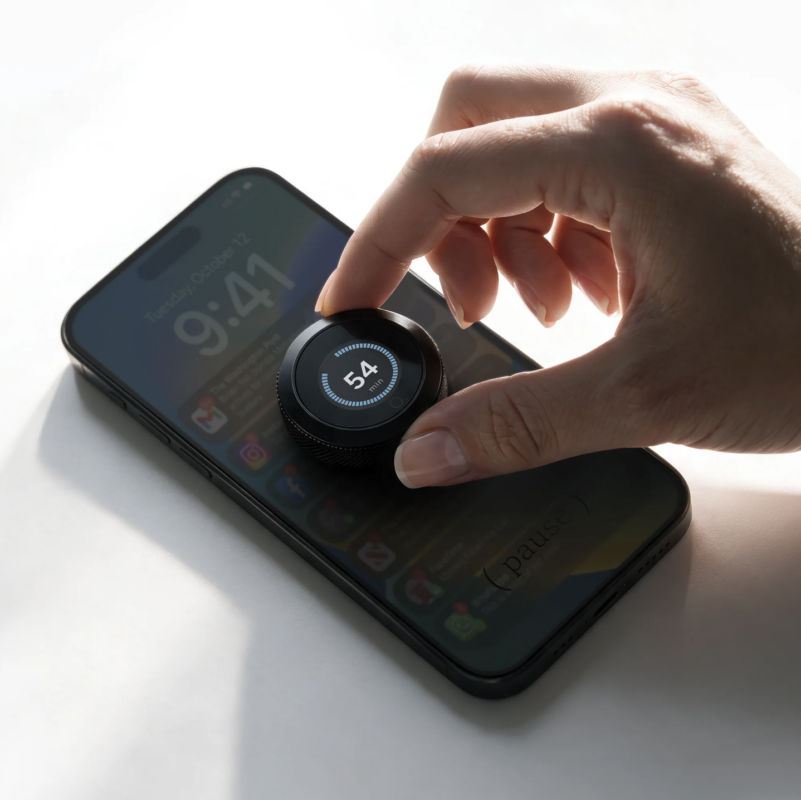
It’s a removable physical cover designed to sit directly over an iPhone display.
According to Pause’s product website, users follow three basic steps.
First, place the device onto the phone screen.
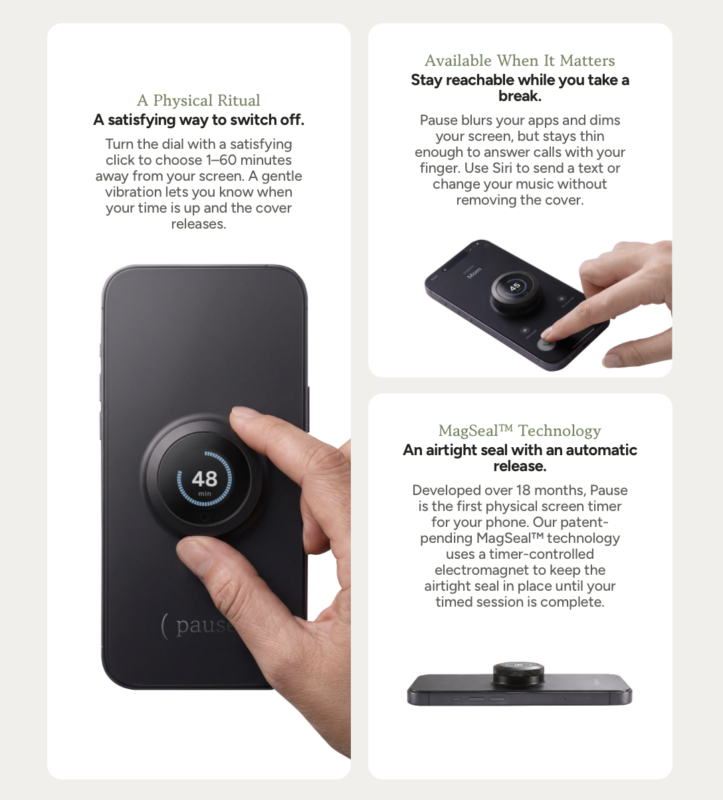
Second, twist the dial to select a time between one and 60 minutes.
Third, let the device create a seal that keeps the cover attached until the timer finishes.
Once the session begins, users can no longer remove the cover through its normal release mechanism.
The cover blurs and dims the display, making it difficult to browse social media, watch videos, or interact with distracting apps.
But the phone isn’t completely disconnected.
Incoming calls still work.
Notifications remain visible through the cover, although they’re harder to read.
And Siri can still perform basic functions, including sending messages, making calls, and controlling music.
When the timer reaches zero, Pause vibrates and automatically releases its seal.
Users can then remove the cover and resume normal phone use.
It’s a different approach from traditional digital detox products.
Instead of removing the phone entirely, Pause removes easy access to the most distracting part of it.
The Technology Behind the Physical Lock
The core innovation is a patent-pending system called MagSeal.
Pause describes the technology as a timer-controlled electromagnet combined with an airtight sealing mechanism.
The system is designed to hold the cover against the phone screen until the selected session ends.
The company says the technology took approximately 18 months to develop.
The result is a product that creates a physical barrier without requiring users to install software or change their phone’s settings.
That matters because software restrictions can often be bypassed.
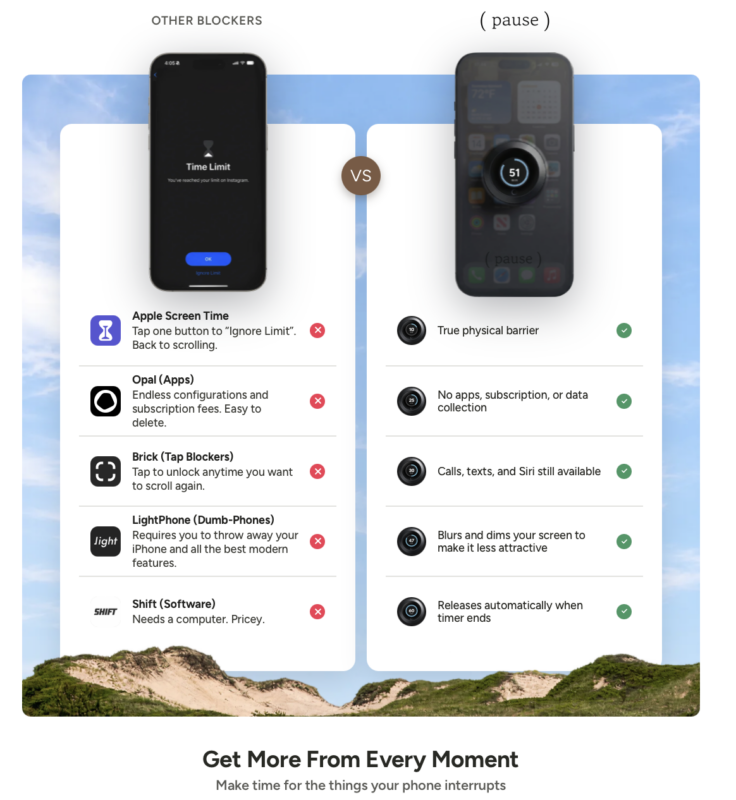
Someone using Apple’s Screen Time feature can choose to ignore certain limits.
Someone using a third-party blocker may be able to disable it or change its settings.
Pause attempts to eliminate that moment of negotiation.
Once the timer is activated, the user has already made the decision to step away from scrolling.
The physical barrier is intended to make that decision harder to reverse.
The device also requires no personal account or access to phone data.
Unlike some digital wellness applications, it doesn’t need to know which apps users open or how long they spend on individual platforms.
It simply covers the screen.
The Founder Tried Almost Everything Else
The idea behind Pause came from a familiar frustration.
The company’s founder, identified in its September marketing materials as Benzion, struggled with excessive screen time.
He tried built-in screen limits.
Downloaded focus apps.
Experimented with other blocking devices.
And repeatedly found ways to return to the same scrolling habits.
According to the company’s founder story, those solutions initially created a sense of progress.
But whenever the urge to use the phone returned, there was usually a workaround.
Ignore the limit.
Delete the app.
Disable the restriction.
Or simply retrieve the device used to unlock it.
The founder eventually concluded that software-based restrictions weren’t enough for his own habits.
He wanted something physical.
Pause says developing the product required approximately $200,000, multiple overseas trips, and numerous prototypes over 18 months.
That development process eventually produced the company’s first physical screen timer.
The product’s underlying philosophy is straightforward.
Instead of fighting digital distractions with more digital tools, create a physical boundary that doesn’t depend on another app.
Why Screen-Time Apps Don’t Always Work
Pause is entering a market that already has plenty of options.
Apple offers built-in Screen Time controls.
Android provides Digital Wellbeing tools.
Apps such as Opal offer customizable blocking schedules.
And products like Brick use physical NFC devices to activate restrictions on selected apps.
Each takes a slightly different approach.
But most still rely on software.
That creates a potential weakness.
A user who feels motivated to avoid distractions at 9 a.m. may feel differently at 9:30.
When the temptation returns, the ability to override a restriction can become part of the problem.
Pause is betting that removing that option will help users follow through on their original intention.
However, the company isn’t the only one recognizing the limits of conventional app timers.
In May 2026, Google introduced Pause Point for Android, a feature designed to interrupt automatic app opening and encourage users to reconsider why they’re using a particular application.
Google’s approach is software-based, using a brief pause and additional friction.
Pause takes the idea further by adding a physical obstruction.
Both products reflect a growing shift in digital wellness.
Rather than simply reporting how much time someone spends on their phone, companies are trying to intervene before that time is lost.
The Bigger Problem Is Automatic Phone Use
One of the most interesting parts of Pause’s positioning is its focus on automatic behavior.
The company isn’t necessarily targeting someone who intentionally decides to spend an hour watching videos.
It’s targeting the person who picks up their phone to check one notification and ends up scrolling for 30 minutes.
That distinction matters.
Many people don’t necessarily intend to spend as much time on their phones as they do.
The behavior can become habitual.
A moment of boredom.
A break between assignments.
Waiting for food.
Sitting on the couch.
Or lying in bed.
The phone becomes the default response.
Pause is designed to interrupt that cycle.
Someone working on a project can lock their phone for 45 minutes.
Someone eating dinner can set it for an hour.
Someone trying to fall asleep can use it to make late-night scrolling less accessible.
The product isn’t necessarily designed to eliminate smartphone use.
It’s designed to create periods when using the phone becomes less automatic.
Digital Wellness Is Becoming a Bigger Consumer Category
The launch also reflects a broader change in how consumers think about technology.
For years, smartphones were designed around increasing engagement.
More notifications.
More content.
More personalization.
More reasons to open an app.
Now another category of technology is emerging around reducing that engagement.
Focus apps.
Minimalist phones.
Physical phone lockboxes.
App-blocking devices.
And now screen-mounted timers.
The growing interest reflects a tension in modern consumer technology.
People rely on smartphones for communication, navigation, work, entertainment, and daily responsibilities.
But they also want more control over how much attention those devices consume.
The American Psychological Association has published extensive resources exploring the relationship between digital technology, social media, behavior, and psychological well-being.
Research suggests that digital media’s effects are complex and depend on how, why, and how much people use it.
That makes it important not to treat every minute of screen time as equally harmful.
But it also creates an opportunity for products that help people align their phone use with their intentions.
Pause is betting that consumers will pay for a device that makes that alignment easier.
Pause Is Selling Time, Not Technology
One unusual aspect of the product is that it doesn’t offer more digital features.
There isn’t an artificial intelligence assistant.
No advanced health dashboard.
No activity score.
No personalized recommendations.
And no subscription service.
Instead, Pause is selling the absence of something.
Distraction.
The company markets the device around everyday activities that can be interrupted by smartphones.
Deep work.
Studying.
Family time.
Exercise.
Sleep.
Creative projects.
And social gatherings.
The appeal isn’t necessarily that the device makes a smartphone more powerful.
It’s that it makes the smartphone less accessible for a limited period.
That’s a different value proposition from most consumer electronics.
And it may resonate with consumers who feel overwhelmed by products that constantly demand more attention.
The Device Still Has Limitations
There are also practical considerations.
Pause isn’t a complete smartphone lockout.
The screen remains partially visible, and certain touch functions are still accessible.
That means it isn’t equivalent to turning off a phone or locking it away completely.
It’s also designed for specific iPhone models.
According to the company’s FAQ, the current product supports iPhone 12 and newer models, while Android compatibility is planned for the future.
The device must be charged using an included magnetic charging cable.
Pause estimates that the battery can last approximately one week under typical use.
And the maximum session length is 60 minutes.
That makes the product better suited to defined periods of focus than an entire day away from a smartphone.
There’s also an important safety consideration.
Because the product intentionally prevents normal screen access during a session, consumers should understand how emergency functions work before relying on it.
Pause says incoming calls and Siri remain available, but those claims should not be confused with unrestricted access to every phone function.
And although the company features positive testimonials from beta testers, there is not yet published independent clinical evidence establishing that Pause reduces screen time or improves sleep, productivity, or mental health.
Those outcomes remain to be demonstrated.
The First Batch Is Shipping October 15
Pause is currently taking reservations for its first production batch.
According to the company’s website, initial orders are scheduled to begin shipping October 15, 2026, with another production batch planned for December.
The company offers discounts for purchasing multiple devices.
That approach creates opportunities for households, couples, or individuals who want to keep a timer in different locations.
Pause also advertises a 60-day money-back guarantee and includes a charging cable and carrying case.
The company hasn’t published a clearly accessible fixed retail price in the product information reviewed, so pricing may vary by configuration and promotion.
The early rollout will be an important test.
The product concept is easy to understand.
But consumer adoption will depend on whether people find the physical routine convenient enough to repeat.
After all, a screen-time tool only works when someone chooses to use it.
The Next Wellness Device Might Help You Use Technology Less
The most interesting thing about Pause may be what it represents.
Consumer wellness technology usually promises to add something.
More data.
More insights.
More tracking.
More personalization.
But Pause is taking the opposite approach.
It doesn’t collect information about users.
It doesn’t require another app.
And it doesn’t introduce another digital platform to manage.
Its primary purpose is to make an existing device less engaging for a predetermined period.
That’s an unusual direction for consumer electronics.
And it connects to a larger theme Vital Report has been following across wellness technology: products are increasingly being designed not just to monitor habits, but to influence them directly.
A sleep tracker can tell someone they went to bed too late.
A focus app can report how long they spent scrolling.
Pause attempts to intervene before the behavior happens.
That difference could become increasingly important as consumers look for more practical ways to manage their relationship with technology.
The Bottom Line
Pause is betting that the best way to reduce screen time isn’t another app.
It’s a physical barrier.
The company’s new screen timer attaches directly to an iPhone, uses patent-pending MagSeal technology to remain in place for one to 60 minutes, and automatically releases when the session ends.
The device blurs and dims the display while preserving limited access to calls, notifications, and Siri.
No subscription.
No account.
No app installation.
And no traditional software override.
With its first batch scheduled to ship October 15, Pause is entering a digital wellness market increasingly focused on helping consumers reduce unwanted smartphone use.
But the product’s long-term success will depend on more than its locking mechanism.
It will depend on whether users find the experience practical, whether the hardware performs reliably, and whether the physical barrier actually helps people change their habits over time.
The concept itself reflects an interesting reversal in consumer technology.
For years, companies have built products designed to keep people looking at screens.
Pause is building one designed to make them look away.
And in an increasingly connected world, that might be a valuable feature.
Source note: Product specifications, founder background, compatibility, and shipping details come from Pause’s website. Its effectiveness claims and early customer testimonials have not been independently verified.