
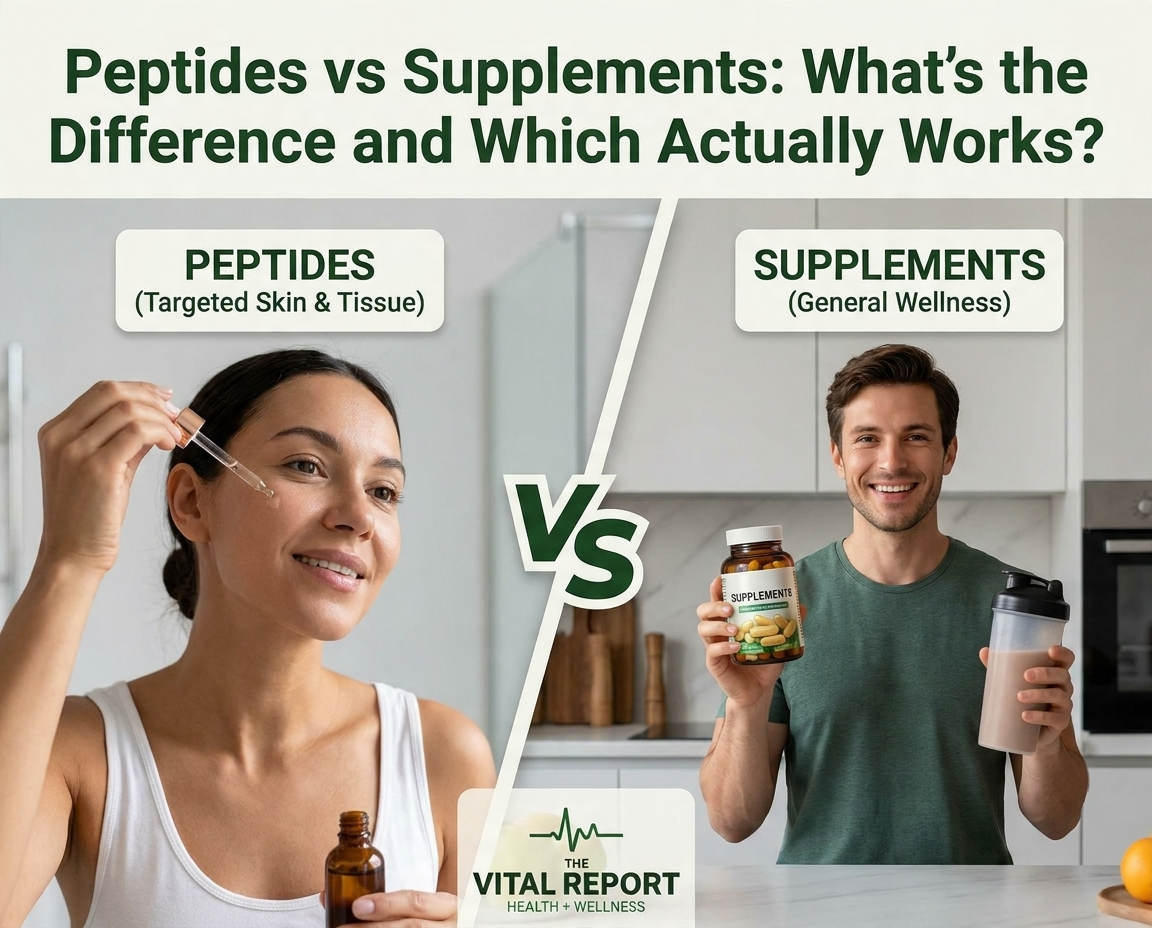
Peptides vs Supplements: Understanding the Difference
The wellness industry is flooded with products promising better health, increased energy, weight loss, longevity, muscle growth, and improved recovery. Two categories have become especially popular in recent years: traditional supplements and peptides.
While both are often marketed toward similar goals, they work through fundamentally different biological mechanisms.
Understanding the distinction between peptides vs supplements is essential for anyone evaluating whether these products are worth incorporating into their health routine.
The short answer is that supplements typically provide the body with nutrients or plant compounds, while peptides act as biological signaling molecules that communicate specific instructions to cells and tissues.
This difference may explain why some peptides produce highly targeted effects while many conventional supplements deliver broader, less predictable outcomes.
What Are Supplements?
Dietary supplements generally contain ingredients intended to support health by providing nutrients or naturally occurring compounds.
Common examples include:
- Vitamin D
- Magnesium
- Omega-3 fatty acids
- Creatine
- Probiotics
- Herbal extracts such as ashwagandha or rhodiola
Most supplements function by:
- Correcting nutrient deficiencies
- Supporting metabolic pathways
- Reducing oxidative stress
- Providing substrates the body uses to produce hormones, neurotransmitters, enzymes, and structural proteins
For example, vitamin D supports calcium metabolism and immune function, while creatine helps replenish cellular ATP production during intense exercise.
In other words, supplements provide “building blocks” or support systems that help the body function optimally.
What Are Peptides?
Peptides are short chains of amino acids, generally containing fewer than 50 amino acids.
Unlike traditional supplements, peptides often function as biological messengers.
Many naturally occurring peptides already exist within the human body and regulate processes such as:
- Hormone release
- Appetite control
- Tissue repair
- Immune activity
- Metabolism
- Cellular communication
Scientists can manufacture peptides that mimic or enhance these naturally occurring signals.
Examples include:
- GLP-1 receptor agonists such as semaglutide
- Insulin
- Growth hormone-releasing peptides
- Certain collagen-derived bioactive peptides
- Various therapeutic peptides under clinical investigation
Therapeutic peptides are increasingly viewed as an important class of medicines because of their high target specificity and ability to bind directly to biological receptors. (Springer Link)
Protein Signaling vs Nutrient Supplementation
The most important distinction in the peptides vs supplements discussion is the difference between signaling and supplementation.
Supplements Supply Resources
Think of supplements as providing raw materials.
For example:
- Magnesium supports enzyme activity
- Vitamin C supports collagen production
- Protein powder provides amino acids
- Fish oil provides omega-3 fatty acids
The body then decides how to use those resources.
Peptides Deliver Instructions
Peptides often work differently.
Instead of providing resources, they send messages.
A peptide can bind to a receptor on a cell and trigger a specific biological response.
Examples include:
- Stimulating insulin release
- Increasing satiety signals
- Activating tissue repair pathways
- Influencing immune responses
- Modulating inflammation
This receptor-driven signaling mechanism is why many researchers view peptides as more targeted than traditional nutritional supplementation. (Springer Link)
A useful analogy:
- Supplements provide construction materials.
- Peptides provide the blueprint telling workers what to build.
Receptor Binding: Why Peptides Can Be More Targeted
Most wellness peptides exert their effects through receptor interactions.
A receptor is a protein located on the surface or inside a cell.
When the appropriate peptide binds to that receptor, it can activate a cascade of biological events.
This specificity helps explain why peptide therapies often produce stronger and more targeted effects than nutritional supplements.
For example, the GLP-1 hormone naturally binds to GLP-1 receptors involved in appetite regulation and blood sugar control.
Drugs such as semaglutide were designed to mimic this naturally occurring peptide signal, producing clinically meaningful changes in body weight and glucose metabolism.
Traditional supplements rarely demonstrate this degree of receptor specificity.
Instead, they generally influence physiology indirectly through broader nutritional support.
Bioavailability: Why Delivery Method Matters
One of the most important concepts when evaluating peptide supplements is bioavailability.
Bioavailability refers to how much of a substance reaches circulation in an active form after administration.
Traditional Supplements
Most vitamins and minerals have relatively straightforward absorption pathways.
For example:
- Vitamin C is absorbed through the intestine
- Magnesium enters circulation through specialized transporters
- Amino acids are efficiently absorbed after digestion
Although absorption rates vary, many conventional supplements are designed specifically for oral use.
Peptides Face Unique Challenges
Peptides are much more fragile.
The digestive tract is designed to break proteins and peptides into individual amino acids.
As a result, many peptides are destroyed before they can enter the bloodstream. (peptideexaminer.com)
Major barriers include:
- Stomach acid
- Digestive enzymes
- Intestinal permeability limitations
- First-pass liver metabolism
Researchers consistently identify low oral bioavailability as one of the largest obstacles facing peptide therapeutics. (Frontiers)
Injectable vs Oral Peptides
Because of these bioavailability challenges, many peptides are administered through injection.
Injectable Peptides
Injectable delivery bypasses digestion entirely.
Benefits include:
- Higher bioavailability
- More predictable dosing
- Greater systemic exposure
- Better receptor engagement
This is why the vast majority of approved peptide drugs use injectable administration. (peptideexaminer.com)
Examples include:
- Insulin
- Semaglutide injections
- Tirzepatide
- Various peptide hormone therapies
Oral Peptides
Oral peptides have historically been difficult to develop because digestive enzymes rapidly degrade them.
However, advances in formulation technology are changing this.
Strategies include:
- Enteric coatings
- Absorption enhancers
- Liposomal delivery systems
- Nanoparticle encapsulation
The approval of oral semaglutide demonstrated that peptide drugs can achieve meaningful efficacy when advanced delivery technologies are employed. (Frontiers)
Still, oral peptide absorption remains significantly more challenging than traditional supplement absorption. (PubMed)
Are Peptide Supplements the Same as Therapeutic Peptides?
No.
This distinction creates enormous confusion in the marketplace.
The term “peptide” describes a molecular structure, not a regulatory category.
For example:
- Collagen peptides are sold as dietary supplements.
- Semaglutide is a prescription medication.
- Some research peptides are neither approved drugs nor legal dietary supplements.
These products exist under entirely different regulatory frameworks. (Healthy Aging Atlas)
Consumers often assume that all peptides belong to the same category, but that assumption is incorrect.
Regulation Differences
Dietary Supplements
In the United States, dietary supplements are regulated under the Dietary Supplement Health and Education Act (DSHEA).
Manufacturers generally do not need FDA approval before marketing products.
They are responsible for ensuring safety and truthful labeling.
Peptide Drugs
Prescription peptide medications undergo:
- Preclinical studies
- Phase I trials
- Phase II trials
- Phase III trials
- FDA review
These processes evaluate:
- Safety
- Effectiveness
- Pharmacokinetics
- Manufacturing quality
This evidence threshold is substantially higher than what is required for dietary supplements. (Healthy Aging Atlas)
Comparing the Evidence
When discussing which actually works, evidence quality matters.
Strong Evidence
The strongest scientific support exists for:
- Prescription GLP-1 agonists
- Insulin
- Certain therapeutic peptide drugs
- Creatine
- Omega-3 fatty acids
- Vitamin D in deficient populations
These compounds have extensive human clinical data.
Moderate Evidence
Moderate evidence supports:
- Collagen peptides
- Certain bioactive milk-derived peptides
- Some probiotic formulations
- Select herbal compounds
Research suggests benefits, though results can vary.
Limited Evidence
Many wellness peptides promoted online remain supported primarily by:
- Animal studies
- Laboratory research
- Anecdotal reports
Human clinical evidence may still be limited or absent.
Consumers should recognize that popularity on social media does not necessarily reflect scientific validation. (Vogue)
Best-Supported Bioactive Peptides
Among the growing list of peptide compounds, several categories currently have stronger evidence than others.
GLP-1-Based Peptides
These represent one of the most successful examples of peptide therapeutics.
Benefits include:
- Weight loss
- Appetite regulation
- Improved blood sugar control
Large-scale human trials support their effectiveness.
Insulin
Insulin remains one of the most important peptide medications ever developed.
Its efficacy and safety profile have been extensively established through decades of clinical use.
Collagen-Derived Bioactive Peptides
Collagen peptides differ from therapeutic peptides because they function partly as nutritional substrates.
Research suggests potential benefits for:
- Skin elasticity
- Joint health
- Connective tissue support
Certain collagen-derived bioactive peptides may also exert signaling effects beyond simple amino acid delivery. (RSC Publishing)
Which Works Better: Peptides or Supplements?
The answer depends entirely on the goal.
Supplements May Be Better When:
- Correcting nutrient deficiencies
- Supporting general wellness
- Improving dietary intake
- Providing foundational health support
Peptides May Be Better When:
- Specific receptor-mediated effects are desired
- Targeted physiological outcomes are needed
- Clinical evidence supports a defined mechanism
- A physician-supervised therapy is appropriate
This is not necessarily an either-or decision.
Many individuals use supplements as a foundation while peptide therapies are reserved for specific medical or performance-related applications.
The Future of Wellness Peptides
Interest in wellness peptides continues to grow rapidly.
Advances in:
- Peptide chemistry
- Drug delivery technology
- Oral bioavailability enhancement
- Precision medicine
are expanding the possibilities for peptide-based interventions.
Researchers increasingly view peptides as a promising therapeutic class because they combine high specificity with relatively favorable safety profiles compared with many small-molecule drugs. (Springer Link)
At the same time, consumers should recognize that not all peptide products are supported by equal levels of evidence.
Final Verdict: Peptides vs Supplements
The debate surrounding peptides vs supplements often misses the central point: they are designed to do different things.
Traditional supplements provide nutrients and compounds that help support biological processes.
Peptides frequently act as signaling molecules that instruct the body to perform specific actions through receptor binding.
Because of this distinction, peptides can offer highly targeted effects that many supplements cannot replicate.
However, peptide therapies often face challenges related to bioavailability, administration, regulation, and evidence quality.
For most people, foundational supplements such as protein, vitamins, minerals, omega-3s, and creatine remain among the most evidence-based tools for supporting health. For specific medical conditions or highly targeted physiological goals, clinically validated peptide therapies may provide advantages that traditional supplements simply cannot match.
The key is understanding the difference between supplying the body with resources and directing the body with biological instructions—a distinction that sits at the heart of modern peptide science.
References
- Clinical Pharmacokinetics. Pharmacokinetics and Pharmacokinetic–Pharmacodynamic Correlations of Therapeutic Peptides. (Springer Link)
- Amino Acids. Therapeutic Peptides: Chemical Strategies Fortify Peptides for Enhanced Disease Treatment Efficacy. (Springer Link)
- Frontiers in Drug Delivery. Navigating the Complexity of Oral Peptide Delivery. (PubMed)
- Frontiers in Drug Delivery. Oral Delivery of Peptides and Proteins. (Frontiers)
- Food & Function. Encapsulation of Short-Chain Bioactive Peptides for Gastrointestinal Delivery. (RSC Publishing)
- Pharmaceutics. Barriers and Strategies for Oral Peptide and Protein Therapeutics Delivery. (MDPI)
- Healthy Aging Atlas. Peptides vs Supplements: What Is the Difference? (Healthy Aging Atlas)