

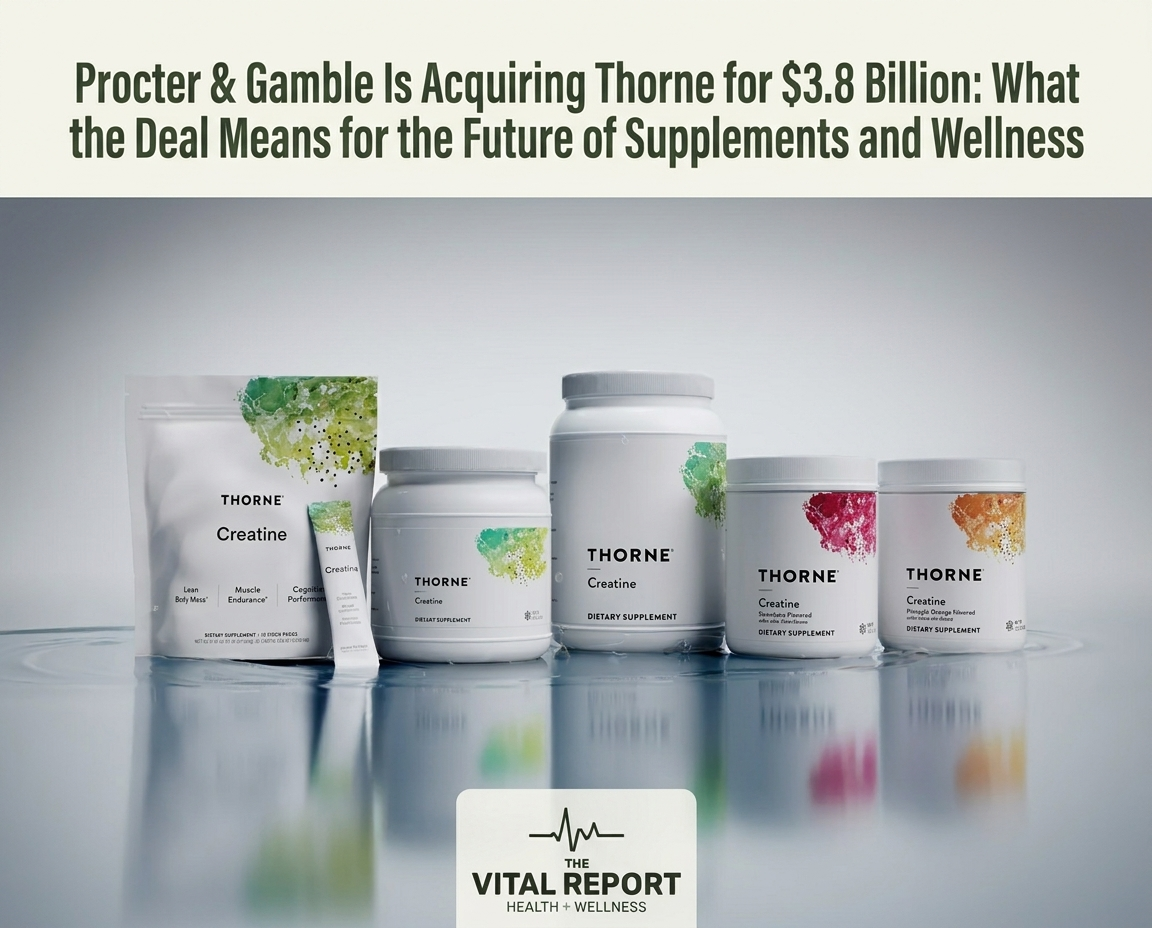
The supplement industry just got one of its biggest endorsements yet from corporate America.
Procter & Gamble, the consumer products giant behind brands ranging from Tide and Pampers to Gillette and Oral-B, has agreed to acquire premium supplement company Thorne in a deal valued at approximately $3.8 billion in cash.
The acquisition represents far more than another major consumer brand changing ownership. It is a signal that vitamins, supplements, preventative health, performance nutrition, and personalized wellness are becoming increasingly important parts of the mainstream consumer economy.
Thorne has spent decades building a reputation around science-backed formulations, ingredient quality, testing, and relationships with healthcare practitioners and athletes. Now, that reputation will sit inside one of the largest consumer products companies in the world.
For Procter & Gamble, the acquisition gives the company immediate access to one of the most recognizable premium brands in the rapidly growing supplement market.
For Thorne, it provides access to P&G’s enormous distribution, marketing, research, and operational infrastructure.
And for consumers, the deal raises an important question: What happens when one of the wellness industry’s most trusted supplement brands becomes part of a global consumer goods empire?
Procter & Gamble Is Buying Thorne for $3.8 Billion
Procter & Gamble has entered into an agreement to acquire Thorne from private equity firm L Catterton for approximately $3.8 billion in cash.
The transaction is expected to close during the fourth quarter of 2026, subject to customary closing conditions.
The valuation immediately makes the acquisition one of the more significant transactions in the modern supplement industry.
Thorne is projected to generate approximately $650 million in sales in 2026, according to reporting surrounding the deal. That means P&G is paying nearly six times Thorne’s projected annual revenue to acquire the company.
The premium highlights just how valuable trusted health and wellness brands have become.
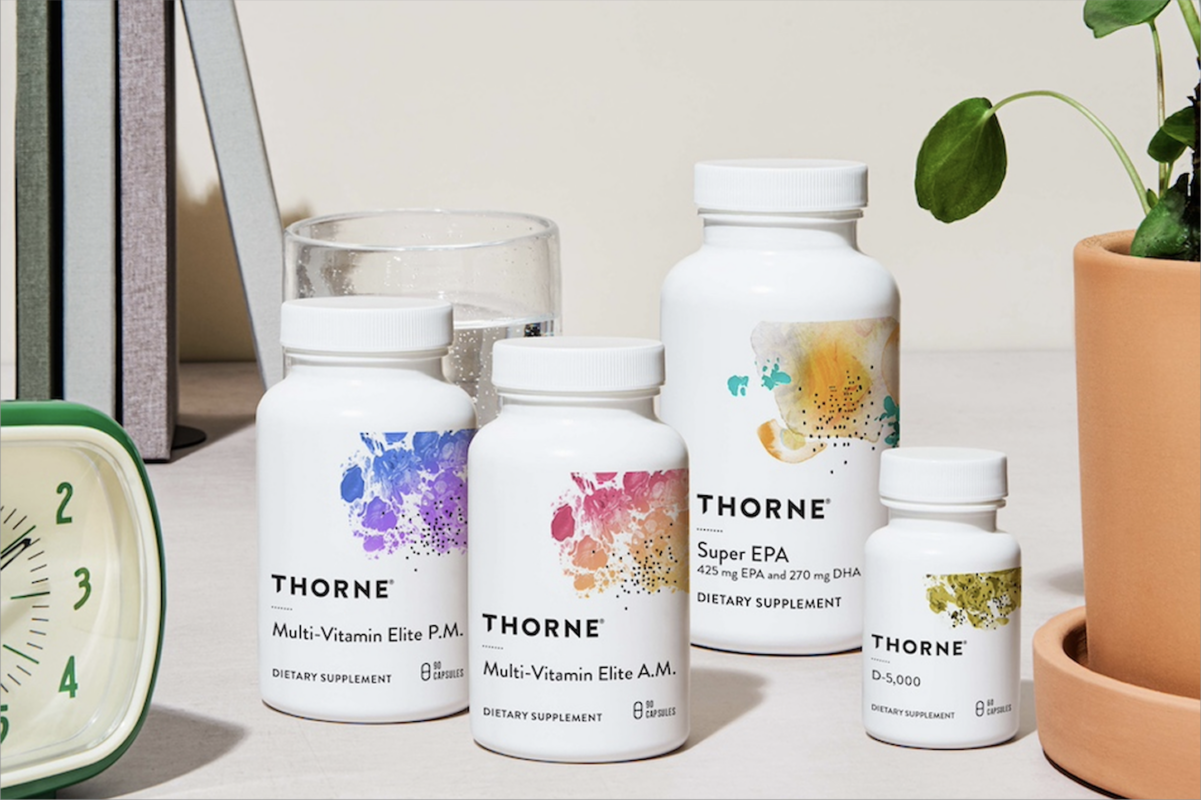
What Is Thorne?
Founded in 1984, Thorne has grown from a supplement company primarily known among healthcare practitioners into a major consumer wellness brand.
Its product portfolio now stretches across numerous health categories, including:
- Daily vitamins and minerals
- Magnesium
- Creatine and sports nutrition
- Gut health
- Sleep and stress
- Women’s health
- Healthy aging
- Heart health
- Metabolic health
- Multivitamins
- Omega-3s
But the company’s biggest differentiator has arguably been trust.
Rather than positioning itself as a traditional mass-market vitamin company, Thorne built much of its identity around testing, research, manufacturing standards, and science-backed formulations.
A number of Thorne products carry NSF Certified for Sport certification, an independent certification designed to verify supplement contents and screen products for certain contaminants and banned substances.
Thorne also says its products undergo multiple rounds of testing throughout manufacturing.
That quality-focused reputation has helped the company become particularly popular among athletes, healthcare professionals, wellness enthusiasts, and consumers willing to pay a premium for supplements.
Thorne’s Value Exploded in Just Three Years
One of the most interesting parts of the acquisition is how quickly Thorne’s valuation has increased.
In 2023, consumer-focused private equity firm L Catterton acquired Thorne HealthTech and took the company private in a transaction worth approximately $680 million.
Three years later, P&G is agreeing to acquire Thorne for approximately $3.8 billion.
That represents an enormous increase in enterprise value over a relatively short period.
It also illustrates what has happened across the broader wellness industry.
Consumers are spending more money on products positioned around longevity, sleep, metabolic health, recovery, nutrition, and preventative healthcare. At the same time, wellness brands have become increasingly sophisticated at selling directly to consumers through social media, podcasts, influencers, healthcare professionals, and subscription models.
Thorne sits directly at the intersection of many of those trends.
Why Procter & Gamble Wants Thorne
For Procter & Gamble, acquiring Thorne significantly strengthens an existing health and wellness business.
P&G is already active in consumer health through brands such as Metamucil, Align Probiotic and New Chapter.
Thorne, however, gives the company something different.
It gives P&G a premium, science-oriented wellness brand with strong recognition among younger and highly health-conscious consumers.
That demographic could become increasingly important.
The traditional consumer packaged goods model was built around household staples: detergent, toothpaste, razors, diapers, shampoo and other products consumers repeatedly purchase.
Wellness is becoming another version of that model.
A consumer taking magnesium, creatine, probiotics, vitamins or other supplements may purchase those products every month for years.
That recurring purchasing behavior can make trusted supplement companies extremely valuable.
Thorne also provides P&G with credibility in areas such as performance nutrition and personalized wellness where traditional consumer brands may have difficulty establishing authenticity.


The Supplement Industry Is Becoming Big Business
The Thorne acquisition is part of a much larger transformation happening across health and wellness.
Supplements were once dominated by bottles of basic multivitamins sitting in pharmacy aisles.
Today, the category looks completely different.
Consumers are buying electrolyte powders, greens powders, creatine, collagen, magnesium, probiotics, protein products, sleep supplements and increasingly specialized formulas designed around specific health goals.
Wellness companies are also becoming more sophisticated.
Brands such as AG1 have helped demonstrate how supplements can become lifestyle products rather than simple commodities.
Meanwhile, companies like Oura are turning personal health data into an everyday consumer experience through wearable technology.
The same shift can be seen in health-testing platforms, continuous glucose monitors, smart rings, recovery devices and longevity clinics.
As Vital Report has covered in its reporting on the best smart rings of 2026, consumers increasingly want tools that help them understand and actively manage their health rather than simply respond when something goes wrong.
Supplements fit naturally into that ecosystem.
Consumers track their sleep, recovery, glucose, exercise and other biomarkers and then increasingly look toward nutrition and supplementation as another way to optimize those numbers.
P&G’s willingness to spend $3.8 billion on Thorne suggests the world’s largest consumer companies are paying attention.
Why Thorne’s Reputation Matters So Much
The most valuable part of Thorne may not be its factories, formulas or even its sales.
It may be consumer trust.
The supplement industry has historically struggled with questions surrounding ingredient quality, labeling accuracy, contamination, and inconsistent manufacturing standards.
Unlike prescription medications, dietary supplements operate under a different regulatory framework in the United States.
That makes independent testing and manufacturing standards particularly important for consumers trying to evaluate brands.
Thorne has made those standards a central component of its identity.
The company has an NSF-certified manufacturing facility and offers more than 20 products carrying NSF Certified for Sport status. The certification includes testing related to label accuracy and substances prohibited by major athletic organizations.
For professional athletes, that distinction can be extremely important.
For everyday consumers, it reinforces the idea that Thorne is selling something beyond another bottle of vitamins.
It is selling confidence.
Will P&G Change Thorne Products?
This will likely become the biggest question surrounding the acquisition.
Consumers who purchase premium wellness products are often highly loyal to specific formulations, ingredients, manufacturing processes and quality standards.
That means P&G has a delicate balancing act ahead.
The company acquired Thorne largely because of the reputation Thorne has already built.
Significantly changing the formulas or quality standards that created that reputation could potentially damage one of the most valuable parts of the acquisition.
There is currently no basis to assume P&G will reduce Thorne’s quality standards simply because ownership is changing.
But consumers are understandably watching closely.
Following reports of the acquisition, supplement communities online quickly began discussing whether Thorne would maintain its existing testing procedures and product standards under P&G ownership.
That reaction demonstrates something important about modern wellness consumers: trust can be difficult to build and extremely easy to lose.
Maintaining Thorne’s reputation will therefore likely be critical to making the $3.8 billion acquisition successful.
What Could P&G Do With Thorne?
The more interesting question may be what happens if P&G leaves Thorne’s core identity intact while dramatically expanding its reach.
P&G operates one of the largest consumer distribution networks in the world.
That infrastructure could potentially expose Thorne to millions of new consumers.
Thorne could expand internationally.
Its retail footprint could grow.
Its marketing budget could increase.
Its manufacturing capacity could expand.
New product categories could also emerge.
And P&G’s relationships with major retailers could potentially make Thorne significantly more accessible without necessarily turning it into a traditional mass-market supplement brand.
The opportunity is enormous.
But P&G will have to balance growth with exclusivity.
Part of Thorne’s appeal comes from the perception that it is different from traditional drugstore supplement brands.
Preserving that premium positioning while expanding distribution could be one of the most important challenges following the acquisition.
The Deal Shows Where Consumer Health Is Heading
The acquisition also reflects a larger change in how people think about healthcare.
For decades, healthcare primarily revolved around treating problems after they appeared.
The emerging wellness economy is increasingly focused on prevention.
Consumers want to understand their bodies earlier.
They are tracking sleep with smart rings.
Monitoring glucose with continuous glucose monitors.
Ordering comprehensive blood tests.
Using recovery technology.
Tracking nutrition.
Experimenting with supplements.
And paying more attention to longevity.
That doesn’t mean supplements can replace medical care, nor does every supplement provide meaningful benefits for every individual.
But consumer behavior is clearly moving toward more proactive health management.
Large consumer companies increasingly want exposure to that shift.
Thorne Could Become a Blueprint for Future Wellness Acquisitions
Thorne may ultimately represent something larger than a $3.8 billion supplement acquisition.
It could provide a blueprint for how major consumer corporations approach wellness brands.
Rather than attempting to create health brands from scratch, companies like P&G can acquire businesses that already possess credibility, loyal communities, strong distribution channels and premium positioning.
That could make other independent wellness companies increasingly attractive acquisition targets.
Brands operating across supplements, functional nutrition, hydration, longevity, personalized health testing and recovery technology may suddenly look much more valuable to major consumer corporations.
If Thorne can go from a roughly $680 million private-equity transaction in 2023 to a $3.8 billion acquisition just three years later, investors will undoubtedly be searching for the next company capable of following a similar trajectory.
What the P&G-Thorne Deal Means for Consumers
In the short term, consumers may notice very little.
Thorne remains Thorne.
The more important changes will likely unfold over several years.
Consumers should watch whether the company maintains its existing manufacturing and testing standards, whether formulas change, how aggressively distribution expands, and what new products emerge under P&G ownership.
If P&G successfully preserves Thorne’s credibility while providing the resources to expand the brand globally, the acquisition could dramatically increase Thorne’s influence.
If consumers begin to believe the brand has sacrificed quality for scale, however, the reaction could look very different.
That makes trust the central issue surrounding this deal.
The Bottom Line
Procter & Gamble’s $3.8 billion acquisition of Thorne is one of the clearest signs yet that supplements and preventative wellness have moved firmly into the mainstream.
Thorne spent decades building a premium brand around science, quality, testing and consumer trust.
P&G is now betting billions that those qualities can become even more valuable at global scale.
The deal also demonstrates just how quickly the economics of wellness are changing. Thorne was acquired by L Catterton for roughly $680 million in 2023. Just three years later, P&G is agreeing to pay approximately $3.8 billion.
That trajectory will get the attention of virtually every investor, entrepreneur and consumer company operating in health and wellness.
The biggest question now isn’t whether wellness has become big business.
It clearly has.
The question is whether the world’s largest consumer companies can scale trusted wellness brands without changing the qualities that made consumers trust them in the first place.
Frequently Asked Questions
Did Procter & Gamble buy Thorne?
Procter & Gamble has entered into an agreement to acquire Thorne from private equity firm L Catterton for approximately $3.8 billion in cash. The transaction is expected to close in the fourth quarter of 2026, subject to customary closing conditions.
How much did P&G pay for Thorne?
The announced purchase price is approximately $3.8 billion in cash.
Who owned Thorne before Procter & Gamble?
Thorne has been owned by consumer-focused private equity firm L Catterton since 2023. L Catterton acquired Thorne HealthTech in a transaction valued at approximately $680 million and took the company private.
How much money does Thorne make?
Thorne is projected to generate approximately $650 million in sales during 2026, according to reporting surrounding the acquisition.
Why did Procter & Gamble buy Thorne?
The acquisition expands P&G’s presence in health and wellness and gives the company ownership of a premium supplement brand with strong recognition among healthcare professionals, athletes, and health-conscious consumers.
Will Thorne supplements change after the P&G acquisition?
There is currently no reason to conclude that Thorne’s formulations or testing standards will change simply because of the acquisition. Consumers will likely pay close attention to manufacturing standards, NSF certifications, ingredient sourcing, and product formulations after the transaction closes.
Is Thorne NSF Certified?
Thorne operates NSF-certified manufacturing facilities and offers numerous products carrying NSF Certified for Sport status. Consumers can verify individual certified products through NSF’s official certification database.