
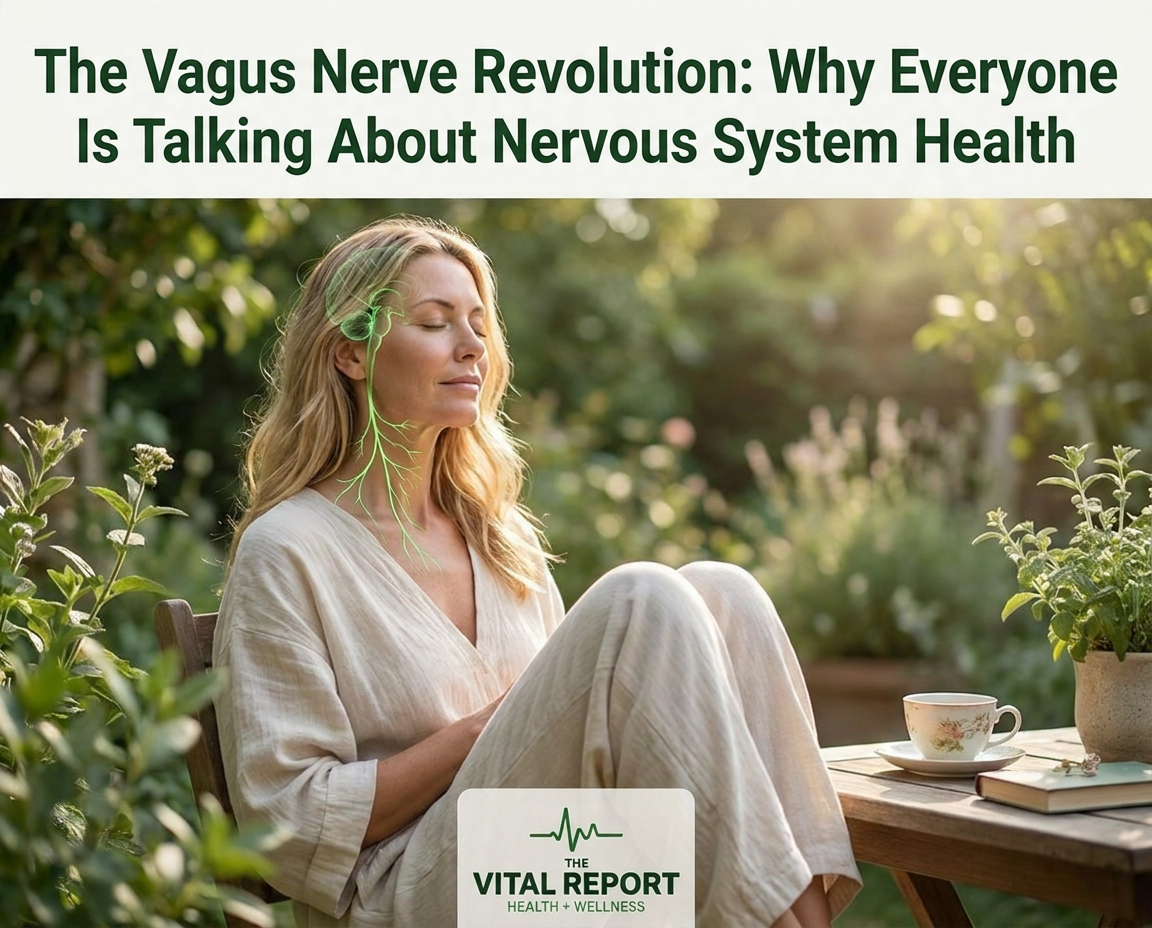
The Wellness World Has a New Obsession—And It Starts in Your Nervous System
For years, health conversations have revolved around nutrition, exercise, sleep, and supplementation.
Those factors remain important.
But a growing number of researchers, physicians, and wellness experts believe another system deserves far more attention: the nervous system.
Specifically, interest has surged around a structure known as the vagus nerve.
Once primarily discussed in medical textbooks and neuroscience research, the vagus nerve has become one of the most talked-about topics in wellness, longevity, mental health, and performance optimization.
Social media is filled with claims about vagus nerve exercises, vagus nerve stimulation devices, cold plunges, breathwork protocols, and nervous system regulation techniques.
Advocates suggest that improving vagal tone may help support everything from stress resilience and sleep quality to digestion, recovery, inflammation, and emotional well-being.
As often happens in wellness, some of the claims are likely exaggerated.
But behind the hype lies a fascinating body of science that is reshaping how researchers think about health.
The question isn’t whether the vagus nerve matters.
It’s how much.
What Is the Vagus Nerve?
The vagus nerve is the longest cranial nerve in the human body.
Its name comes from the Latin word for “wandering,” which is fitting because it travels throughout much of the body.
Originating in the brainstem, the vagus nerve extends through the neck and connects to numerous organs, including:
- The heart
- The lungs
- The digestive tract
- The liver
- The spleen
Rather than serving a single function, the vagus nerve acts as a communication superhighway between the brain and the body.
Researchers estimate that approximately 80% of vagal nerve fibers carry information from the body back to the brain.
This means the vagus nerve isn’t just delivering instructions—it is constantly providing feedback.
As a result, it plays a central role in maintaining balance across multiple physiological systems.
Understanding the Autonomic Nervous System
To understand why the vagus nerve is receiving so much attention, it helps to understand the autonomic nervous system.
The autonomic nervous system controls many functions that occur automatically, including:
- Heart rate
- Blood pressure
- Digestion
- Breathing
- Immune responses
This system consists of two primary branches.
The Sympathetic Nervous System
Often called the “fight-or-flight” system, the sympathetic branch prepares the body to respond to challenges.
When activated, it can:
- Increase heart rate
- Raise blood pressure
- Release stress hormones
- Mobilize energy stores
This response is essential for survival.
The problem arises when it remains activated for extended periods.
The Parasympathetic Nervous System
The parasympathetic branch is frequently described as the “rest-and-digest” system.
Its job is to promote recovery, relaxation, and restoration.
The vagus nerve serves as the primary driver of this system.
When parasympathetic activity increases, the body shifts toward:
- Slower heart rate
- Improved digestion
- Enhanced recovery
- Reduced stress responses
Modern life often places heavy demands on the sympathetic system.
Many researchers believe chronic stress may contribute to an imbalance between these two branches.
This has fueled growing interest in techniques that support parasympathetic activity.
Why Nervous System Health Has Become a Major Wellness Trend
Historically, many health discussions focused on isolated symptoms.
Today, researchers increasingly recognize that chronic stress influences nearly every aspect of health.
Stress can affect:
- Sleep quality
- Metabolic health
- Immune function
- Recovery
- Cognitive performance
- Cardiovascular health
The nervous system sits at the center of these interactions.
As scientists continue uncovering connections between stress physiology and chronic disease, nervous system regulation has become a major area of focus.
The vagus nerve occupies a prominent position within this conversation.
What Is Vagal Tone?
One of the most frequently discussed concepts in this field is vagal tone.
Vagal tone refers to the activity and responsiveness of the vagus nerve.
Higher vagal tone is generally associated with greater adaptability and resilience.
In practical terms, individuals with strong vagal tone may be better able to transition between states of activation and recovery.
Instead of remaining chronically stressed, their nervous systems can more effectively return to baseline.
Researchers often view vagal tone as a marker of autonomic flexibility.
The healthier and more responsive the system, the better the body may adapt to challenges.
Heart Rate Variability: The Window Into Vagal Function
Interest in vagal tone has increased significantly thanks to wearable technology.
Devices such as fitness trackers and smartwatches now monitor a metric known as heart rate variability, or HRV.
HRV measures the variation in time between heartbeats.
Contrary to what many assume, a perfectly steady heartbeat is not necessarily ideal.
Healthy hearts exhibit subtle fluctuations that reflect communication between the sympathetic and parasympathetic nervous systems.
Higher HRV is generally associated with:
- Better recovery
- Greater stress resilience
- Improved cardiovascular health
- Enhanced autonomic flexibility
Because vagal activity strongly influences HRV, researchers often use HRV as an indirect measure of vagal tone.
This has made HRV one of the most popular metrics in modern wellness tracking.
The Vagus Nerve and Stress Resilience
Stress is unavoidable.
The goal isn’t eliminating stress entirely.
Instead, health experts increasingly focus on resilience—the ability to recover after stress occurs.
The vagus nerve appears to play a major role in this process.
When functioning effectively, it helps signal the body that a threat has passed.
This promotes a shift away from stress responses and toward recovery processes.
Individuals with higher vagal tone often demonstrate:
- Faster recovery after stressful events
- Better emotional regulation
- Greater physiological flexibility
These observations have contributed to the growing popularity of nervous system training practices.
The Connection Between the Vagus Nerve and Inflammation
One of the most intriguing areas of research involves inflammation.
Scientists once viewed the nervous and immune systems as largely separate.
Today, they understand that the two systems communicate extensively.
The vagus nerve appears to play an important role in regulating inflammatory responses through what researchers call the inflammatory reflex.
In simple terms, the vagus nerve may help modulate immune activity and prevent excessive inflammation.
This has attracted attention because chronic inflammation is associated with:
- Cardiovascular disease
- Obesity
- Type 2 diabetes
- Neurodegenerative disorders
- Accelerated aging
Researchers continue exploring whether improving vagal function could influence inflammatory pathways.
The Gut-Brain Connection
The gut-brain connection has become one of the most exciting fields in health science.
The vagus nerve serves as one of the primary communication channels between the digestive system and the brain.
Signals travel in both directions.
The brain influences digestion.
The gut influences mood, cognition, and nervous system activity.
This communication network helps explain why stress can affect digestion and why gut health may influence mental well-being.
Researchers continue investigating how the microbiome, vagus nerve, and brain interact within this complex system.
Can You Stimulate the Vagus Nerve?
This question has fueled enormous interest in wellness circles.
A variety of techniques are believed to activate parasympathetic pathways and potentially support vagal function.
While research continues evolving, several approaches have received scientific attention.
Controlled Breathing
Slow, deliberate breathing appears to be one of the most reliable methods for increasing parasympathetic activity.
Many breathing techniques emphasize:
- Slow inhalations
- Extended exhalations
- Consistent rhythm
Longer exhalations may be particularly effective at promoting vagal activation.
Meditation
Meditation practices have been associated with improvements in stress management, emotional regulation, and autonomic function.
Researchers believe some of these benefits may involve vagal pathways.
Physical Activity
Regular exercise consistently improves overall nervous system health.
Both aerobic exercise and resistance training appear beneficial.
Exercise may help improve autonomic balance over time while also supporting cardiovascular and metabolic health.
Social Connection
Humans are highly social organisms.
Research suggests positive social interactions may influence vagal activity and emotional regulation.
This finding highlights an often-overlooked aspect of wellness: relationships matter.
Cold Exposure
Cold plunges and cold showers have become increasingly popular.
Some researchers believe cold exposure may influence vagal pathways and autonomic regulation.
While the science remains preliminary, interest continues to grow.
What About Vagus Nerve Stimulation Devices?
Medical vagus nerve stimulation is not new.
Implantable devices have been used for years in certain clinical settings, including treatment-resistant epilepsy and depression.
More recently, non-invasive vagus nerve stimulation technologies have entered the consumer wellness market.
These devices typically target branches of the vagus nerve near the ear or neck.
Researchers are investigating their potential effects on:
- Stress
- Mood
- Sleep
- Recovery
- Pain management
Although results are promising in some areas, many applications remain under active study.
Consumers should recognize that research is still evolving.
Can Poor Vagal Function Affect Health?
Because the vagus nerve influences numerous bodily systems, reduced vagal activity has been associated with various health challenges.
Researchers have observed connections between lower vagal tone and:
- Chronic stress
- Anxiety
- Depression
- Cardiovascular disease
- Poor sleep quality
- Metabolic dysfunction
Importantly, these relationships are often complex and bidirectional.
Reduced vagal tone may contribute to certain conditions, while those conditions may also affect vagal function.
The nervous system rarely operates in isolation.
The Problem With Some Wellness Claims
As interest in the vagus nerve has exploded, so have exaggerated claims.
Some social media content suggests that nearly every health issue can be solved through vagus nerve stimulation.
The evidence does not support this.
The vagus nerve is important, but it is not a magic switch.
Health outcomes depend on many factors, including:
- Nutrition
- Physical activity
- Sleep
- Genetics
- Environment
- Medical conditions
Nervous system regulation should be viewed as one component of a comprehensive wellness strategy rather than a standalone solution.
Why Longevity Experts Are Paying Attention
Longevity research increasingly focuses on resilience rather than simply disease prevention.
Researchers want to understand why some individuals maintain physical and cognitive function well into older age.
Several recurring themes emerge:
- Lower chronic inflammation
- Better stress regulation
- Strong cardiovascular health
- Healthy metabolic function
The vagus nerve intersects with each of these areas.
This helps explain why nervous system health has become a growing topic within longevity circles.
Rather than focusing solely on lifespan, many experts are interested in optimizing healthspan—the number of years spent healthy, functional, and resilient.
The Bottom Line
The vagus nerve has emerged as one of the most fascinating areas of modern health research.
As the primary driver of the parasympathetic nervous system, it helps regulate recovery, digestion, stress responses, inflammation, and communication between the brain and body.
While some wellness claims exceed the available evidence, the broader scientific story is compelling.
Researchers increasingly recognize that nervous system health influences nearly every aspect of human physiology.
Practices such as exercise, quality sleep, stress management, social connection, and controlled breathing may support healthier autonomic function and improved resilience over time.
The growing interest in the vagus nerve reflects a larger shift in health science.
Instead of viewing the body as a collection of separate systems, researchers are beginning to understand how deeply interconnected everything truly is.
And at the center of many of those connections sits one remarkable nerve that has been there all along.