
Aging Is No Longer Just About Birthdays
For decades, aging was measured with a simple number: the number of years you’ve been alive.
But a growing body of research suggests that chronological age may tell only part of the story.
Two people can both be 50 years old, yet one may have the cardiovascular health, metabolic function, and cognitive performance of someone decades younger. The other may already show signs of accelerated aging and increased disease risk.
This realization has sparked one of the fastest-growing trends in wellness and longevity science: biological age testing.
From Silicon Valley entrepreneurs and professional athletes to health-conscious consumers, more people are using advanced biomarker tests to estimate how quickly their bodies are aging. The promise is compelling. Instead of simply tracking age, biological age tests aim to measure how your body is functioning right now—and potentially how lifestyle changes may influence your future health.
But can a test really determine how fast you’re aging?
And if it can, what should you do with that information?
Here’s what the science says.
What Is Biological Age?
Chronological age refers to the number of years that have passed since birth.
Biological age attempts to measure the actual condition of your body’s cells, tissues, and systems.
In simple terms, chronological age tells you how long you’ve been alive. Biological age attempts to tell you how well you’re aging.
Researchers have found that aging does not occur at the same rate in everyone. Genetics play a role, but lifestyle factors such as nutrition, exercise, sleep, stress management, environmental exposures, and metabolic health can significantly influence aging trajectories.
This means that a person who maintains healthy habits may exhibit biological characteristics associated with younger individuals, while another person of the same age may experience accelerated aging.
The goal of biological age testing is to quantify those differences.
Why Biological Age Has Become a Major Longevity Metric
Interest in longevity has exploded over the past decade.
Rather than focusing solely on lifespan, researchers increasingly discuss the concept of healthspan—the number of years a person remains healthy, functional, and free from chronic disease.
Many longevity experts argue that biological age may be one of the most useful indicators of healthspan because it reflects the cumulative impact of lifestyle and environmental factors on the body.
Instead of waiting decades to determine whether a health intervention works, researchers can potentially track changes in biological aging markers over shorter periods.
This has transformed biological age into one of the most discussed metrics in preventive health and longevity medicine.
The Science Behind Biological Aging
Aging is not caused by a single process.
Scientists now understand aging as a complex interaction of multiple biological mechanisms.
These include:
- DNA damage accumulation
- Cellular senescence
- Chronic inflammation
- Mitochondrial dysfunction
- Loss of protein quality control
- Epigenetic changes
- Stem cell exhaustion
Over time, these processes contribute to declining tissue function and increased susceptibility to disease.
Biological age tests attempt to capture signals from some of these mechanisms to estimate overall aging rates.
The challenge is that aging is extraordinarily complex. No single biomarker can fully measure it.
As a result, different testing companies use different methods.
What Are Epigenetic Clocks?
One of the most promising developments in longevity research involves epigenetic clocks.
Epigenetics refers to chemical modifications that influence how genes are expressed without altering the underlying DNA sequence.
One of the most studied epigenetic mechanisms is DNA methylation.
As humans age, predictable changes occur in DNA methylation patterns throughout the genome.
Researchers discovered that these patterns could be used to estimate biological age with remarkable accuracy.
This led to the development of epigenetic clocks.
Some of the most influential include:
- Horvath Clock
- Hannum Clock
- PhenoAge
- GrimAge
- DunedinPACE
These models analyze methylation patterns at specific locations across the genome and compare them with established aging datasets.
The result is an estimate of biological age or aging pace.
Many scientists consider DNA methylation clocks among the most promising tools currently available for assessing biological aging.
What Happens During a Biological Age Test?
The process varies depending on the company and testing method.
Some tests use blood samples.
Others rely on saliva or cheek swabs.
After collection, laboratory analysis examines biomarkers associated with aging and health status.
Depending on the platform, results may include:
- Biological age estimate
- Aging pace score
- Metabolic health markers
- Inflammation indicators
- Cardiovascular risk factors
- Lifestyle recommendations
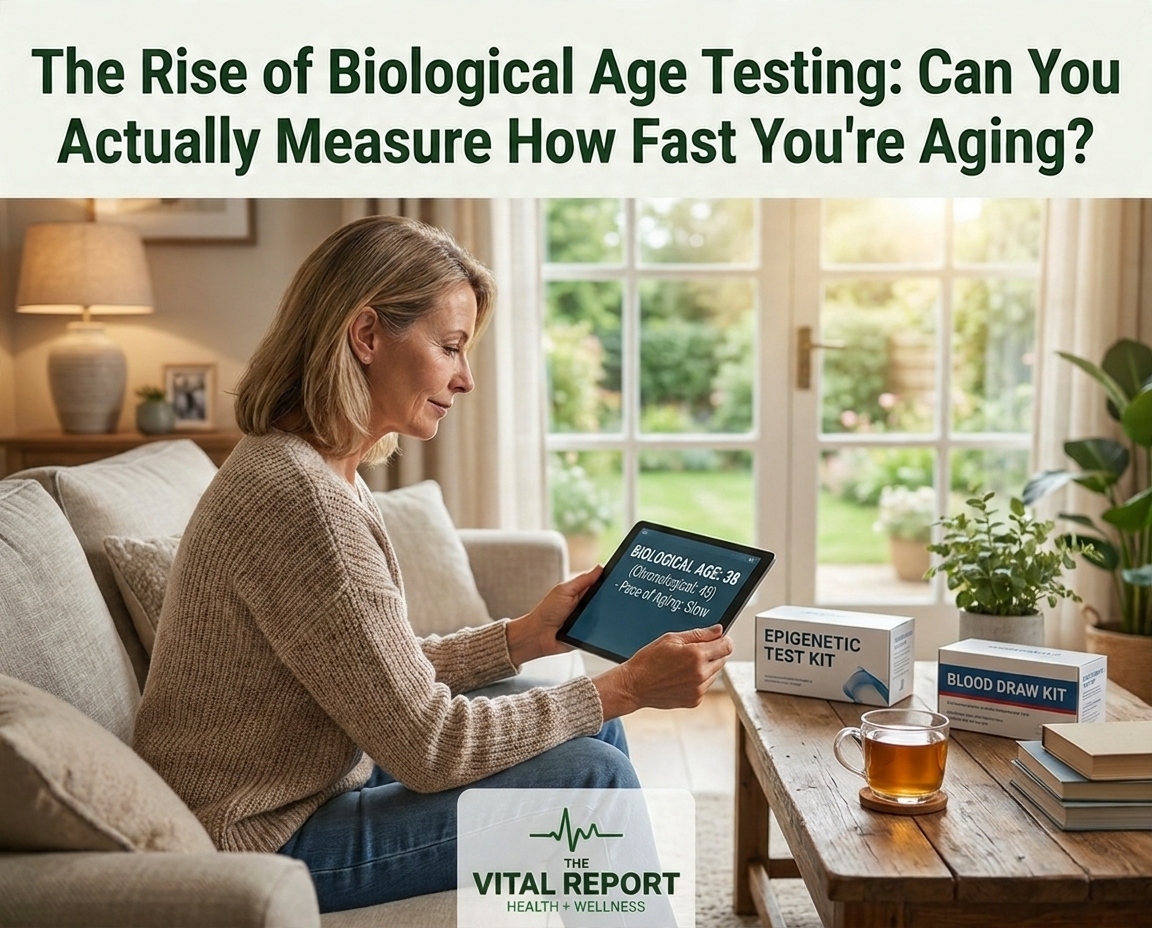
Many companies also provide personalized reports that compare biological age to chronological age.
For example, a 45-year-old individual might receive results indicating a biological age of 39 or 52.
These comparisons often generate significant consumer interest because they provide a tangible metric for tracking health improvements.
Beyond Epigenetics: Other Aging Biomarkers
While epigenetic testing receives much of the attention, researchers study many additional biomarkers associated with aging.
These include:
Inflammatory Markers
Chronic low-grade inflammation has become one of the most recognized hallmarks of aging.
Researchers often refer to this phenomenon as “inflammaging.”
Biomarkers such as:
- C-reactive protein (CRP)
- Interleukin-6 (IL-6)
- Tumor necrosis factor-alpha (TNF-α)
may provide insights into aging-related inflammatory processes.
Metabolic Health Indicators
Metabolic dysfunction is closely linked to accelerated aging.
Key markers include:
- Fasting glucose
- Insulin
- HbA1c
- Triglycerides
- HDL cholesterol
Poor metabolic health has been associated with increased biological aging rates and elevated disease risk.
Cardiovascular Biomarkers
Cardiovascular disease remains one of the leading causes of death worldwide.
Measurements such as:
- Blood pressure
- ApoB
- LDL cholesterol
- Arterial stiffness
can offer valuable information about biological aging and long-term health outcomes.
Body Composition Metrics
Muscle mass and visceral fat strongly influence aging trajectories.
Loss of muscle tissue and accumulation of abdominal fat have both been associated with poorer healthspan outcomes.
For this reason, body composition assessments are increasingly included in comprehensive longevity evaluations.
Can You Lower Your Biological Age?
This is the question that drives much of the excitement surrounding biological age testing.
Several studies suggest that biological age markers can change over time.
In some cases, researchers have observed improvements following interventions such as:
- Regular exercise
- Weight loss
- Improved sleep quality
- Smoking cessation
- Stress reduction
- Dietary changes
For example, exercise consistently ranks among the most effective lifestyle interventions for supporting healthy aging.
Physical activity influences numerous aging pathways, including mitochondrial function, inflammation, insulin sensitivity, and cardiovascular health.
Similarly, sleep has emerged as a critical factor in aging research.
Chronic sleep deprivation has been linked to metabolic dysfunction, impaired recovery, cognitive decline, and accelerated biological aging markers.
Nutrition also plays a central role.
Dietary patterns emphasizing whole foods, fruits, vegetables, lean proteins, healthy fats, and adequate fiber are associated with healthier aging outcomes compared with highly processed dietary patterns.
The Role of Wearables and Health Tracking
The rise of wearable technology has accelerated consumer interest in biological age.
Smartwatches and health trackers can now monitor:
- Heart rate variability
- Resting heart rate
- Sleep quality
- Activity levels
- Recovery metrics
Some platforms even generate biological age estimates using wearable-derived data.
While these estimates are generally less sophisticated than laboratory-based testing, they highlight an important shift toward continuous health monitoring.
Consumers increasingly want actionable health information rather than annual snapshots.
Limitations of Biological Age Testing
Despite the excitement, biological age testing remains an evolving science.
Several important limitations should be considered.
Different Tests Can Produce Different Results
One of the biggest challenges is the lack of standardization.
Different companies use different algorithms, biomarkers, and datasets.
As a result, two tests may generate different biological age estimates for the same individual.
Biological Age Is Not a Diagnosis
A biological age score does not diagnose disease.
Nor can it predict with certainty how long a person will live.
Instead, it provides an estimate based on currently available data.
It should be viewed as one piece of a broader health picture.
Long-Term Validation Is Ongoing
Researchers continue studying how well biological age measures predict long-term health outcomes.
While many findings are promising, the field remains relatively young compared with traditional medical diagnostics.
Additional validation will likely improve accuracy over time.
Who Might Benefit From Biological Age Testing?
Biological age testing may appeal to individuals who are interested in:
- Preventive health
- Longevity optimization
- Lifestyle tracking
- Personalized wellness programs
- Monitoring intervention effectiveness
It can also provide motivation.
Many people find biological age easier to understand than isolated laboratory values.
Seeing measurable changes in aging-related markers may encourage healthier habits and long-term adherence.
However, experts generally recommend interpreting results alongside traditional health assessments rather than using biological age as a standalone measure.
The Future of Longevity Testing
The field of longevity science is advancing rapidly.
Researchers are developing increasingly sophisticated methods for measuring aging, integrating data from:
- Epigenetics
- Proteomics
- Metabolomics
- Microbiome analysis
- Artificial intelligence models
Future biological age assessments may provide far more personalized insights than today’s tests.
Instead of a single aging score, individuals may receive detailed maps showing which biological systems are aging faster or slower than expected.
This could enable more targeted interventions and truly personalized longevity strategies.
The Bottom Line
Biological age testing represents one of the most fascinating developments in modern wellness and longevity science.
Rather than focusing solely on the number of years you’ve lived, these tests attempt to measure how your body is functioning beneath the surface.
While no test can perfectly capture the complexity of aging, emerging tools—particularly epigenetic clocks—are providing valuable insights into how lifestyle, environment, and biology interact over time.
The science is still evolving, and biological age should not be viewed as a crystal ball.
However, it may offer something equally valuable: a clearer understanding of how daily choices influence long-term health.
As longevity research continues to advance, biological age testing could become an increasingly important tool for those seeking not just a longer life, but a healthier one.