

Grüns built one of the fastest-growing supplement brands by making daily nutrition look more like a pack of gummy bears than a traditional multivitamin.
Now the company is applying the same playbook to fiber.
The team behind Grüns has officially launched Müves, a new daily prebiotic fiber gummy designed to support digestive health and regularity without requiring consumers to mix powders, swallow capsules or crack open another functional soda.
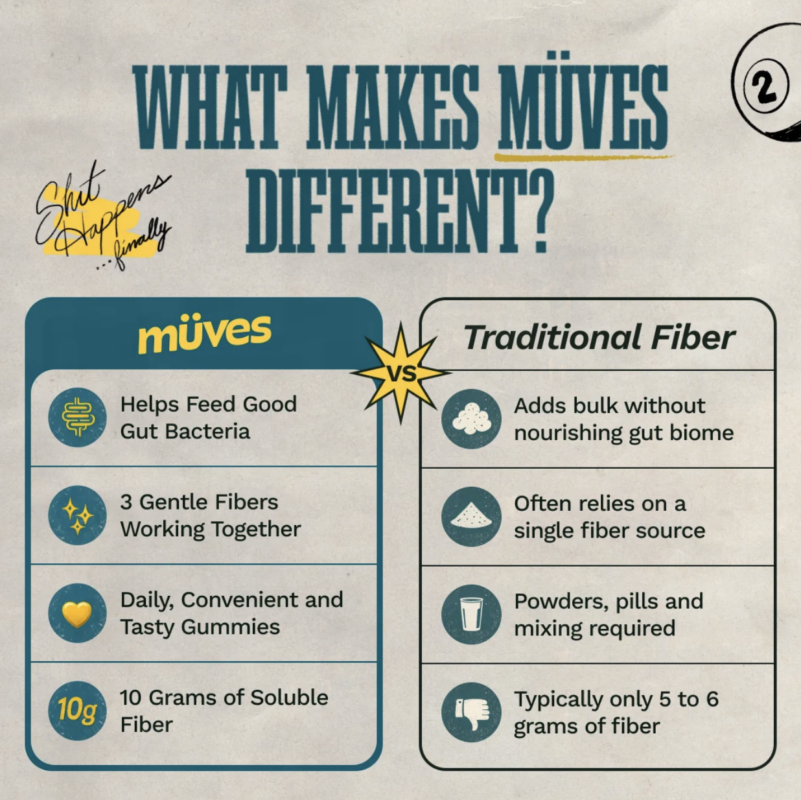
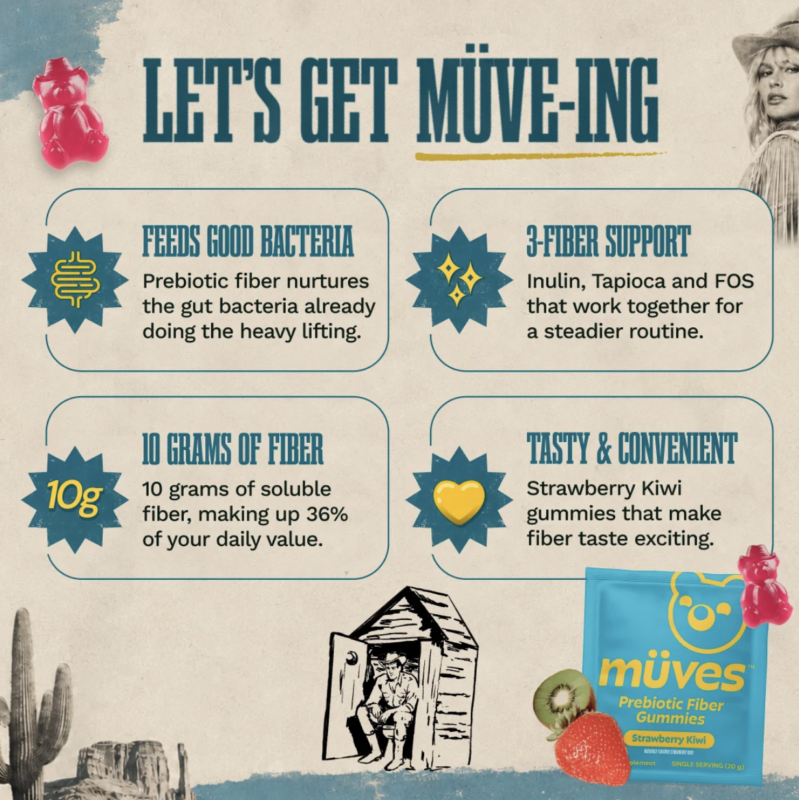
Each daily pack delivers 10 grams of soluble fiber through a three-fiber blend of inulin, tapioca fiber and fructooligosaccharides, better known as FOS.
And while Müves may look like another gummy supplement, the launch says something bigger about where Grüns is headed.
The company that became known for one viral greens gummy is rapidly turning itself into a portfolio of highly targeted wellness brands.
Müves may be its clearest example yet.
What Is Müves?
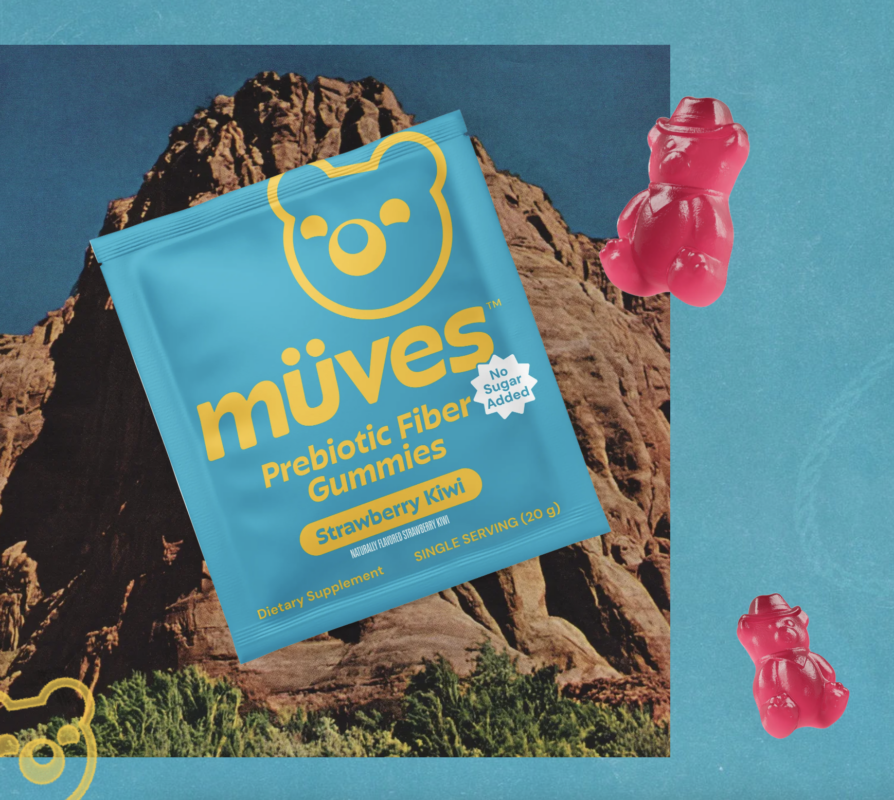
Müves is a daily prebiotic fiber supplement packaged as Strawberry Kiwi-flavored gummy bears.
Instead of positioning the product as another broad nutritional supplement, Müves has one very specific job:
Fiber.
Each serving contains 10 grams of soluble fiber, which the company says represents 36% of the Daily Value.
The formula combines three different fiber sources:
Inulin from chicory root
Tapioca fiber from cassava root
Fructooligosaccharides, or FOS, from beets
The gummies use a plant-based pectin base rather than gelatin and are vegan, gluten-free, dairy-free, nut-free and non-GMO, according to the company.
Müves is available in both low-sugar and no-sugar-added versions, with 28 individually packaged daily servings in each pouch.
But perhaps the most important part of the product is what isn’t required.
No shaker.
No scoop.
No glass of fiber powder.
No handful of capsules.
Grüns founder Chad Janis described the product at launch as an attempt to make getting fiber easier for consumers who have struggled to stick with traditional fiber supplements.
That is the same fundamental consumer insight that helped build Grüns:
A supplement cannot provide much benefit if people don’t consistently take it.
America Has a Fiber Problem
Müves is entering a category with a massive underlying nutritional gap.
Fiber is naturally found in plant foods including fruits, vegetables, whole grains, beans, nuts and seeds.
But many Americans aren’t eating enough of those foods to consistently reach recommended fiber intake.
The Dietary Guidelines for Americans have repeatedly identified dietary fiber as a nutrient of public health concern because many Americans consume less than recommended amounts.
That matters because fiber does considerably more than help people go to the bathroom.
Different forms of dietary fiber can influence stool consistency, digestion, satiety, blood glucose responses, cholesterol and the gut microbiome.
The Harvard T.H. Chan School of Public Health notes that adequate fiber intake is associated with a lower risk of several chronic diseases and explains that fermentable fibers can interact with bacteria living in the colon.
But knowing fiber is important and actually eating enough of it are two different things.
That gap has created an enormous supplement market.
Fiber powders such as Metamucil have been household products for decades.
More recently, functional beverages including prebiotic sodas have made fiber part of the modern wellness conversation.
Now Müves wants gummies to become another major delivery format.
Why Müves Uses Three Types of Fiber
One of the more interesting parts of Müves is its decision to use three fiber sources rather than build the product around a single ingredient.
The formula combines inulin, tapioca fiber and FOS.
Inulin and FOS are particularly interesting because they are commonly discussed as prebiotics.
The International Scientific Association for Probiotics and Prebiotics defines a prebiotic as a substrate selectively utilized by host microorganisms that confers a health benefit.
In simpler terms, certain prebiotic fibers can become food for microbes already living in the digestive system.
Humans do not fully digest these compounds in the small intestine.
They can instead travel farther through the digestive tract, where microorganisms ferment them.
That fermentation can produce metabolites including short-chain fatty acids.
This is where fiber increasingly overlaps with one of wellness’s biggest categories:
The microbiome.
Consumers are no longer buying fiber exclusively because they want to improve regularity.
Fiber is increasingly being marketed as a way to support the ecosystem of microorganisms living inside the gut.
And Müves is leaning directly into that shift.
Fiber Is Becoming a Gut-Health Product
For decades, fiber supplements were marketed primarily around constipation and regularity.
That positioning is changing.
Today, fiber sits at the intersection of several wellness trends:
Digestive health.
The microbiome.
Metabolic health.
Satiety.
Healthy aging.
Functional food.
That shift is helping transform fiber from an older, medicinal-feeling supplement category into something much more consumer-friendly.
The microbiome boom has been particularly important.
Research has increasingly examined how dietary fiber affects gut microbial composition and the production of microbial metabolites.
A review published in The Lancet and extensive nutrition research have linked higher-quality carbohydrate and fiber intake with better long-term health outcomes.
But not all fibers behave identically.
Solubility, viscosity and fermentability can all influence how different fibers function inside the body.
That is important when evaluating products like Müves.
“Fiber” is not one single ingredient.
And taking a fiber gummy is not necessarily nutritionally equivalent to eating fiber-rich fruits, vegetables, legumes and whole grains, which also provide vitamins, minerals and phytochemicals.
Müves is best understood as a supplement to fiber intake — not a replacement for a fiber-rich diet.
Müves vs. Grüns
Despite coming from the same company, Müves isn’t supposed to replace Grüns.
The company describes the products as complementary.
Grüns remains the broad nutritional product.
Its daily Superfoods Greens Gummies contain more than 60 ingredients and provide vitamins, minerals and other ingredients alongside 6 grams of fiber.
Müves is far more targeted.
Its focus is delivering 10 grams of soluble fiber specifically for digestive and gut-health support.
That distinction reveals something important about the company’s larger strategy.
Grüns can act as the nutritional foundation.
Then consumers can add more specialized products based on what they want.
Need more fiber?
Müves.
Want pre-workout support?
Jüced.
Want a product positioned around cognition?
Nütrops.
Want immune support?
Immün.
Grüns is no longer building a single supplement.
It is building an ecosystem.
From Grüns to Ü Snacks
The company’s expansion has been happening quickly.
Grüns launched in 2023 and became recognizable for its individually packaged green gummy bears.
The core pitch was straightforward: combine the convenience of a multivitamin with a more enjoyable gummy format.
But founder Chad Janis has made clear that the company’s ambitions extend beyond greens.
Earlier this year, he told Inc. that the company planned to launch numerous new products as it pushed deeper into the gummy supplement market.
That strategy is now becoming visible.
Under the broader Ü Snacks umbrella, the team has expanded into products targeting different wellness needs.
Grüns — daily nutrition.
Jüced — pre-workout energy.
Nütrops — cognitive support.
Immün — immune support.
Müves — fiber and digestive health.
The common thread isn’t a specific health benefit.
It’s the format.
Gummies.
The company appears to believe almost every traditional supplement category can be rebuilt around something consumers actually enjoy eating.
And that is a much bigger opportunity than greens alone.
The “Gummy-Fication” of Wellness
The supplement aisle has traditionally been dominated by a few familiar formats.
Capsules.
Tablets.
Powders.
Liquids.
Gummies changed the equation.
What began largely as a format associated with children’s vitamins has expanded across adult wellness.
Multivitamins became gummies.
Apple cider vinegar became gummies.
Creatine became gummies.
Sleep supplements became gummies.
Greens became gummies.
And now fiber is becoming gummies.
The appeal isn’t difficult to understand.
Traditional supplements frequently create friction.
Powders need to be mixed.
Capsules need to be swallowed.
Some products taste unpleasant.
Others are easy to forget.
A gummy can turn supplementation into something much closer to snacking.
That convenience can be powerful.
But it also makes formulation more complicated.
Companies have to deliver meaningful quantities of active ingredients while maintaining taste, texture, stability and reasonable sugar levels.
Fiber is particularly interesting because effective doses are generally measured in grams rather than milligrams.
Müves getting 10 grams of soluble fiber into a daily gummy pack is therefore central to the product’s positioning.
Müves Is Also Taking Aim at Prebiotic Soda
There is another competitor sitting between traditional fiber powders and gummy supplements:
Functional soda.
Brands such as OLIPOP and other modern soda companies helped make prebiotic fiber feel culturally relevant.
Instead of asking consumers to take a supplement, these brands embedded fiber into something they were already drinking.
Müves appears to be attacking the same problem from another direction.
Instead of drinking your fiber, chew it.
The company explicitly compares Müves with gut-health sodas, powders and pills.
That positioning makes the product less of a direct competitor to Grüns and more of a competitor to the entire modern fiber category.
The battle is increasingly about format.
Powder versus beverage versus capsule versus gummy.
And the winning format may ultimately be the one consumers are most willing to use consistently.
Why Gut Health Keeps Producing New Brands
The gut-health category has become one of the most crowded areas of wellness for a reason.
Consumers can now buy:
Probiotics.
Prebiotics.
Fiber supplements.
Digestive enzymes.
Fermented foods.
Microbiome tests.
Functional sodas.
Gut-health gummies.
And increasingly, these products are being marketed as parts of everyday wellness rather than solutions reserved for digestive problems.
As Vital Report has covered in its reporting on the growing microbiome and personalized-health movement, companies are increasingly treating the microorganisms living in and on the human body as another source of actionable health information.
That trend extends beyond the gut.
Companies like Evvy are analyzing the vaginal microbiome.
Oral-health startups are targeting the oral microbiome.
Nutrition companies are building products around gut bacteria.
Müves sits on the consumer-friendly end of the same movement.
It doesn’t sequence your microbiome.
It simply provides fermentable fiber designed to interact with the bacteria already living there.
But both ideas stem from the same broader realization:
Human health is increasingly being viewed alongside the microbial ecosystems that live with us.
More Fiber Isn’t Always Better Overnight
There is one important caveat.
Increasing fiber intake too quickly can cause digestive discomfort.
Müves itself recommends gradually increasing intake rather than immediately jumping to the full serving.
That is because fermentable fibers including inulin and FOS can produce gas as gut bacteria metabolize them.
Some people may experience bloating, gas or changes in bowel habits when substantially increasing their fiber intake.
The National Institute of Diabetes and Digestive and Kidney Diseases recommends adding fiber to the diet gradually and drinking adequate liquids as fiber intake increases.
Individual tolerance can also vary considerably.
For someone eating very little fiber, suddenly adding 10 grams of fermentable fiber could feel very different from adding it gradually.
That makes Müves’ suggested ramp-up period particularly relevant.
Convenience May Be the Real Product
Müves is marketed as a fiber supplement.
But the product the company is really selling may be consistency.
Most consumers already know vegetables are healthy.
They know fiber is important.
They know vitamins matter.
The wellness industry’s problem has rarely been convincing people that nutrition matters.
It has been convincing them to maintain healthy behaviors every day.
That is where Grüns has built its brand.
The individually wrapped daily pouch removes measurement.
The gummy format removes mixing.
The flavor removes some of the unpleasantness associated with traditional supplements.
The subscription removes remembering to reorder.
Müves applies those same behavioral mechanics to fiber.
The Bigger Story Behind Müves
Müves matters because it shows what Grüns is trying to become.
The original Superfoods Greens Gummies gave the company an entry point into consumers’ daily routines.
Now the brand is expanding horizontally.
Instead of trying to make one gummy solve every health goal, the company can create specialized products around individual needs.
Fiber.
Energy.
Cognition.
Immunity.
And potentially many more categories.
That model resembles the way traditional supplement companies build large portfolios — but with a modern direct-to-consumer brand and a consistent gummy format tying everything together.
It also comes at an important moment for the business.
Grüns has rapidly expanded since launching in 2023, and its growing product portfolio suggests the company’s next chapter may look very different from its first.
The question is no longer whether consumers will buy greens gummies.
The question is how many parts of the supplement cabinet Grüns can turn into gummies.
The Bottom Line
Müves takes one of nutrition’s oldest recommendations — eat more fiber — and packages it for the modern wellness consumer.
Each daily Strawberry Kiwi pack delivers 10 grams of soluble fiber from three sources: inulin, tapioca fiber and FOS.
But the product is more interesting when viewed as part of the bigger Grüns strategy.
Grüns started with broad daily nutrition.
Now its expanding family of brands is targeting specific needs including energy, cognition, immunity and digestive health.
Müves takes the company directly into the booming gut-health market while competing with traditional fiber powders, capsules and the newer generation of prebiotic beverages.
The formula isn’t the only innovation.
The format is.
For years, fiber supplementation meant scooping powder into a glass.
The functional beverage boom put fiber into soda.
Now Grüns is betting the next version looks like a bag of gummy bears.
And if the company’s first product is any indication, making nutrition feel less like a supplement and more like a snack may be the entire point.