

Running watches used to have a relatively simple job: tell you how far you ran, how fast you ran it, and what your heart rate looked like along the way.
That era is disappearing fast.
Today’s performance watches are becoming full-fledged training computers, combining GPS, mapping, recovery data, health sensors, music, communication, and increasingly premium hardware into devices designed to stay on your wrist around the clock.
Now COROS is taking that evolution one step further.
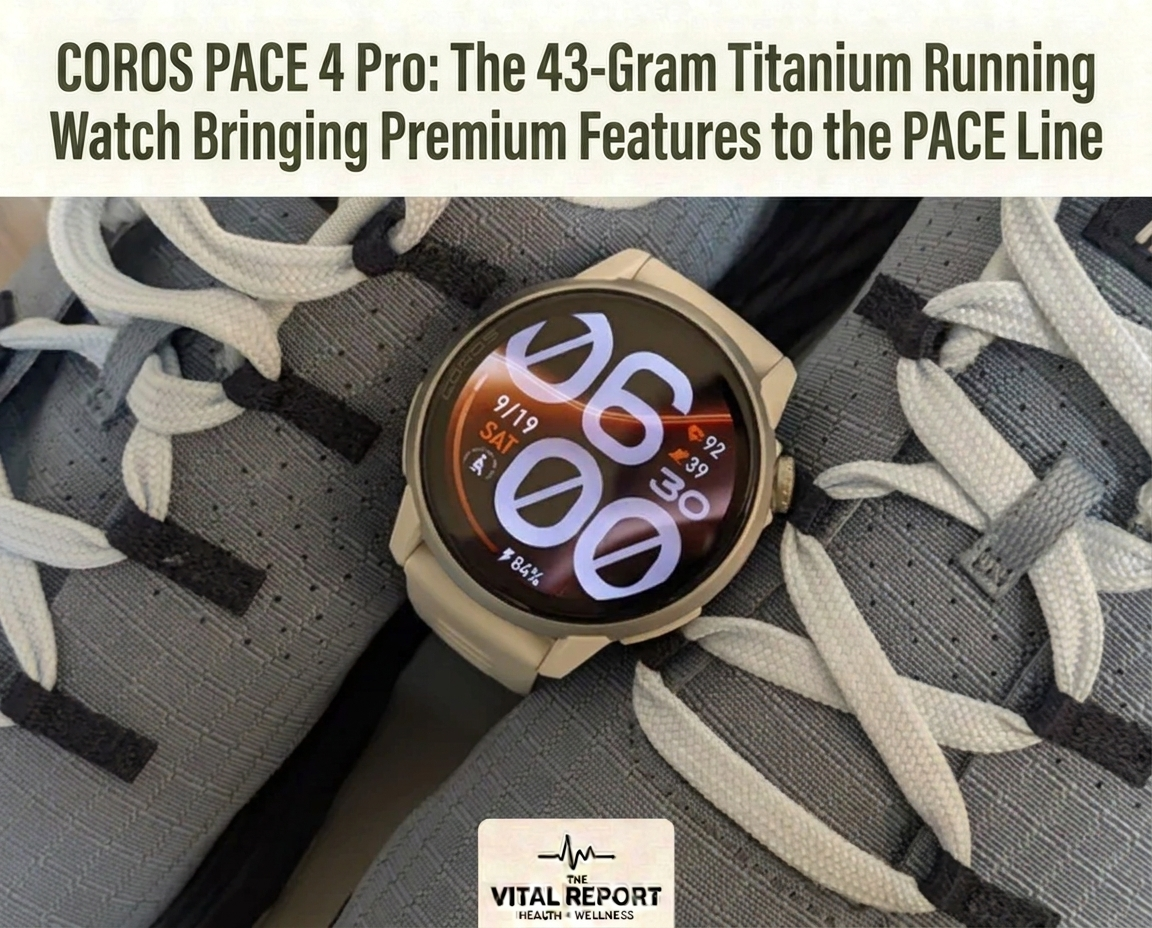
The company has introduced the PACE 4 Pro, a new premium addition to its lightweight PACE family that combines aerospace-grade titanium, sapphire glass, a 3,500-nit AMOLED display, offline maps, dual-frequency GPS, ECG, music, calling, and multisport tracking.
The surprising part?
It weighs just 43 grams.
According to COROS, the watch also delivers up to 60 hours of GPS battery life and as much as 21 days of daily use, giving the company a new product that sits somewhere between a lightweight running watch and a premium outdoor smartwatch.
The PACE 4 Pro isn’t simply about adding more features.
It’s about how much COROS can pack into a running watch without losing the lightweight simplicity that helped define the PACE lineup in the first place.

A More Premium PACE
COROS has historically positioned PACE watches around performance without unnecessary bulk.
The PACE 4 Pro takes that philosophy into much more premium territory.
Its case uses TC4 titanium alloy, while the display is protected by edge-to-edge sapphire glass. The complete watch weighs 43 grams with the band and measures 11.8 millimeters thick.
Those materials are significant.
Titanium and sapphire are typically associated with higher-end performance watches because they can provide greater durability without relying on heavier materials.
You can see that hierarchy clearly across Garmin’s current running watch lineup, where features including sapphire lenses, metal bezels, multi-band GPS, built-in mapping, and advanced training capabilities become more common as consumers move into premium devices.
COROS is taking many of those premium characteristics and putting them into a watch built around low weight.
That creates an interesting proposition for runners.
Instead of choosing between a lightweight training watch and a heavier premium outdoor device, COROS wants the PACE 4 Pro to provide elements of both.
The Brightest Display COROS Has Made
The biggest visual upgrade is the screen.
The PACE 4 Pro uses a 1.47-inch AMOLED touchscreen with a 466 x 466 resolution and brightness reaching 3,500 nits.
COROS says it is the brightest display the company has ever put into a watch.
That brightness matters when athletes are trying to check pace, navigation, heart rate, or other metrics under direct sunlight.
But adding a brighter AMOLED display creates another challenge: battery life.
COROS is using an adaptive LTPO refresh rate that can shift between 60Hz and 1Hz depending on what’s happening on the screen. Moving through maps can trigger a smoother refresh rate, while periods of inactivity allow the display to scale back power consumption.
The result is a watch that COROS says can deliver 60 hours in high GPS mode, or 45 hours with the always-on display enabled. Daily use is rated at up to 21 days.
Real-world battery performance will naturally vary depending on GPS settings, music, mapping, screen brightness, navigation, and other features.
Still, the broader trend is important.
AMOLED displays were once an obvious trade-off for endurance athletes concerned about battery life.
That trade-off is getting smaller.
Dual-Frequency GPS Is Becoming the New Standard
A premium running watch still needs to do one thing extremely well: know where you are.
The PACE 4 Pro uses dual-frequency GPS, designed to improve positioning in environments where satellite signals can become difficult to interpret.
That matters because GPS accuracy isn’t consistent everywhere.
The U.S. government’s GPS accuracy guidance notes that buildings, bridges, trees, atmospheric conditions, signal blockage, and reflected signals can all affect positioning. It also explains that using two GPS frequencies can improve accuracy by helping correct signal distortions.
Think about a runner moving through Manhattan between tall buildings or a trail runner spending hours under dense tree cover.
Those are exactly the environments where positioning can become more challenging.
COROS says the PACE 4 Pro’s dual-frequency system is designed to perform across cities, canyons, and dense canopy.
Better GPS isn’t only about drawing a prettier route afterward.
Distance and location data feed directly into pace, speed, route tracking, and other performance metrics athletes may use to evaluate their training.
As running watches become more data-driven, the quality of the underlying location data becomes increasingly important.
Maps Are Moving Down the Product Line
Navigation may be one of the most important upgrades.
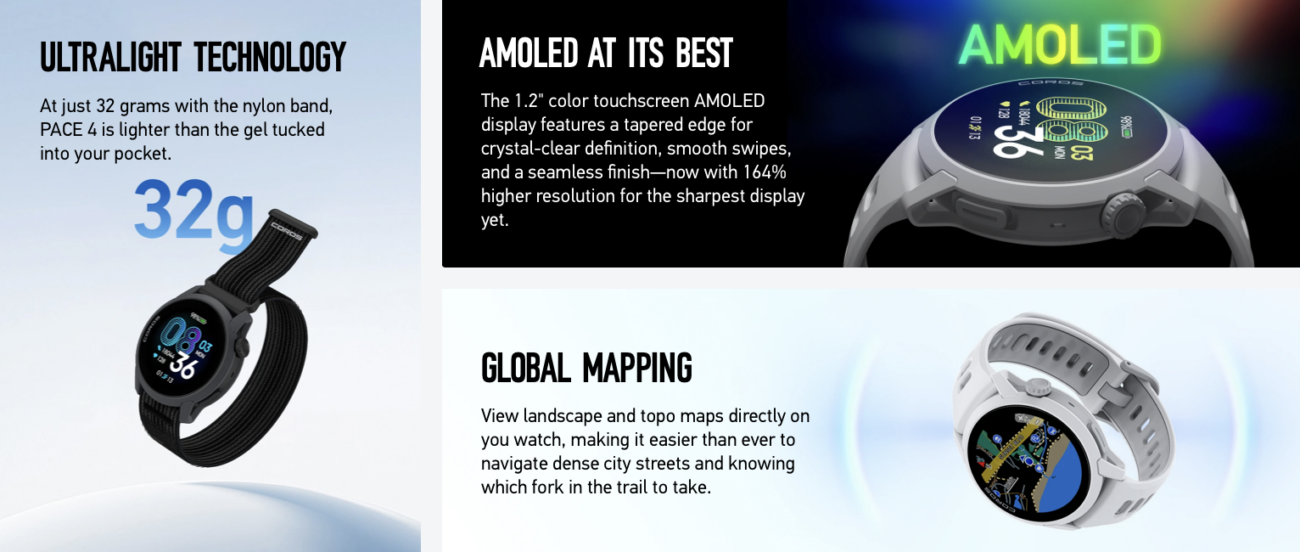
The PACE 4 Pro includes detailed maps with street and trail names, points of interest, turn-by-turn navigation, and offline functionality.
That’s part of a larger mapping push from COROS.
In its September 2026 software update, the company expanded global maps to the standard PACE 4, including street and trail names, points of interest, and offline coverage.
That might sound like a software detail, but it represents a bigger change in the running-watch market.
Detailed mapping used to help separate lightweight running watches from larger adventure devices.
Now that distinction is disappearing.
A runner can increasingly buy one watch for road training and use the same device for hiking, cycling, trail running, traveling, or exploring an unfamiliar route.
For COROS, that makes the PACE lineup useful for more than recording workouts.
It starts becoming a navigation platform.
COROS Is Going Deeper Into Health Data
The PACE 4 Pro also expands what COROS can measure from the wrist.
The watch introduces the company’s fourth-generation optical heart-rate sensor alongside SpO2 and ECG capabilities.
That reflects another important evolution in performance wearables.
Running watches aren’t only analyzing runs anymore.
They’re trying to understand what happens during the other 23 hours of the day.
Sleep, resting heart rate, HRV, stress, training load, and recovery data can help athletes build a larger picture around performance.
That’s why the line separating a running watch from a health wearable keeps getting harder to see.
Vital Report has been following that same shift across the broader wearable industry. In our recent look at Ultrahuman Home and the changing sleep-tracking market, we explored how health tracking is moving beyond basic wearable metrics toward understanding the larger factors influencing sleep, recovery, and performance.
COROS is approaching that same trend from the athlete’s wrist.
It Wants to Replace More Than Your Running Watch
COROS has also added features that aren’t directly related to running.
The PACE 4 Pro includes onboard storage for music and audiobooks, while a built-in microphone and speaker allow users to record voice notes and take hands-free calls when connected to a phone.
That matters because performance-watch companies are competing for more than workouts.
They’re competing for wrist time.
A device that is excellent during a 90-minute run but inconvenient during the other 22 and a half hours of the day has a disadvantage against watches designed to be worn constantly.
That’s why features like music, notifications, calls, health monitoring, and sleep tracking increasingly matter even on products marketed primarily toward athletes.
The goal isn’t simply to build a better running watch.
It’s to build the watch a runner never needs to take off.
The Premium Running Watch Category Is Getting Crowded
COROS isn’t alone in moving this direction.
Garmin’s running smartwatch lineup now spans products with AMOLED displays, multi-band GPS, built-in mapping, music storage, training readiness, multisport modes, and advanced health and recovery tools.
That makes the competitive question much more interesting than it was several years ago.
Nearly every serious GPS watch can record a run.
Now consumers are comparing everything surrounding that run.
How accurate is the GPS?
How useful are the maps?
How long does the battery last?
How comfortable is it overnight?
How detailed are the recovery metrics?
Can it store music?
Can it handle a triathlon?
Can it navigate a trail?
Can it function like a smartwatch when training ends?
Those questions create an arms race around capability.
But COROS is emphasizing another variable: weight.
At 43 grams, the PACE 4 Pro is significantly lighter than many traditional premium outdoor watches while still offering features that increasingly overlap with them.

The Bigger Wearable Shift
The PACE 4 Pro is interesting because it reflects where the entire sports-wearable category appears to be heading.
The old product categories are collapsing into one another.
Running watches are getting premium materials.
Outdoor watches are getting brighter smartwatch-style displays.
Smartwatches are getting more sophisticated training metrics.
Health wearables are moving deeper into recovery and performance.
And consumers increasingly expect one device to do all of it.
That changes what companies have to compete on.
Adding another metric isn’t necessarily enough anymore.
Brands need to combine better sensors, better software, better navigation, better displays, better battery life, and better everyday usability—without turning the watch into something athletes don’t actually want on their wrists.
For COROS, the PACE 4 Pro is an attempt to solve that equation through miniaturization.
More capability.
More premium materials.
More sensors.
More navigation.
But not necessarily more weight.
The Bottom Line
The COROS PACE 4 Pro isn’t just a more expensive version of a lightweight running watch.
It’s a sign of how quickly the definition of a running watch is changing.
COROS has packed aerospace-grade titanium, sapphire glass, a 3,500-nit AMOLED display, dual-frequency GPS, offline maps, upgraded heart-rate sensing, ECG, music, calls, voice notes, and multisport tracking into a watch weighing just 43 grams.
That combination puts the PACE 4 Pro directly into the broader race to eliminate the compromises athletes once had to make between lightweight performance watches and premium multisport devices.
The bigger question is no longer whether a watch can track your run.
It’s how much else it can do without getting in the way of the run itself.
And with the PACE 4 Pro, COROS is betting that the future of premium performance wearables isn’t bigger.
It’s fitting more into less.