


David Protein built its name by asking a relatively simple question: How much protein can you fit into as few calories as possible?
First, it applied that formula to protein bars.
Then came frozen dessert.
Now, David wants people to drink it.
The protein-focused food brand has officially entered the ready-to-drink category with its first Protein Milkshakes, extending the same protein-to-calorie philosophy behind its bars into a 12-ounce bottle.
According to David Protein, each shake contains 30 grams of protein, 140–150 calories, and less than 1 gram of sugar, depending on the flavor. The drinks are made with ultra-filtered milk, are lactose-free, and are shelf-stable until opened.
The initial lineup keeps things simple: Vanilla and Chocolate.
Vanilla contains 30 grams of protein for 140 calories, while Chocolate delivers the same amount of protein for 150 calories. Both are positioned less like traditional protein drinks and more like actual milkshakes—thick, creamy, and designed around indulgence rather than purely functional sports nutrition.
But the bigger story isn’t another protein shake hitting the market.
It’s David rapidly turning itself from a protein-bar company into a much broader high-protein food brand.
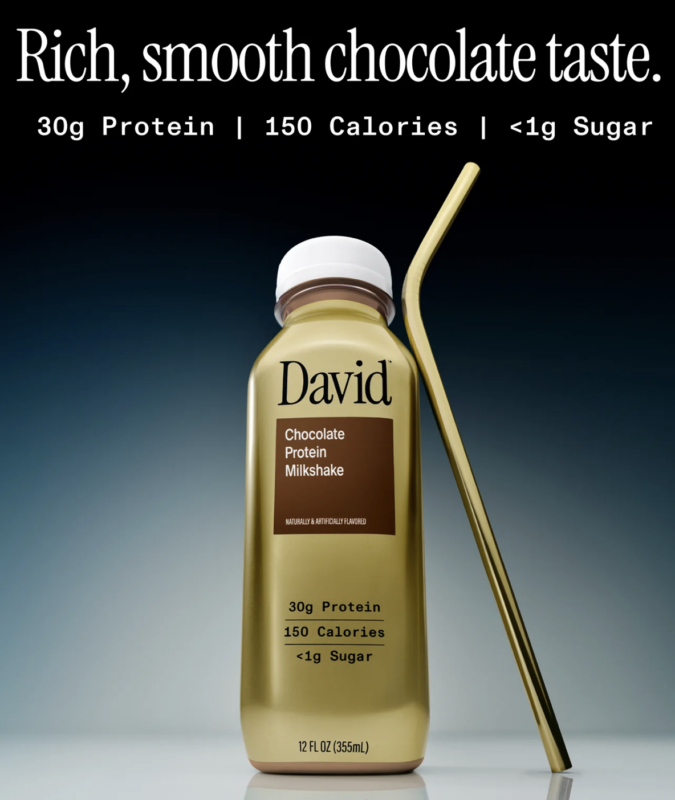
David Is Bringing Its Protein Math to Drinks
David’s core proposition has always been unusually numerical.
The brand doesn’t simply market products as “high protein.” It emphasizes how much protein consumers are getting relative to the total number of calories they’re consuming.
That strategy helped its original Gold bars stand out with 28 grams of protein for 150 calories, while its newer Bronze bars deliver 20 grams for the same calorie count.
The Milkshakes extend that formula.
Each 12-ounce bottle contains 30 grams of protein, with Vanilla coming in at 140 calories and Chocolate at 150.
That means protein accounts for a significant portion of the overall calories in each bottle.
And unlike a powder, there’s no measuring, shaking, blending, or cleanup.
David is effectively taking the nutritional proposition of a performance-oriented protein product and packaging it in the convenience format of a bottled beverage.
That matters because ready-to-drink protein is no longer just a bodybuilding product.
RTD shakes are increasingly consumed as breakfast replacements, afternoon snacks, post-workout nutrition, or simply an easy way for consumers to increase daily protein intake. A recent Food Network overview of ready-to-drink protein shakes highlighted products from Core Power, Premier Protein, Oikos, Slate, OWYN and Muscle Milk—showing just how crowded and mainstream the category has become.
David is entering that market with one very clear differentiator:
protein density.
Why Ultra-Filtered Milk Matters
The shakes are built around ultra-filtered skim milk.
Ultra-filtration changes the composition of milk by using membrane filtration to separate components based on size. In practice, it allows manufacturers to concentrate protein while reducing some of the sugar and water naturally found in milk.
For David, that’s particularly useful.
The company needs enough dairy protein to reach 30 grams per bottle without pushing total calories or carbohydrates dramatically higher.
The resulting drinks contain just 3 grams of carbohydrates in Vanilla, alongside 1.5 grams of fat and less than 1 gram of sugar. David also adds lactase to break down remaining lactose, allowing it to market the shakes as lactose-free.
Ultra-filtered milk has become increasingly prominent in high-protein beverages for the same reason.
In May, Muscle Milk announced a reformulation of its protein shakes around ultra-filtered milk, with products providing between 26 and 42 grams of protein per serving.
That puts David inside a broader shift toward dairy-based beverages that can deliver higher protein concentrations without requiring the texture or preparation of traditional protein powder.
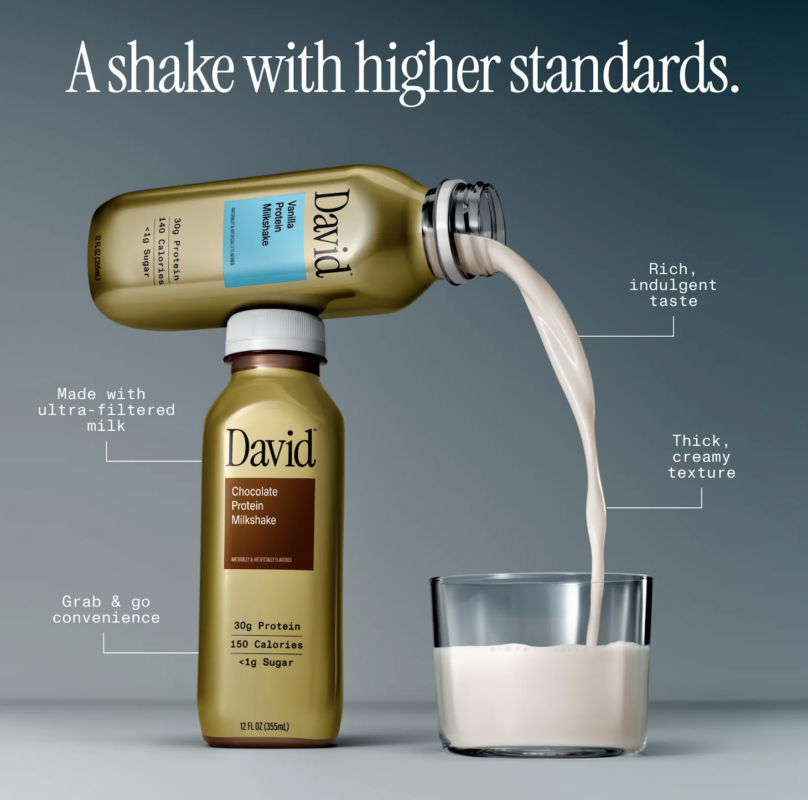
The Ingredient That Makes the Math Work
There’s another important part of the formula: EPG.
David’s shakes use a modified plant fat called esterified propoxylated glycerol, or EPG.
The company says it uses EPG to help provide the texture consumers expect from a milkshake while maintaining its emphasis on protein-to-calorie ratio.
That helps explain how David can position the product around a creamy, indulgent experience without adding the amount of conventional fat that would normally push calories significantly higher.
The full Vanilla ingredient list includes an ultra-filtered skim milk protein system, EPG, natural and artificial flavors, salt, sucralose, acesulfame potassium, dipotassium phosphate, gum arabic, cellulose gum, and gellan gum.
That distinction is worth noting because David’s approach isn’t built around minimal ingredients.
It’s built around macronutrient optimization.
The product is engineered to deliver a specific combination: lots of protein, very little sugar, relatively few calories, and a texture designed to resemble something much more indulgent.
For consumers, whether that formulation is appealing will depend partly on what they prioritize.
Someone looking primarily for the shortest possible ingredient list may evaluate the shake differently from someone trying to get 30 grams of protein into a 140-calorie snack.
David is clearly building for the second consumer.
Protein Is Becoming an Everyday Food Category
The timing is important.
Protein has escaped the gym.
Products once marketed primarily toward bodybuilders and serious athletes are now appearing across grocery aisles, convenience stores, coffee shops, snack brands, cereal, pasta, ice cream, and beverages.
And major food companies are responding.
The ready-to-drink shake category in particular gives brands an attractive format because it combines nutrition with convenience.
No shaker bottle.
No scoop.
No blender.
No refrigeration before opening in David’s case.
Just open the bottle and drink.
That’s especially useful as protein becomes less associated with a specific workout window and more associated with everyday eating.
David is leaning directly into that behavior.
Its milkshakes can theoretically compete across several occasions: breakfast on the go, post-workout recovery, afternoon snacking, travel, or dessert replacement.
That gives the brand significantly more opportunities to reach consumers than a protein bar alone.
“Drink David” Is Also a Branding Play
The launch isn’t being marketed like a traditional sports-nutrition product.
David introduced the Milkshakes alongside a new campaign called “Drink David,” starring model Stella Maxwell.
According to the company’s launch announcement, the campaign is running across digital, social, and out-of-home advertising in New York City and uses David’s distinctive gold bottles as a central visual element.
That’s significant because David has consistently positioned itself differently from traditional supplement brands.
Instead of protein tubs, gym imagery, shaker bottles, and performance language, the company has leaned toward minimalist packaging and lifestyle-driven creative.
The Stella Maxwell campaign pushes that strategy further into fashion and culture.
In other words, David isn’t only trying to make protein more convenient.
It’s trying to make protein products feel culturally desirable.
That strategy could matter as the protein category becomes increasingly crowded.
When multiple brands can offer 20, 25, or 30 grams of protein, nutritional specifications alone become harder to own.
Brand becomes the differentiator.
David Is Quickly Moving Beyond Bars
The Milkshakes are also another signal that David doesn’t plan to remain a bar company.
Earlier this year, the company launched David Frozen Dessert, which contains 30 grams of protein per pint, between 210 and 260 calories, and roughly 1–2 grams of sugar depending on flavor.
Now it has bars, frozen dessert, and beverages.
That expansion is happening against a much larger financial backdrop.
As Vital Report recently covered in our story on David Protein’s parent company raising $250 million, Medici Brands is building beyond a single breakout protein product and has significant capital available to expand its presence across the broader food and nutrition market.
The Milkshakes show what that expansion can look like in practice.
Rather than abandoning what made the original bars successful, David can take the same basic nutritional framework and apply it to new eating occasions.
Bars cover snacking.
Frozen dessert covers indulgence.
RTD shakes cover convenience.
The underlying promise remains almost identical.
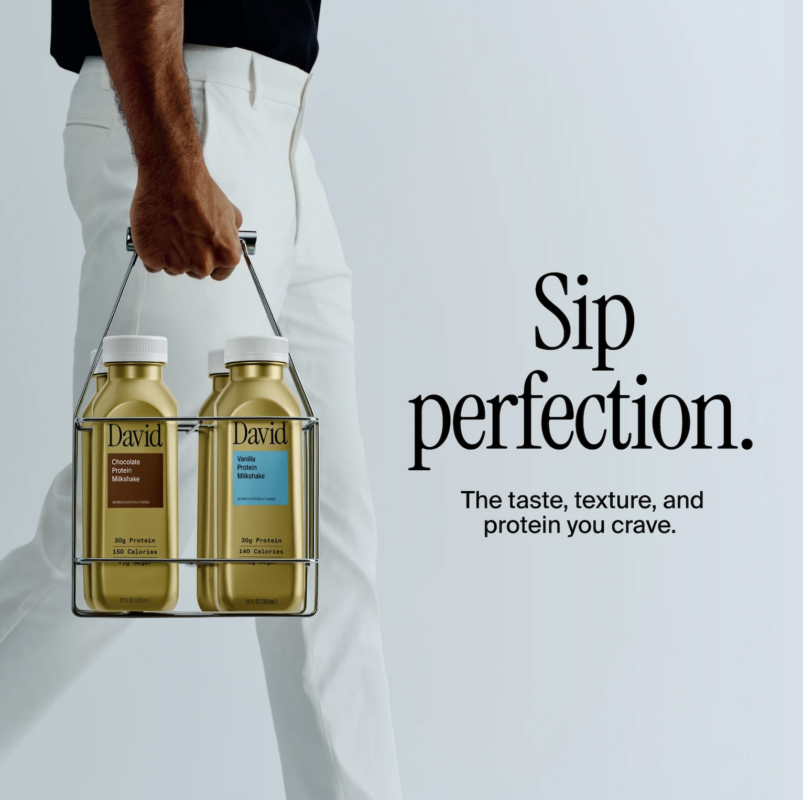
The RTD Market Is Already Crowded
Of course, David isn’t entering an empty category.
Ready-to-drink protein already includes established names across sports nutrition, dairy, and mainstream food.
That creates a different challenge than launching a distinctive protein bar.
Consumers already have plenty of bottled protein options.
Some prioritize very high protein.
Others emphasize clean ingredients, plant-based formulas, taste, low sugar, or lower calories.
David’s positioning is particularly aggressive around the relationship between protein and calories.
The company is effectively betting that consumers will look at a bottle containing 30 grams of protein and 140–150 calories and immediately understand the value proposition.
And that’s consistent with everything David has built so far.
The brand doesn’t necessarily need to convince consumers that protein shakes are useful.
It needs to convince them that its protein math is better suited to their goals.
The Bottom Line
David Protein is officially becoming a beverage brand.
Its first ready-to-drink Milkshakes bring the same macro-focused strategy behind its protein bars into a format built for convenience: 30 grams of protein, 140–150 calories, and less than 1 gram of sugar per 12-ounce bottle.
But the launch is more interesting as part of David’s larger expansion.
In a relatively short period, the company has moved from protein bars into frozen dessert and now ready-to-drink beverages.
The products look different, but the strategy is remarkably consistent.
Take something consumers already understand.
Rebuild its macros around protein.
Keep calories and sugar low.
Then package it like a lifestyle product rather than traditional sports nutrition.
The Milkshakes may be David’s clearest example of that strategy yet.
Because the company isn’t asking consumers to learn a new behavior.
People already drink chocolate and vanilla shakes.
David just wants to convince them that the next one should contain 30 grams of protein.