

Peptide therapy has quickly become one of the biggest trends in longevity, recovery, weight management, and personalized health.
From BPC-157 and GHK-Cu to GLP-1 medications and newer experimental compounds, peptides are appearing across telehealth platforms, longevity clinics, performance centers, and biohacking communities.
But as peptide therapy becomes more popular, consumers are running into another question:
Do peptides have to be injected, or can you take them under your tongue instead?
Sublingual peptides are increasingly marketed as an easier, needle-free alternative to injections. The idea sounds appealing: place the product under your tongue, allow it to absorb, and avoid needles altogether.
The reality is more complicated.
Peptides are notoriously difficult molecules to deliver into the body. Their size, chemical structure, stability, formulation, and route of administration can dramatically affect how much of a compound actually reaches circulation.
That means the question isn’t simply whether sublingual or injectable peptides are "better."
The more important question is:
Does this particular peptide have credible evidence showing that this particular route and formulation delivers a safe and effective dose?
Here’s what consumers should understand about sublingual versus injectable peptides in 2026.
First: Why Peptides Are Difficult to Deliver
To understand the difference between sublingual and injectable peptides, you first have to understand what peptides are.
Peptides are short chains of amino acids.
Many naturally occurring peptides function as biological messengers, interacting with receptors and signaling systems throughout the body.
Medicine has successfully turned some of these biological mechanisms into major treatments.
Insulin is a peptide hormone.
Modern GLP-1 receptor agonists are peptide-based medications.
Other peptides are being researched for potential applications involving metabolism, inflammation, tissue repair, skin, and numerous other biological processes.
But peptides present a major drug-delivery problem.
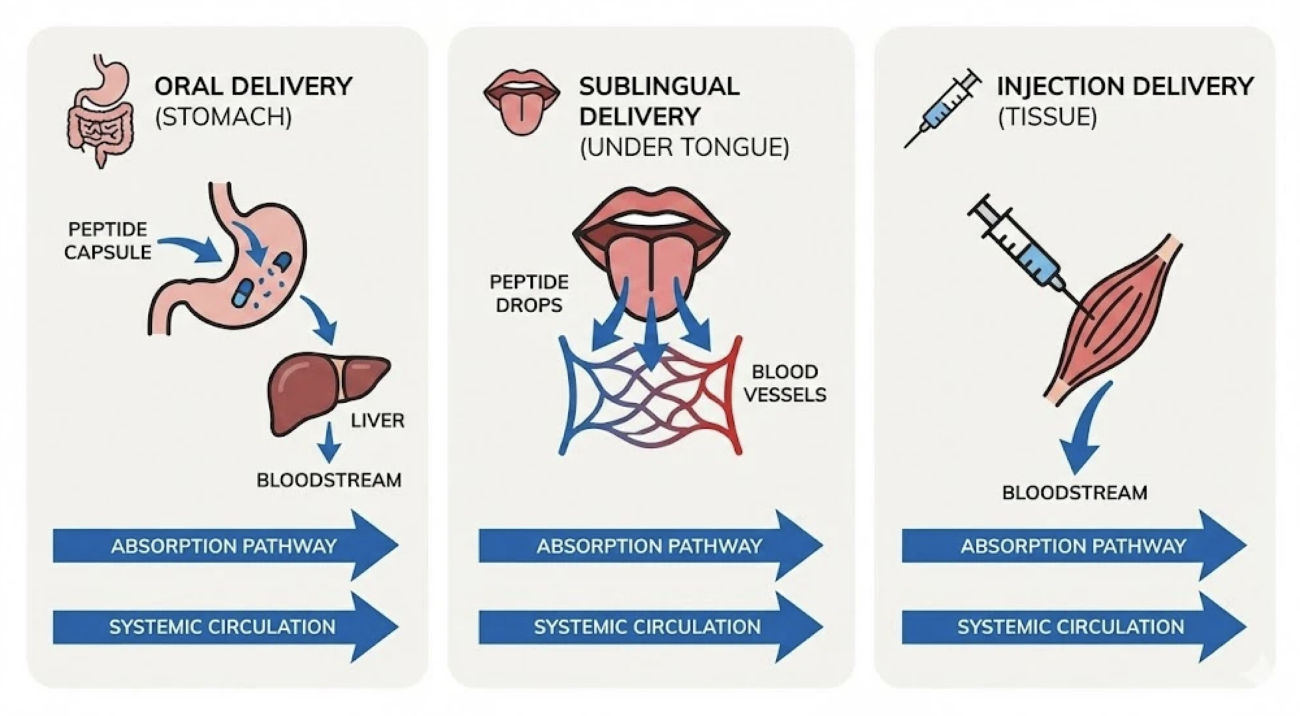
If you simply swallow many peptide molecules, the digestive system may treat them similarly to dietary proteins.
Enzymes can break them down.
The acidic environment of the stomach can affect their stability.
And even peptides that survive digestion may have difficulty crossing the intestinal barrier and reaching the bloodstream.
A review indexed by the National Library of Medicine explains that many therapeutic peptides have historically required parenteral administration because gastrointestinal absorption is poor. Two major obstacles are enzymatic degradation and difficulty penetrating the intestinal mucosa.
This is one reason injections became such an important delivery method for peptide medications.
How Injectable Peptides Work
Injection largely bypasses the gastrointestinal tract.
With a subcutaneous injection — the route used for medications including several GLP-1 drugs — medication is delivered into the fatty tissue beneath the skin.
From there, the drug can be absorbed into systemic circulation.
That creates a major advantage:
The peptide doesn’t have to survive the stomach and intestinal tract first.
This can make drug exposure considerably more predictable when the injectable formulation has been properly developed and clinically studied.
That’s one reason some of the most successful peptide-based medicines are injections.
Insulin has historically been administered by injection.
Wegovy is injected.
Zepbound is injected.
Mounjaro is injected.
These aren’t injections simply because pharmaceutical companies enjoy making patients use needles.
Drug developers have to find a route that delivers enough active medication to the correct place at a predictable concentration.
For many peptide drugs, injection has historically been the most practical way to accomplish that.
What Are Sublingual Peptides?
"Sublingual" means under the tongue.
Rather than swallowing a product immediately, a sublingual formulation is placed underneath the tongue and held there while the active ingredient is intended to absorb through the oral mucosa.
The tissue beneath the tongue has a rich blood supply.
For certain drugs, sublingual administration can allow active ingredients to enter circulation without first traveling through the entire gastrointestinal tract.
This route is already used successfully for some established medications.
But that doesn’t mean every molecule works well sublingually.
And it definitely doesn’t mean that taking an injectable peptide and simply putting it into a sublingual liquid automatically creates an equally effective treatment.
Formulation matters enormously.
The Big Question: Can Peptides Actually Be Absorbed Under the Tongue?
Potentially — but this is where marketing often gets ahead of evidence.
The oral mucosa provides an attractive route for drug delivery because it can bypass some gastrointestinal degradation and first-pass metabolism.
However, peptides can still face significant absorption barriers.
Peptide molecules can be relatively large.
They may have poor membrane permeability.
They can be unstable.
Enzymes present in biological tissues may degrade them.
And only a limited amount of medication can practically remain underneath the tongue.
Drug-delivery researchers have spent decades attempting to solve these problems through technologies such as absorption enhancers, nanoparticles, permeation enhancers, enzyme inhibitors, and specialized formulations.
The existence of that enormous research field demonstrates an important point:
Getting peptides into the bloodstream without an injection isn’t as simple as putting them underneath your tongue.
Sublingual Peptides: The Potential Advantages
Despite the challenges, the appeal of sublingual administration is obvious.
No Needles
This is the biggest advantage.
Many people simply don’t like injections.
Needle anxiety is real, and even consumers comfortable with injections may prefer something they can take without syringes, sharps containers, or injection-site management.
Convenience
A properly designed sublingual product can potentially be much easier to use.
Place the medication underneath the tongue.
Wait for the recommended period.
Continue with your day.
That simplicity could theoretically improve adherence for certain patients.
No Injection-Site Reactions
Injectable medications can sometimes cause reactions around the injection site, including redness, itching, swelling, or discomfort.
Sublingual administration eliminates the injection site entirely.
Potentially Easier Travel
Depending on the medication’s storage requirements, a non-injectable format may be easier for some people to travel with than syringes and injectable vials.
But convenience only matters if the medication is actually delivered effectively.
That’s where injections have an important advantage.
Injectable Peptides: The Potential Advantages
More Predictable Delivery
For a clinically validated injectable peptide medication, one of the biggest advantages is predictable drug exposure.
The gastrointestinal tract and oral mucosal barriers are bypassed.
That can make it easier for drug developers to establish how a specific dose behaves inside the body.
Established Pharmaceutical Precedent
Some of the world’s most important peptide medications have extensive clinical evidence supporting injectable administration.
That includes insulin and modern metabolic medications.
For example, Eli Lilly’s Zepbound contains tirzepatide and is administered by subcutaneous injection.
The FDA-approved formulation, dose escalation schedule, pharmacokinetics, clinical trial evidence, and safety information are all tied to that specific product and method of administration.
Changing the delivery method creates a different formulation question.
Potentially More Reliable Bioavailability
Bioavailability refers to how much of an administered drug reaches systemic circulation.
For many peptide molecules, injection can produce much more reliable systemic exposure than attempting to move the same compound through the gastrointestinal tract or oral mucosa.
This is a major reason peptide drugs have historically relied so heavily on injections.
But Oral Peptide Drugs Are Possible
There’s an important exception that shows how sophisticated drug formulation can overcome some of these challenges.
Semaglutide can be taken orally.
Novo Nordisk’s Rybelsus is an FDA-approved oral semaglutide medication.
That might seem to contradict everything about peptides being difficult to absorb.
It actually proves the point.
Oral semaglutide required specialized formulation technology to make oral delivery viable.
Rybelsus combines semaglutide with an absorption enhancer called SNAC, which helps facilitate absorption in the stomach.
In other words, researchers didn’t simply take injectable semaglutide, put it into a tablet, and assume it would work.
They engineered a specific drug-delivery system around the molecule.
This is an important lesson for the broader peptide industry.
Route of administration and formulation cannot be separated from the drug itself.
Sublingual vs. Injectable BPC-157
BPC-157 is one of the most common examples consumers encounter when comparing sublingual and injectable peptides.
It has become popular in biohacking and recovery communities, where it is promoted for potential effects involving tendons, ligaments, muscle, gastrointestinal health, inflammation, and tissue repair.
Some clinics and online companies offer injectable versions.
Others advertise oral or sublingual formulations.
But there is a major problem with trying to declare a winner:
BPC-157 does not have the robust human clinical evidence needed to establish that either route produces the recovery benefits frequently claimed online.
The FDA’s information on bulk substances used in compounding states that the agency has identified limited safety-related information for proposed routes of BPC-157 administration and has raised concerns involving immunogenicity, peptide-related impurities, and active pharmaceutical ingredient characterization.
That makes statements such as "injectable BPC-157 is X percent more effective than sublingual BPC-157" difficult to support with credible human evidence.
Theoretically, an injectable route could provide more direct and predictable systemic exposure.
But that is not the same as proving a particular injectable BPC-157 product safely heals injuries in humans.
What About GHK-Cu?
GHK-Cu adds another layer to the discussion.
The copper-binding peptide has attracted considerable interest in skin health, collagen production, tissue remodeling, and hair-related applications.
But route matters here too.
GHK-Cu has been studied and used in topical skincare contexts, while some longevity clinics market injectable versions.
A consumer therefore shouldn’t simply ask:
"Does GHK-Cu work?"
The better questions are:
What formulation was studied?
How was it administered?
What outcome was measured?
Was the research conducted in humans?
Does the product being sold resemble the product used in that research?
Those questions are useful for virtually every peptide currently trending online.
What About Tirzepatide?
Tirzepatide provides a useful contrast because it has extensive human clinical evidence.
Tirzepatide is the active ingredient in Mounjaro and Zepbound.
The FDA-approved products are injectable medications.
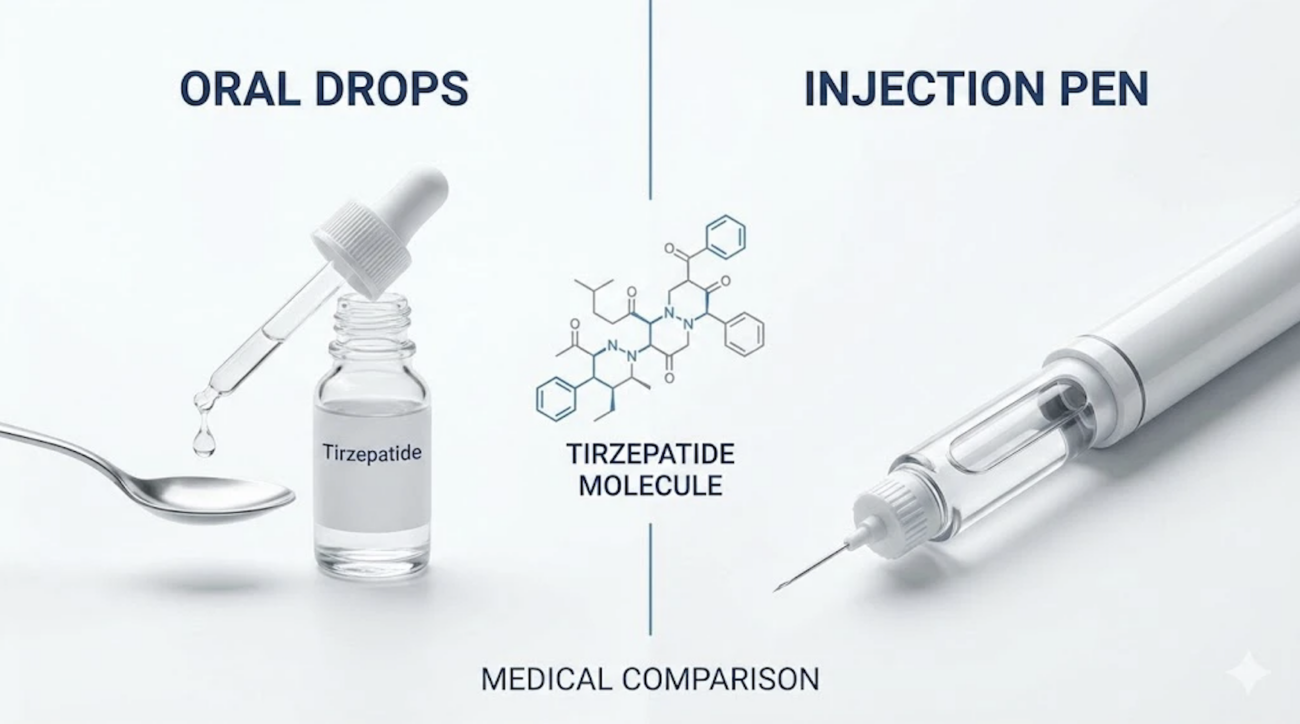
Consumers may encounter telehealth companies or compounding pharmacies advertising alternative formulations of various GLP-1 drugs, including oral or sublingual products.
That does not mean those products have the same evidence as the FDA-approved injectable medication.
The FDA specifically warns consumers about unapproved GLP-1 products, including compounded versions of semaglutide and tirzepatide.
Compounded drugs do not undergo the FDA’s premarket review for safety, effectiveness, and quality.
That distinction becomes particularly important when the route or formulation differs from the approved medication.
Sublingual Doesn’t Automatically Mean Safer
This is another common misconception.
Because sublingual products don’t involve needles, they can feel less "medical."
That can create the impression that they are inherently safer.
But the absence of a needle doesn’t tell you whether the active ingredient itself is safe.
It also doesn’t tell you:
How accurately the product was compounded.
Whether the listed dose is correct.
How much is actually absorbed.
Whether contaminants are present.
Whether degradation has occurred.
Whether the active ingredient has been adequately studied.
Or whether the treatment is appropriate for the patient.
A sublingual experimental peptide remains an experimental peptide.
Injectable Doesn’t Automatically Mean More Effective Either
The opposite misconception also exists.
Some consumers assume that because a peptide is injected, it must be stronger, more legitimate, or more effective.
That isn’t necessarily true.
An injection may improve systemic delivery of certain molecules, but it cannot transform an ineffective compound into an effective treatment.
Nor does injection solve problems involving poor-quality manufacturing or contamination.
Sterility becomes particularly important with injectable products because the body’s protective barriers are being bypassed.
Poorly manufactured injectable products can create serious risks.
The FDA explains that compounded drugs are not FDA-approved and therefore do not undergo the same premarket review for safety, effectiveness, and quality as approved medications.
The agency has documented serious injuries associated with poor-quality compounded products.

The Compounding Pharmacy Matters
This may be one of the most overlooked parts of the peptide conversation.
Many wellness peptides aren’t being purchased as FDA-approved pharmaceutical products.
They may be prepared by compounding pharmacies.
Compounding can serve legitimate medical needs. For example, a patient might need a different formulation because an approved product contains an ingredient they cannot tolerate.
But compounded drugs are not the same thing as FDA-approved medications.
According to the FDA’s compounding guidance, compounded medications do not undergo FDA premarket approval to verify safety, effectiveness, and quality.
The agency recommends that patients obtain prescriptions from healthcare professionals and use appropriately licensed pharmacies.
This becomes especially important with injectable products, where contamination or incorrect dosing can have serious consequences.
The "Research Peptide" Problem
Consumers should also be cautious when purchasing products marketed as:
"For research use only."
"Not for human consumption."
"Laboratory grade."
These labels are fundamentally different from receiving a medication through a licensed healthcare provider and legitimate pharmacy.
A polished website does not prove pharmaceutical quality.
Neither does an influencer endorsement.
Consumers interested in peptide therapy should understand exactly who manufactured the product, who prescribed it, which pharmacy dispensed it, and what clinical evidence supports the treatment.
Sublingual vs. Injectable Peptides: Which Is Better?
There isn’t one universal answer.
It depends entirely on the peptide and the formulation.
For a medication with strong evidence supporting subcutaneous injection, injectable administration may offer well-characterized and predictable exposure.
For a medication specifically engineered and clinically validated for oral or mucosal administration, a non-injectable formulation may work effectively.
For an experimental peptide without robust human evidence, neither route should automatically be described as proven.
That distinction is critical.
The real hierarchy isn’t:
Injection > sublingual.
It’s closer to:
Clinically validated formulation > assumptions based on delivery method.
What Consumers Should Ask Before Using a Peptide
Instead of focusing only on whether something is injectable or sublingual, consumers should ask several bigger questions.
Is this compound FDA-approved for what I’m using it for?
Has this exact route of administration been studied in humans?
What evidence supports the dose?
Who manufactures the product?
Is it coming from a properly licensed pharmacy?
Is a licensed healthcare professional overseeing treatment?
What are the known side effects and unknown long-term risks?
Does an FDA-approved alternative exist?
Those questions can reveal far more than simply asking which version is stronger.
Why Sublingual Peptides Could Still Be Important
None of this means sublingual peptide delivery isn’t promising.
Quite the opposite.
Finding reliable ways to deliver peptide drugs without injections is a major pharmaceutical opportunity.
Needle-free peptide delivery could improve convenience and treatment adherence for millions of people.
Scientists are actively researching oral, buccal, sublingual, nasal, transdermal, and other delivery systems.
The success of oral semaglutide demonstrates that some of the barriers can be overcome with sophisticated formulation science.
As technology improves, more peptide-based medications may eventually move beyond injections.
But those breakthroughs will require evidence.
The future of peptide medicine isn’t simply taking injectable compounds and putting them into droppers.
It is engineering formulations that reliably deliver specific molecules and then demonstrating their safety and effectiveness through clinical research.
The Bigger Peptide Boom
The debate over sublingual versus injectable peptides reflects a much bigger change happening across wellness.
Consumers increasingly want personalized interventions that go beyond traditional supplements.
GLP-1 medications have transformed weight management.
Longevity clinics are expanding.
Advanced blood testing is becoming more accessible.
Wearables continuously monitor sleep and recovery.
And experimental peptide therapies have moved from niche bodybuilding and biohacking communities into mainstream wellness conversations.
As Vital Report has covered in our breakdown of Wolverine, GLOW, NAD+, retatrutide, and tirzepatide, the word "peptide" now encompasses everything from experimental recovery compounds to rigorously studied FDA-approved medications.
Understanding those differences is becoming increasingly important.
The Bottom Line
Sublingual peptides offer something consumers clearly want: convenience.
No needles.
Potentially easier administration.
And a less intimidating experience.
Injectable peptides, meanwhile, can bypass many of the biological barriers that make peptide drug delivery so difficult and have a long history of successful use in medicine.
But neither route is automatically superior.
The effectiveness of a peptide depends on the molecule, formulation, dose, delivery system, manufacturing quality, and — most importantly — the clinical evidence behind it.
For FDA-approved medications, consumers can look to established clinical trials and prescribing information.
For many experimental wellness peptides, that evidence simply doesn’t exist yet.
As peptide therapy becomes more mainstream, the smartest question may therefore shift from:
"Should I inject it or take it under my tongue?"
to:
"Has this exact product, at this exact dose, through this exact route, actually been shown to work?"
That is the question that separates promising peptide science from peptide hype.
Frequently Asked Questions
Are sublingual peptides as effective as injections?
It depends on the specific peptide and formulation. Peptides can have difficulty crossing biological membranes, so a sublingual product should not automatically be assumed to provide the same exposure as an injectable version. Reliable comparisons require pharmacokinetic and clinical data for the specific products.
Why are so many peptides injected?
Many peptides are susceptible to enzymatic degradation and have poor absorption through the gastrointestinal tract. Injection can bypass those barriers and provide more predictable systemic exposure for appropriately developed medications.
Do sublingual peptides bypass the stomach?
Sublingual administration is intended to allow medication to absorb through tissue beneath the tongue rather than relying entirely on gastrointestinal absorption. However, the amount actually absorbed depends heavily on the molecule and formulation.
Is sublingual BPC-157 better than injectable BPC-157?
There is not enough robust human clinical evidence to establish that sublingual or injectable BPC-157 provides the recovery benefits frequently promoted online, much less determine a definitive winner between the two routes.
Can tirzepatide be taken sublingually?
FDA-approved tirzepatide products Mounjaro and Zepbound are administered by subcutaneous injection. Consumers may encounter compounded products marketed in alternative formulations, but those formulations should not be assumed to have the same clinical evidence or FDA review as the approved products.
Are compounded peptides FDA-approved?
No. The FDA does not approve compounded drugs. Compounded medications can serve legitimate patient needs, but they do not undergo FDA premarket review for safety, effectiveness, or quality.
Are oral peptide medications possible?
Yes. Rybelsus is an important example of an FDA-approved oral peptide-based medication. Its formulation uses specialized technology to facilitate absorption, demonstrating why the formulation itself is an essential part of peptide drug development.
Which is safer: sublingual or injectable peptides?
There is no universal answer. Safety depends on the active compound, formulation, dose, manufacturing quality, patient characteristics, and evidence supporting the treatment. Injectable products also introduce considerations such as sterility, dosing accuracy, and injection-site reactions.