

For years, the functional beverage industry has focused on one thing.
More energy.
More caffeine.
More focus.
More productivity.
Energy drinks have become a staple of convenience stores, gyms, and grocery aisles, with brands competing to deliver stronger formulas and longer-lasting stimulation.
But another category is emerging around the opposite idea.
What if consumers don’t want more energy? What if they want to unwind?
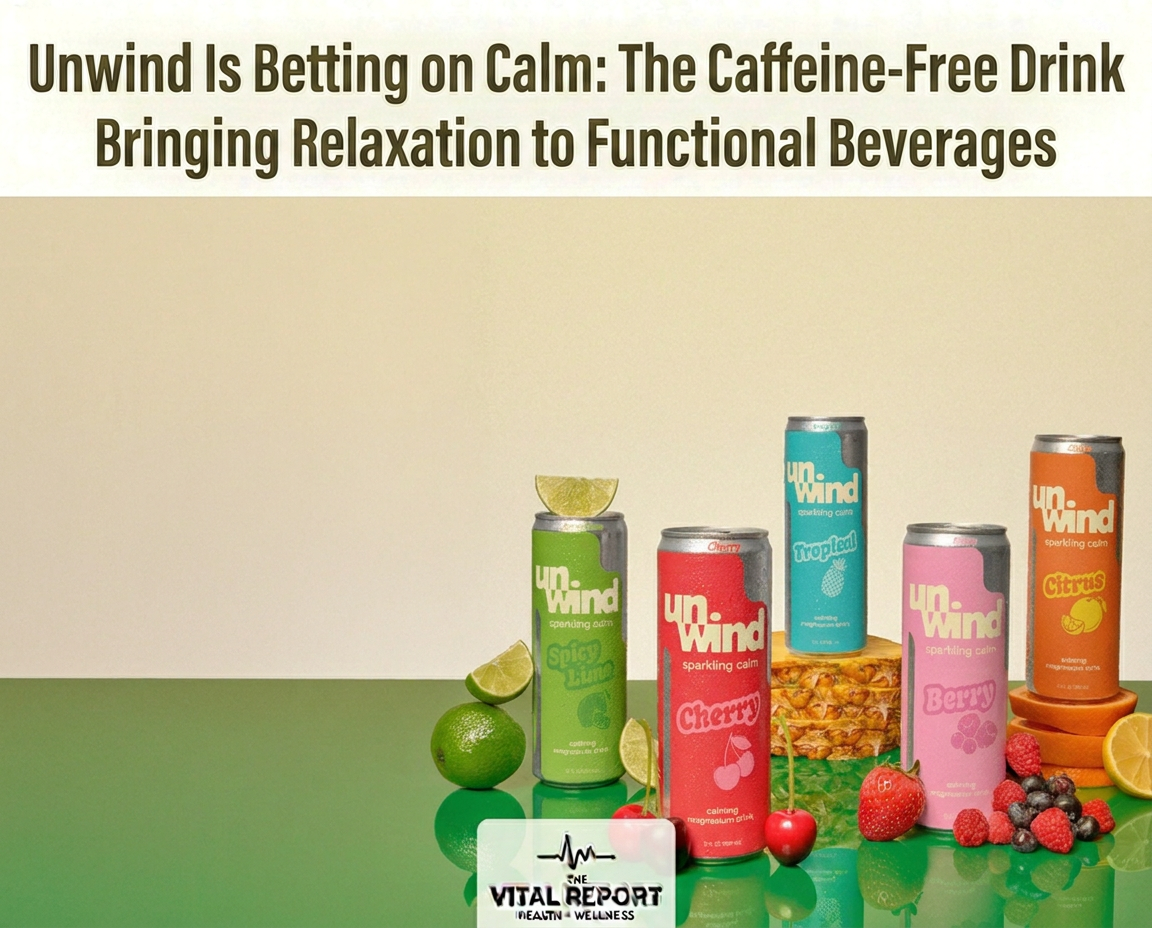
That’s the opportunity behind Unwind, a caffeine-free calming beverage positioned around relaxation rather than stimulation.
The concept reflects a broader shift in functional drinks, as companies explore beverages designed for different moments throughout the day.
Energy in the morning.
Hydration during workouts.
And relaxation in the evening.
For Unwind, the opportunity isn’t necessarily to replace coffee or traditional energy drinks.
It’s to create another reason for consumers to reach for a functional beverage.
One built around slowing down.
The Founders Behind Nowadays Are Entering a New Beverage Category
Unwind officially launched on October 1, 2026, through approximately 1,000 Walmart stores nationwide.
The company was founded by Justin Tidwell and Anthony Puterman, the entrepreneurs behind Nowadays, a beverage brand launched in 2023.
According to Unwind’s official launch announcement, Nowadays generated more than $100 million in sales over approximately three and a half years.
That experience gave the founders an understanding of how to build a beverage business around changing consumer preferences.
Now they’re applying that experience to relaxation.
Instead of another energy drink, Unwind is designed to support a calmer state of mind without caffeine.
And instead of targeting consumers exclusively before bedtime, the brand is positioning itself for everyday moments when people want to feel less overwhelmed.
After work.
Between meetings.
Before dinner.
Or during a break in a busy day.
That distinction is central to the company’s strategy.
Unwind isn’t necessarily trying to make consumers sleepy.
It’s trying to create a beverage occasion around feeling calm while remaining present and alert.
What’s Inside Unwind?
Unwind is a 12-ounce sparkling beverage formulated with magnesium and L-theanine, two ingredients commonly associated with relaxation-focused supplements.
According to Unwind’s official product information, each can contains 42 milligrams of magnesium, supplied through magnesium L-threonate and magnesium bisglycinate.
The magnesium L-threonate is sourced from Magtein, a patented ingredient used in certain cognitive health and relaxation supplements.
The formula also includes L-theanine and chamomile bud extract.
Unlike traditional energy drinks, Unwind contains no caffeine.
Each can has approximately 25 calories and is marketed as a low-sugar alternative to conventional soft drinks.
The ingredient list includes carbonated water, sugar, natural flavors, citric acid, magnesium compounds, chamomile bud extract, L-theanine, and stevia.
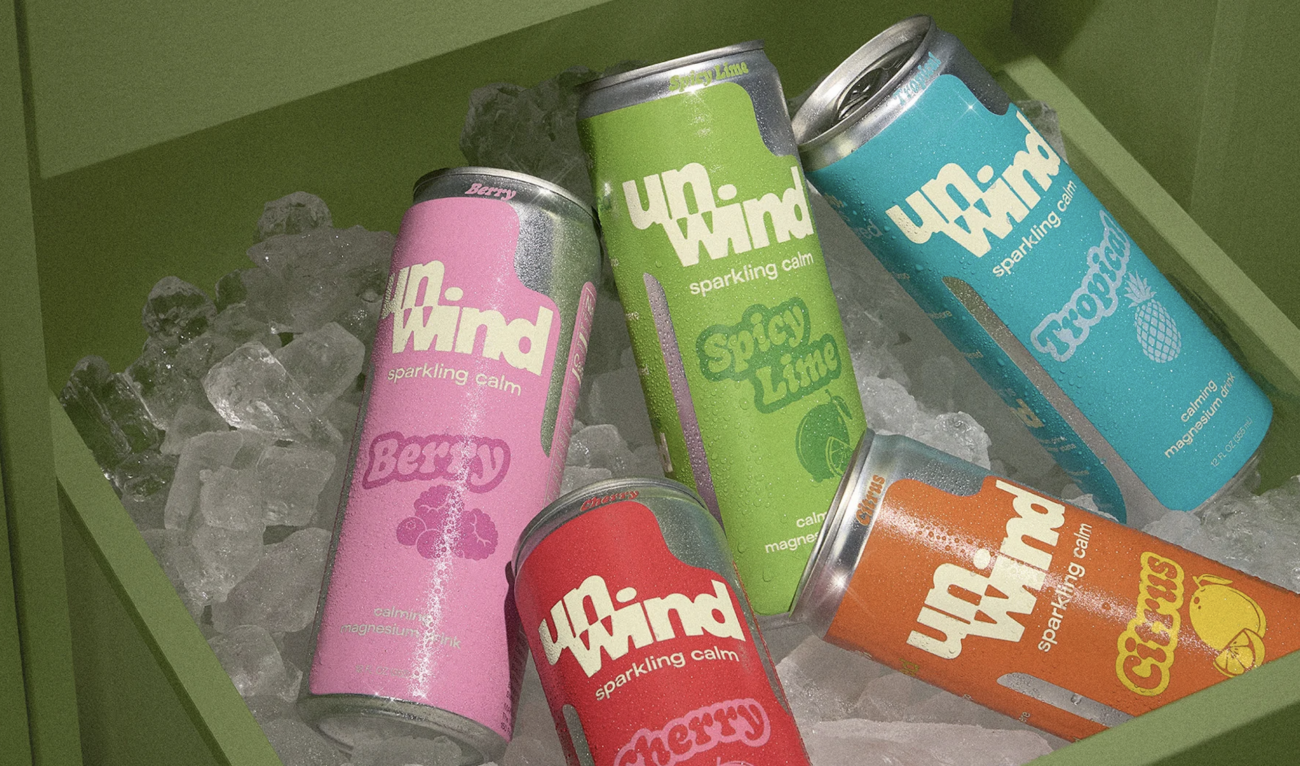
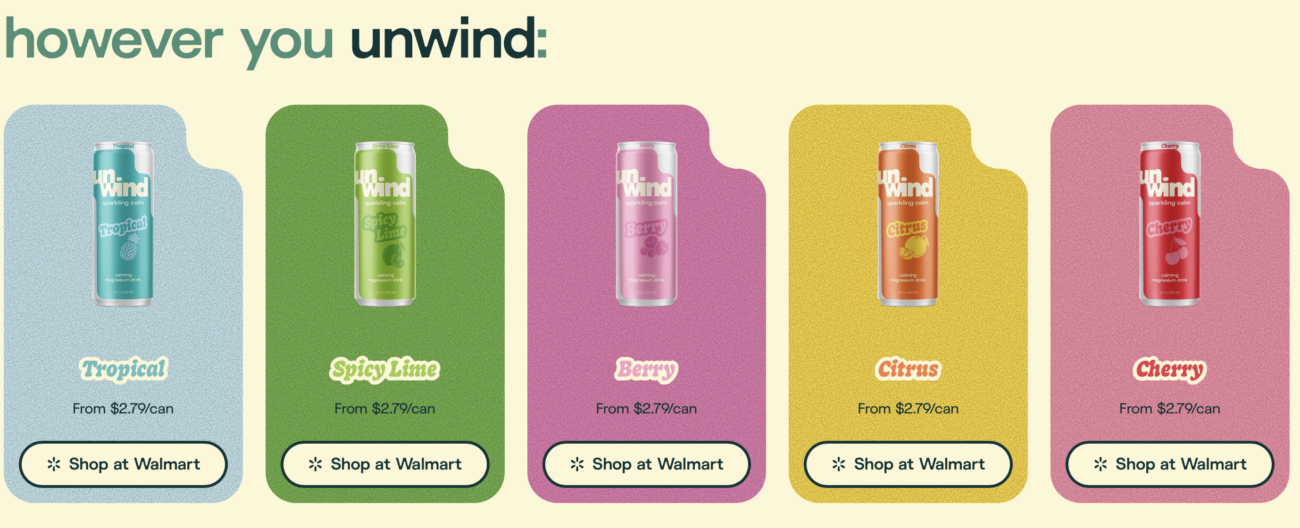
The brand is launching with five flavors:
- Berry
- Cherry
- Citrus
- Tropical
- Spicy Lime
Each flavor is designed to deliver a familiar sparkling beverage experience rather than the taste of a traditional supplement.
That matters because functional drinks increasingly need to compete on flavor and convenience, not just their active ingredients.
Unwind is betting that consumers will be more willing to incorporate relaxation-focused ingredients into their routines when those ingredients come in a beverage they enjoy drinking.
Why Magnesium Is Becoming a Popular Beverage Ingredient
Magnesium has become one of the most recognizable minerals in the wellness industry.
It plays a role in hundreds of biochemical reactions throughout the body.
Those functions include supporting normal muscle and nerve activity, energy production, and other essential cellular processes.
According to the National Institutes of Health Office of Dietary Supplements, magnesium is necessary for normal physiological function, and inadequate intake can contribute to various health problems.
But magnesium’s growing popularity in wellness products extends beyond its basic nutritional role.
Brands increasingly market certain forms of magnesium around sleep, relaxation, and cognitive support.
Unwind uses two forms.
Magnesium L-threonate.
And magnesium bisglycinate.
Magnesium L-threonate has attracted interest because of research exploring its potential effects on cognitive function and sleep-related outcomes.
However, the evidence remains developing, and results from studies using specific doses and formulations cannot automatically be applied to every product containing the ingredient.
Magnesium bisglycinate is another commonly used supplemental form.
For Unwind, combining these ingredients creates a recognizable nutritional foundation for its calming positioning.
But the dose matters.
A can contains 42 milligrams of magnesium, which is a relatively modest contribution compared with the daily recommended intake for most adults.
Consumers shouldn’t assume that one can will produce the same effects as a higher-dose magnesium supplement used in a clinical study.
What Does L-Theanine Actually Do?
The second major ingredient in Unwind is L-theanine.
L-theanine is an amino acid naturally found in tea leaves.
It has attracted attention because of its potential relationship with relaxation, attention, and stress-related responses.
Unlike caffeine, L-theanine is not primarily used as a stimulant.
Instead, researchers have investigated whether it may influence subjective stress and certain measures of cognitive performance.
Some small clinical trials have reported improvements in stress-related outcomes following L-theanine supplementation.
For example, a randomized controlled study published in Nutrients examined the effects of L-theanine on stress-related symptoms and cognitive functions in healthy adults.
The researchers reported improvements in some measured outcomes, although the study was relatively small and its findings should not be interpreted as proof that every L-theanine beverage will produce the same benefits.
The amount of L-theanine also matters.
Unwind’s publicly available FAQ identifies the ingredient but does not clearly disclose its per-can dosage.
Without that information, it’s difficult to compare the finished beverage directly with doses used in published clinical research.
That doesn’t mean the product cannot be useful.
It means the evidence for the ingredients should be distinguished from evidence for the finished drink.
Unwind Isn’t Trying to Be a Sleep Drink
One of the most important distinctions in Unwind’s marketing is what the product isn’t designed to do.
It’s not positioned as a sleep aid.
And it’s not intended to make consumers feel sedated.
According to the company’s FAQ, Unwind is designed to help people feel calmer while remaining clear-headed and present.
That separates it from products containing melatonin or other ingredients marketed specifically for bedtime.
It also creates more potential consumption occasions.
Someone might drink Unwind after finishing work.
Another person might reach for it while preparing dinner.
And someone else might choose it instead of an afternoon caffeinated beverage.
The product is designed around the idea that relaxation doesn’t have to happen exclusively at night.
That’s an interesting development in functional beverages.
For years, companies have organized products around increasing alertness.
Morning coffee.
Pre-workout drinks.
Afternoon energy beverages.
Unwind is introducing another occasion into that schedule.
A moment when consumers want less stimulation rather than more.
The Brand Is Launching in Approximately 1,000 Walmart Stores
Unwind isn’t entering the market through a small online-only release.
The company launched in approximately 1,000 Walmart stores across the United States.
That gives the brand immediate access to a national retail audience.
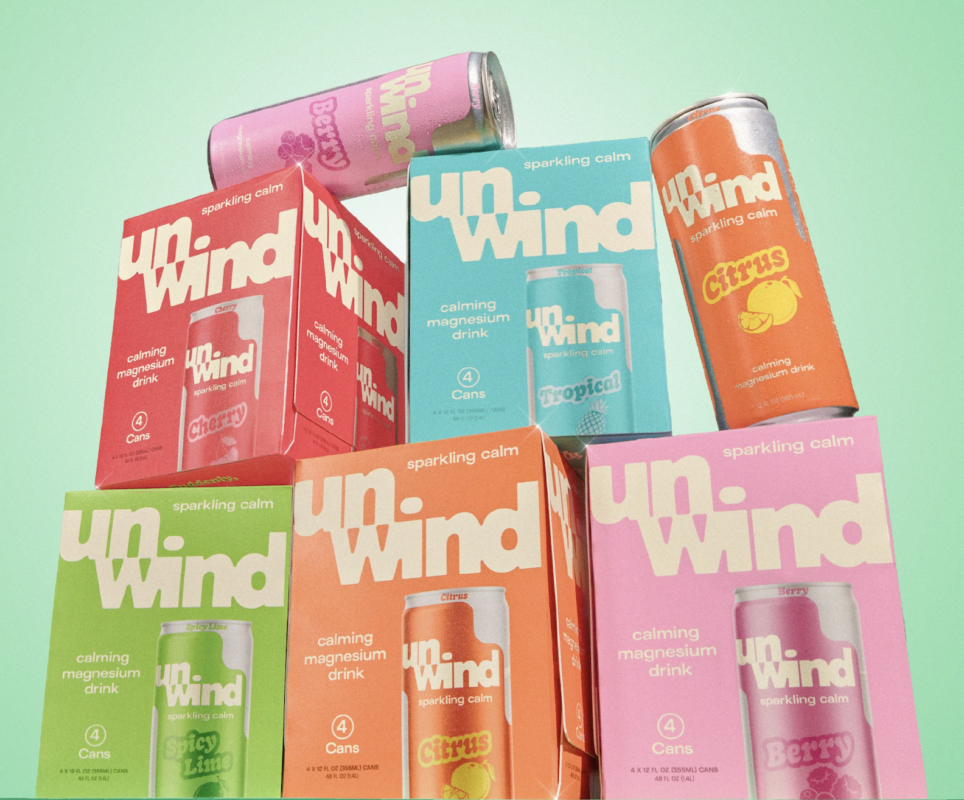
According to Beverage Information Group’s October coverage, the beverages have a suggested retail price beginning at $2.79 per can or $10.99 for a four-pack.
That positions Unwind within the premium functional beverage category.
The company also announced plans to sell through TikTok Shop beginning in mid-October, with additional national retail expansion scheduled for early 2027.
The launch will be supported by creator partnerships, digital advertising, sampling events, and in-store activations.
That strategy reflects how functional beverage companies increasingly combine traditional grocery distribution with social media discovery.
A consumer may first see the product in a TikTok video.
Then encounter it in a Walmart aisle.
And eventually incorporate it into a regular shopping routine.
For Unwind, the challenge will be turning that initial curiosity into repeat purchases.
Walmart Is Creating Space for Calming Beverages
Unwind’s launch is happening as Walmart expands its focus on mood-oriented functional drinks.
On October 1, the retailer announced a new Mood & Mind beverage assortment featuring products positioned around calm, relaxation, and other emotional wellness occasions.
The assortment includes brands such as TRIP, which has built its identity around caffeine-free functional beverages.
According to TRIP’s announcement about Walmart’s Mood & Mind assortment, calming beverages have become an increasingly important segment of the functional drink market.
The company cited SPINS data suggesting that calming and mood-support beverages are growing faster than several other functional beverage categories.
That growth creates opportunities for new entrants.
But it also means Unwind is entering an increasingly competitive market.
TRIP has already established a recognizable presence in calming beverages.
Other brands are developing products featuring magnesium, L-theanine, adaptogens, and botanical ingredients.
And traditional beverage companies are watching the category closely.
Unwind will need to differentiate itself through flavor, pricing, marketing, and product experience.
The founders’ previous success provides credibility.
But the new brand will still need to prove itself.
The Founders Are Applying Their Beverage Playbook Again
One reason Unwind is attracting attention is the experience of its founders.
Justin Tidwell and Anthony Puterman previously built Nowadays into a substantial beverage business.
Their new company is separate from Nowadays, but the founders are applying lessons from their earlier venture.
According to Inc.’s reporting on the launch, the pair recognized an opportunity to build a brand around consumers looking for an alternative to the constant stimulation associated with modern life.
That insight is central to Unwind.
Rather than competing with energy drinks on their own terms, the company is attempting to establish a different reason to purchase a functional beverage.
The founders also understand that ingredients alone rarely create a lasting consumer brand.
Packaging matters.
Flavor matters.
Retail distribution matters.
And the product needs to fit naturally into an existing routine.
Unwind is designed around those principles.
It’s a sparkling drink in a familiar can.
It comes in recognizable flavors.
And it’s sold through one of the country’s largest retailers.
The functional ingredients provide the differentiation.
But the everyday drinking experience is what could help the brand scale.
The Science of Calm Is More Complicated Than a Beverage Label
The rise of calming drinks creates an important question.
Can a beverage actually make someone feel less stressed?
The answer depends on the ingredients, their doses, individual responses, and the type of outcome being measured.
Magnesium is essential for normal nervous system function.
L-theanine has been studied for stress-related responses.
And chamomile has a long history of use in relaxation-focused products.
But that doesn’t mean combining them in a beverage guarantees a noticeable calming effect.
There is also a difference between feeling relaxed and treating a medical condition.
Unwind is marketed as an everyday functional beverage, not a treatment for anxiety disorders, insomnia, or other medical conditions.
The company’s claim that the drink supports a calmer state of mind should therefore be understood as a product-positioning claim rather than evidence of a clinically established treatment effect.
Consumers should also consider individual circumstances.
Unwind’s FAQ advises pregnant or breastfeeding individuals and people taking medications to consult a healthcare professional before consuming the product.
The company also states that the drink is not recommended for children.
For most consumers, the practical question will be whether the beverage provides an enjoyable alternative to caffeine or alcohol, regardless of whether its ingredients produce a measurable calming effect.
The Functional Beverage Industry Is Shifting From Energy to Balance
The emergence of brands like Unwind reflects a broader change in consumer wellness.
For years, functional beverages were primarily designed around improving performance.
More energy.
More endurance.
More focus.
More productivity.
But consumers are increasingly interested in products that support different needs.
Hydration.
Sleep.
Digestion.
Relaxation.
And general well-being.
That shift is changing how beverage companies develop products.
Instead of competing exclusively on stimulation, brands are exploring ways to create distinct drinking occasions throughout the day.
Vital Report recently covered Once Upon a Farm’s launch of electrolyte blends for children, another example of how functional ingredients are moving into familiar consumer formats.
Unwind represents a different side of the same trend.
It takes ingredients associated with supplements and incorporates them into a ready-to-drink beverage.
The idea isn’t necessarily to replace traditional supplements.
It’s to make functional ingredients part of an everyday experience.
Can Calm Become the Next Major Beverage Category?
The opportunity is clear.
Consumers are already familiar with functional drinks.
They understand energy beverages.
They recognize electrolyte products.
And they’re increasingly encountering magnesium and L-theanine in the supplement aisle.
Unwind brings those ingredients into a sparkling beverage.
But building a lasting category will require more than consumer interest in relaxation.
Products need to taste good.
They need to be affordable enough for repeat purchases.
And consumers need to understand what benefits they can realistically expect.
The company also faces a positioning challenge.
If the beverage doesn’t contain caffeine or alcohol, some consumers may view it primarily as a premium sparkling drink.
Others may be attracted specifically by the magnesium and L-theanine.
Unwind needs to appeal to both groups.
That’s where the founders’ experience could become important.
They’ve already built a beverage brand around a distinctive consumer need.
Now they’re attempting to do it again in a different category.
The Bottom Line
Unwind is bringing a different approach to the functional beverage aisle.
Founded by Nowadays creators Justin Tidwell and Anthony Puterman, the new brand launched October 1, 2026, in approximately 1,000 Walmart stores nationwide.
Each 12-ounce can contains magnesium and L-theanine, with zero caffeine and approximately 25 calories.
The beverages are available in five flavors: Berry, Cherry, Citrus, Tropical, and Spicy Lime.
Pricing begins at $2.79 per can or $10.99 for a four-pack, with additional retail expansion planned for 2027.
But the bigger story is what Unwind represents.
The functional beverage industry has spent years helping consumers feel more energized, alert, and productive.
Now companies are increasingly developing products for the opposite occasion.
Relaxation.
Unwind isn’t designed to make consumers sleepy.
It’s positioned as a sparkling drink for moments when people want to feel calmer without checking out of their day.
The clinical evidence for the finished beverage remains limited, and its benefits shouldn’t be confused with treatment for stress-related medical conditions.
But its launch highlights a growing opportunity in consumer wellness.
Not every functional beverage needs to deliver more energy.
Some are being designed to help consumers slow down.