

The next frontier of wearable health technology may not be your sleep, heart rate, or glucose.
It may be your muscles.
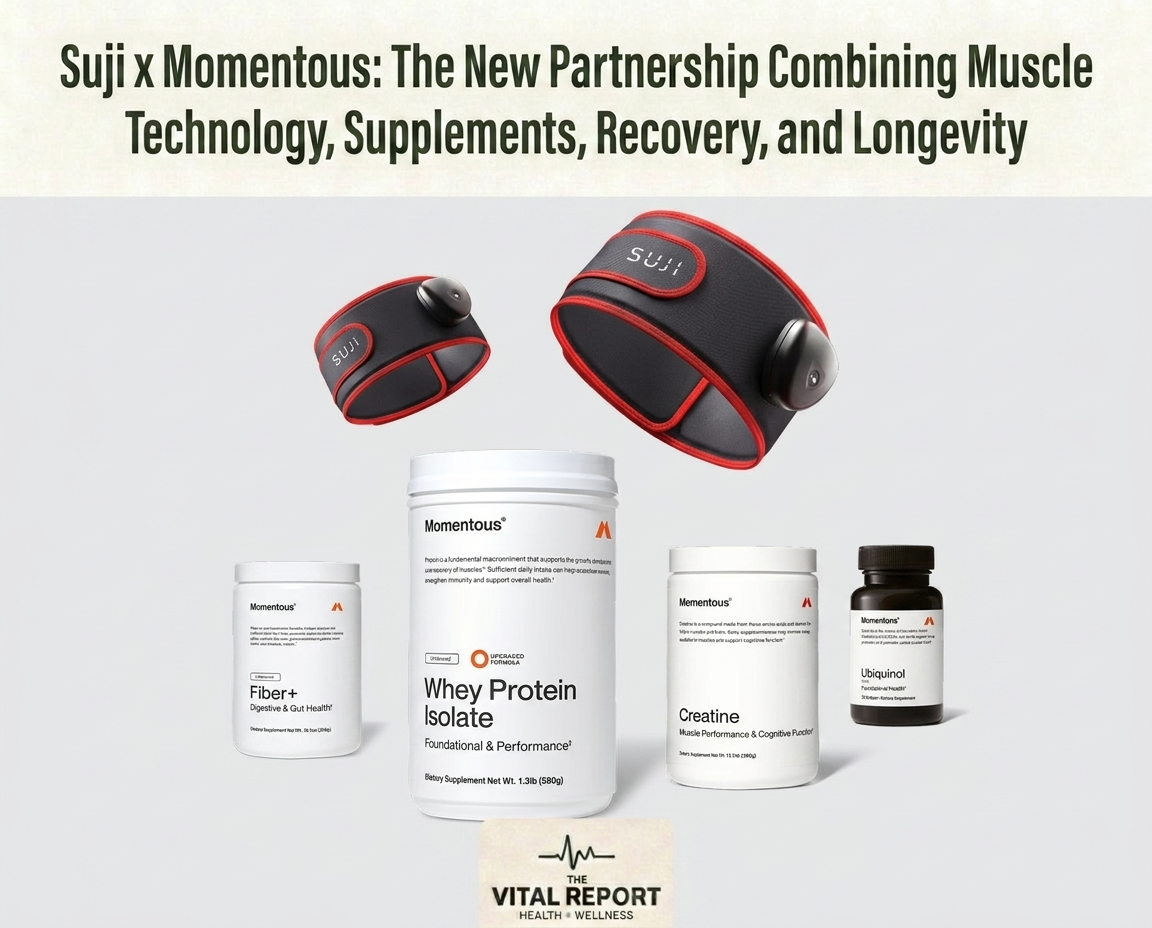
Muscle-health technology company Suji has announced a new strategic partnership with performance nutrition brand Momentous, bringing together two increasingly important areas of the wellness industry: technology-driven training and science-backed supplementation.
The partnership initially combines Suji’s targeted compression wearable with curated Momentous supplement bundles built around two primary goals: injury/recovery and strength/longevity.
But the bigger opportunity could come later.
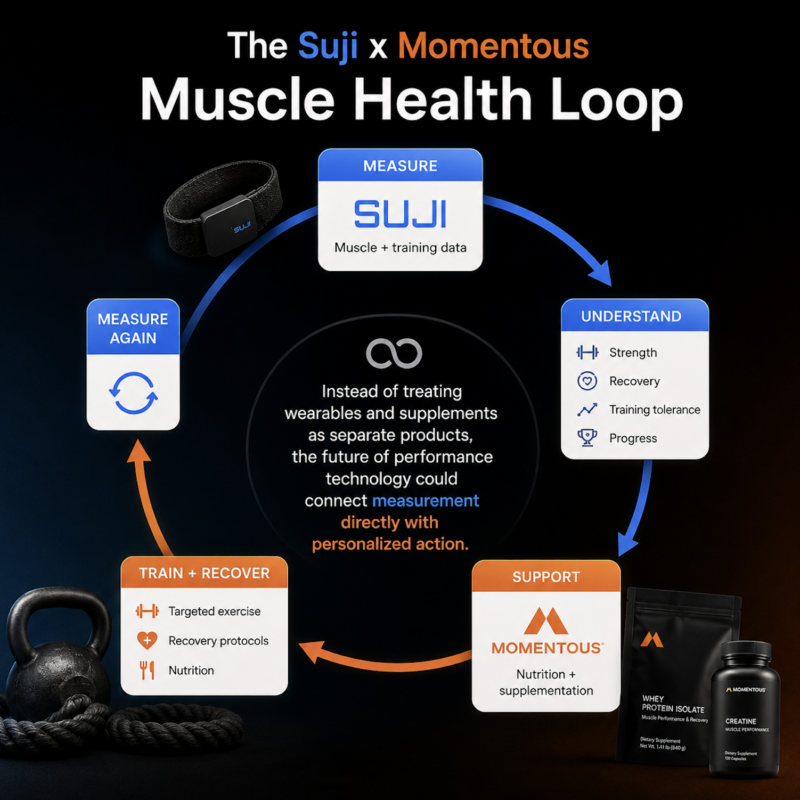
The companies are exploring how muscle-health data collected through Suji could eventually help inform more personalized recommendations — potentially creating a system where consumers don’t simply track their bodies or take supplements independently, but use data to help connect the two.
It is another sign of where personalized wellness may be heading.
Wearables spent the last decade measuring us.
The next generation may increasingly try to tell us what to do with those measurements.
What Is Suji?
Suji is a wearable muscle-health company built around a technology it calls Targeted Compression.
The concept is related to blood flow restriction training, commonly known as BFR.
Traditional blood flow restriction training involves placing a cuff around a limb to partially restrict arterial inflow and reduce venous outflow while performing relatively low-load exercise.
The result is an unusual training environment.
Instead of requiring extremely heavy resistance to create a substantial muscular stimulus, BFR can allow individuals to train using considerably lighter loads.
That has made the technique particularly interesting across sports performance, rehabilitation, physical therapy, and healthy aging.
A 2024 systematic review and meta-analysis examining low-load BFR training found that low-load BFR produced muscle-mass gains comparable to high-load resistance training in the studies analyzed, although traditional high-load training generally produced greater strength gains overall.
Importantly, the analysis also found that factors such as individualized pressure could influence outcomes.
That last point is particularly relevant to Suji.
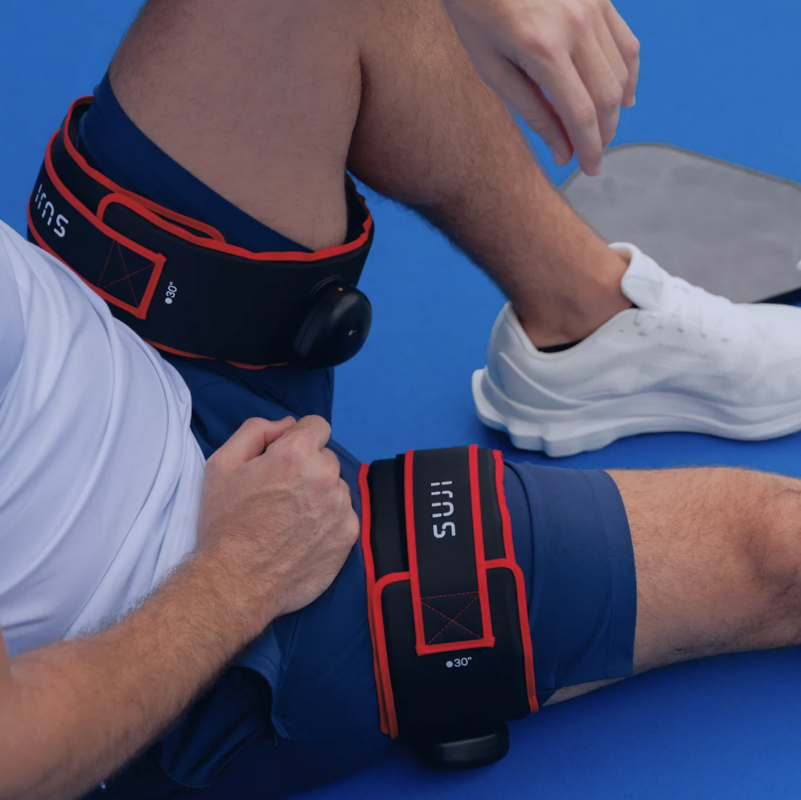
Instead of relying on a traditional manually adjusted BFR cuff, Suji says its system uses automated calibration to personalize compression for the user.
The goal is to make the technique more accessible outside elite training facilities and rehabilitation environments.
Why Blood Flow Restriction Training Has Become So Popular
The appeal of BFR becomes easier to understand when you look at one of the fundamental problems with strength training.
Building and maintaining muscle usually requires resistance.
But heavy resistance isn’t always practical.
An athlete recovering from an injury may not be able to load a joint heavily.
Someone recovering from surgery may need to gradually rebuild muscle.
Older adults may struggle with heavy resistance.
Even healthy athletes sometimes need ways to generate a meaningful training stimulus while reducing mechanical stress during periods of intense competition.
BFR attempts to solve part of that problem.
Research continues to investigate exactly where it is most useful, but the evidence around low-load BFR and muscle growth is increasingly substantial.
A 2025 systematic review and meta-analysis published in Frontiers in Physiology examined upper-body BFR training and found that low-load BFR produced improvements in muscle strength and hypertrophy, including advantages over comparable low-load training performed without blood flow restriction.
Another systematic review and meta-analysis examining BFR across healthy and clinical populations similarly found improvements in muscular strength and hypertrophy, while noting that conventional high-intensity resistance training can remain superior for certain outcomes.
That nuance matters.
BFR isn’t magic.
It doesn’t eliminate the importance of traditional resistance training.
Instead, its potential advantage may be allowing individuals to create a significant muscular stimulus without always requiring the same external load.
And that makes it particularly interesting when the goal is recovery, rehabilitation, longevity, or maintaining muscle while heavy training isn’t ideal.
Enter Momentous
If Suji represents the hardware side of muscle health, Momentous represents the nutritional side.
Momentous has become one of the more recognizable performance-supplement companies in professional sports.
The company develops products across categories including creatine, protein, omega-3s, sleep, hydration, and foundational health.
It has also built much of its identity around testing and sports credibility.
Momentous says its products undergo independent third-party testing, and the company works extensively across professional and collegiate sports.
That makes the partnership with Suji relatively intuitive.
Suji is attempting to influence how people train and recover.
Momentous is attempting to support how they fuel that process.
Put the two together and you begin to get something closer to a muscle-health ecosystem.
What the Suji x Momentous Partnership Actually Includes
The initial partnership is relatively straightforward.
Suji customers will be able to purchase curated bundles pairing the Suji wearable with Momentous supplements.
Those bundles are organized around two broad categories:
Injury + Recovery
and
Strength + Longevity
Suji app subscribers will also receive preferred pricing on Momentous products, while members of the Momentous Insider community will receive discounts on Suji.
On its own, that is a conventional brand partnership.
But the long-term vision is more interesting.
The companies have indicated that they want to explore how muscle-health information could eventually be used to provide more personalized recommendations.
That moves the concept from:
Wearable + supplements
toward:
Data → recommendation → intervention → measurement
And that could be much more significant.
Why Creatine Makes This Partnership Particularly Interesting
One of Momentous’ flagship categories is creatine.
And unlike many supplements that become popular through wellness marketing before strong evidence exists, creatine has decades of research behind it.
The International Society of Sports Nutrition’s position stand on creatine describes creatine monohydrate as one of the most effective nutritional ergogenic aids available for increasing high-intensity exercise capacity and supporting lean body mass during training.
That creates an interesting overlap with Suji.
BFR aims to create a muscular training stimulus using relatively low external loads.
Creatine helps support rapid energy availability during high-intensity muscular activity and can improve adaptations to resistance training.
They are not interchangeable technologies, and combining them doesn’t automatically create a greater effect.
But they represent two evidence-backed approaches aimed at influencing muscle performance from completely different directions.
Suji targets the training stimulus.
Momentous targets nutritional support.
That distinction could become increasingly important as wellness companies move beyond individual products and toward integrated protocols.
Muscle Is Becoming a Longevity Metric
Perhaps the most interesting part of the partnership is that it isn’t being positioned only around athletes.
It also focuses on longevity.
That reflects a major shift occurring throughout wellness.
For years, longevity conversations were dominated by topics such as supplements, fasting, glucose, sleep, cardiovascular health, and experimental anti-aging interventions.
Muscle is increasingly entering that conversation.
Maintaining muscle mass and physical function becomes especially important as people age.
Age-related loss of muscle mass and strength can affect mobility, independence, metabolic health, and quality of life.
This is one reason resistance training has become such an important component of healthy-aging recommendations.
BFR could potentially become particularly relevant here because older adults or people with orthopedic limitations may not always tolerate heavy resistance training.
A 2025 umbrella review examining BFR in older adults found that systematic reviews generally supported low-load BFR for increasing muscle hypertrophy compared with low-load exercise alone, although results surrounding strength and physical function were more variable.
That is an important distinction.
The goal isn’t to replace traditional strength training.
It is to create more tools for maintaining muscle.
From Sleep Scores to Muscle Scores
The wearable industry has already trained consumers to think about health in numbers.
Oura gives users readiness and sleep scores.
WHOOP tracks strain and recovery.
Continuous glucose monitors visualize metabolic responses.
Smart scales estimate body composition.
Blood-testing platforms track dozens of biomarkers.
The next major category could be muscle health.
As Vital Report has covered across the rapidly expanding world of health wearables and preventive technology, consumers increasingly want tools that don’t simply record exercise — they want technologies that help them understand what is happening inside their bodies.
The Suji-Momentous partnership pushes that idea toward an interesting next step.
If muscle performance can be measured over time, those measurements could potentially influence decisions about:
Training intensity
Recovery
Protein intake
Creatine supplementation
Mobility work
Exercise frequency
Rehabilitation
Healthy aging
That would make the wearable more than a tracker.
It could become part of a feedback system.
The Bigger Trend: Wearables Are Moving From Tracking to Intervention
This may be the most important part of the Suji x Momentous story.
First-generation fitness wearables counted steps.
Then devices began measuring heart rate.
Then came HRV.
Sleep staging.
Skin temperature.
Blood oxygen.
Recovery scores.
Glucose.
Blood pressure.
The industry is gradually moving from tracking health toward influencing health.
A wearable that simply tells you your recovery score is useful.
A system that potentially recognizes changes in recovery and then helps adjust training, nutrition, or supplementation could be much more valuable.
That is the larger opportunity behind partnerships like Suji and Momentous.
The ultimate product may not be the wearable.
And it may not be the supplement.
It may be the personalized recommendation layer connecting them.
Why Personalization Could Be the Real Opportunity
Imagine a future version of the system.
A user completes several Suji training sessions.
The platform recognizes that strength progression has slowed.
Recovery metrics change.
Training volume has increased.
Instead of presenting another dashboard, the system could potentially adjust recommendations.
Maybe training volume changes.
Maybe recovery sessions increase.
Maybe protein intake becomes a priority.
Maybe creatine is recommended for an appropriate user.
Maybe the system determines that no change is necessary.
That kind of recommendation engine is where health technology is increasingly heading.
Consumers don’t necessarily need another 50 biomarkers.
They need help understanding what those biomarkers mean and what they should do next.
The companies that solve that problem could become some of the most important players in consumer health.
Suji Could Make BFR More Consumer-Friendly
There is another reason Suji is worth watching.
Traditional BFR requires knowledge.
Pressure matters.
Cuff placement matters.
Training load matters.
Individual physiology matters.
Using excessive pressure or applying the technique incorrectly can create unnecessary risk.
This creates friction for consumer adoption.
Suji’s bet is essentially that technology can remove some of that friction through automated calibration and guided training.
That follows a familiar consumer-health playbook.
Heart-rate monitors existed before Apple Watch.
Sleep laboratories existed before Oura.
Continuous glucose monitors existed before wellness companies brought them to larger consumer audiences.
The winning consumer product often isn’t the company that invents the underlying science.
It is the company that makes the science easy enough for ordinary people to use.
Suji may be attempting to do exactly that with targeted compression.
There Are Still Important Limitations
The excitement surrounding BFR shouldn’t erase the need for nuance.
Research supports legitimate applications for blood flow restriction training, but results vary depending on population, pressure, exercise protocol, training status, and outcome.
High-load resistance training remains extremely effective.
Some studies show traditional heavy resistance training produces greater strength improvements than low-load BFR.
BFR also isn’t appropriate for every individual.
People with certain cardiovascular, vascular, clotting, or other medical conditions may require additional evaluation before using blood-flow-restriction techniques.
And while Suji and Momentous products may each have evidence supporting aspects of their respective categories, that doesn’t automatically prove that combining the two produces superior outcomes.
That would require direct research on the combined protocol.
The partnership should therefore be viewed as an interesting integration of two muscle-health strategies rather than proof of a new superior training method.
Why This Partnership Matters
The wellness industry is becoming increasingly fragmented.
Consumers have:
A wearable.
A supplement stack.
A workout program.
A sleep tracker.
A nutrition app.
A blood-testing platform.
A recovery device.
A smart scale.
Each generates another piece of information.
Very few actually communicate with one another.
The next phase of consumer health may therefore be about integration.
That is what makes Suji x Momentous interesting.
Instead of asking consumers to independently decide how training, recovery, nutrition, and supplementation fit together, the companies are beginning to explore whether those areas can become connected.
If they can successfully combine objective muscle information with evidence-based recommendations, the partnership could represent a broader shift in performance technology.
The Future of Muscle Health Could Look Very Different
Muscle has traditionally been measured in crude ways.
How much can you lift?
How big is your arm?
How fast can you run?
How high can you jump?
New technology could make muscle health much more measurable.
Combine that with increasingly sophisticated nutritional science and you begin to see the possibility of personalized muscle-health platforms built around maintaining strength throughout life.
That opportunity extends far beyond professional athletes.
It includes:
People recovering from injuries.
Older adults trying to preserve strength.
Weekend athletes.
People returning to exercise.
Consumers focused on longevity.
And anyone trying to maintain muscle while reducing unnecessary stress on joints.
That makes the potential market significantly larger than traditional sports performance.
The Bottom Line
The Suji x Momentous partnership brings together two sides of the growing muscle-health economy.
Suji is focused on how people train and recover.
Momentous is focused on how they fuel and support performance.
Initially, the partnership will combine Suji’s wearable technology with curated Momentous supplement bundles centered around injury/recovery and strength/longevity.
But the longer-term possibility is much more interesting.
If muscle-health data can eventually inform personalized training, recovery, and nutritional recommendations, consumers could move from simply collecting health information toward actually using it to create adaptive wellness protocols.
That is where the wearable industry appears to be heading.
The first generation counted steps.
The second measured sleep and recovery.
The next may connect those measurements directly to what we eat, how we train, how we recover, and how we maintain strength as we age.
Suji x Momentous could be an early look at what that future looks like.
Frequently Asked Questions
What is the Suji x Momentous partnership?
Suji and Momentous announced a strategic partnership in August 2026 focused on muscle health, strength, recovery, and longevity. The initial offering combines Suji technology with curated Momentous supplement bundles, while the companies have also discussed eventually using muscle-health data to inform personalized recommendations.
What is Suji?
Suji is a wearable muscle-health company that uses automated targeted compression technology related to principles of blood flow restriction training. Its system is designed to support strength training, warm-ups, and recovery using individualized compression.
What is Momentous?
Momentous is a performance-nutrition company offering supplements including creatine, protein, omega-3s, magnesium, and other performance and health products. The brand has extensive adoption across professional and collegiate sports.
What is blood flow restriction training?
Blood flow restriction training involves applying controlled pressure to a limb while exercising, typically using relatively light loads. Research suggests low-load BFR can stimulate muscle growth and strength improvements, although results depend on the training protocol and population.
Can BFR replace heavy strength training?
Not necessarily. Research indicates that BFR can produce meaningful muscle adaptations using lower loads, but traditional high-load resistance training may still produce superior strength improvements in certain situations. BFR may be particularly useful when heavy loading is impractical or poorly tolerated.
Does creatine help build muscle?
Creatine monohydrate is one of the most extensively researched sports supplements. Research supports its ability to improve high-intensity exercise capacity and support training adaptations, including increases in lean body mass when combined with resistance training.
Is Suji only for athletes?
No. Although targeted compression and BFR have significant applications in sports performance, their ability to create muscular stimulus using lighter resistance has also generated interest in rehabilitation, recovery, and healthy aging.