
For years, consumer wearables have been getting closer to the body.
First came step counters.
Then smartwatches began tracking heart rate.
Smart rings moved onto the finger to measure sleep, temperature and recovery.
Continuous glucose monitors put sensors directly onto the skin.
Now Atlas wants to move consumer wearables somewhere considerably more ambitious:
The brain.
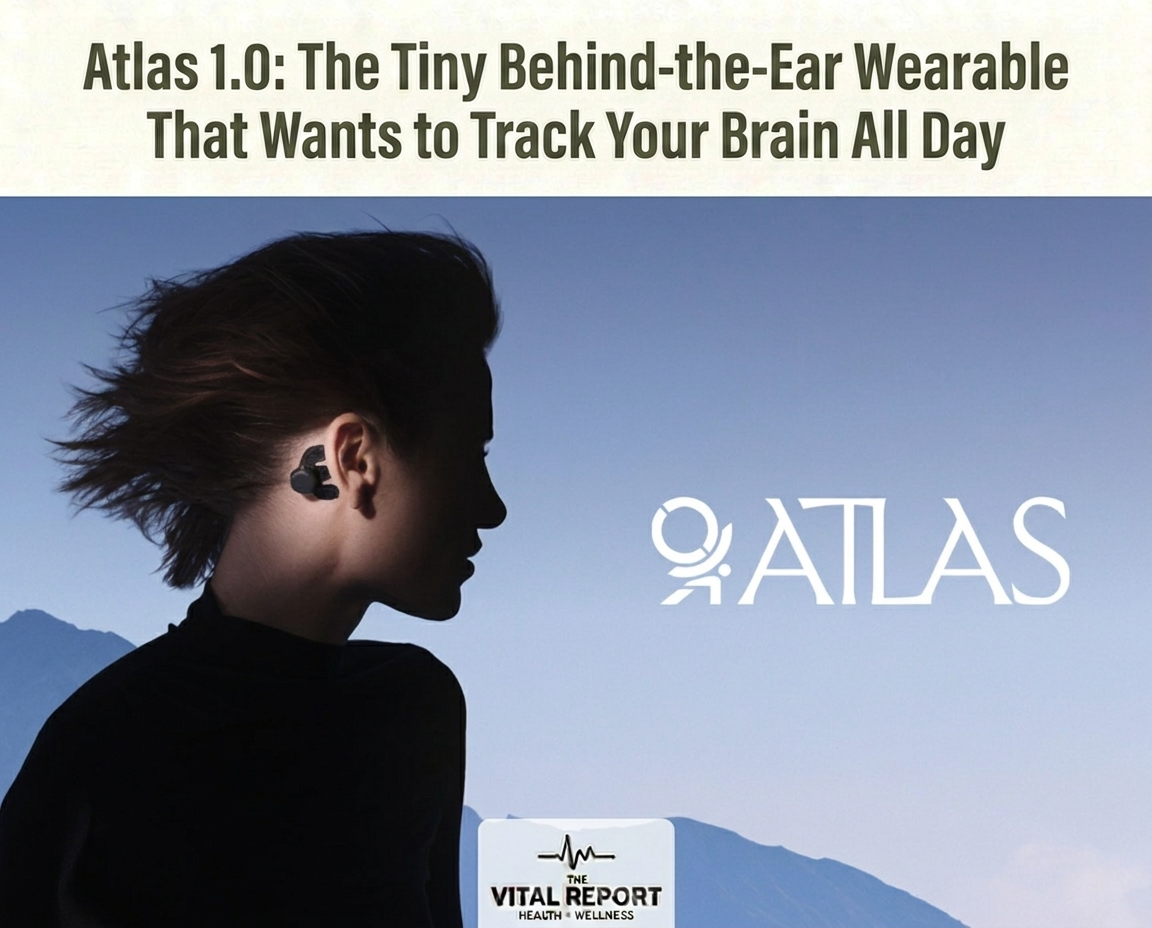
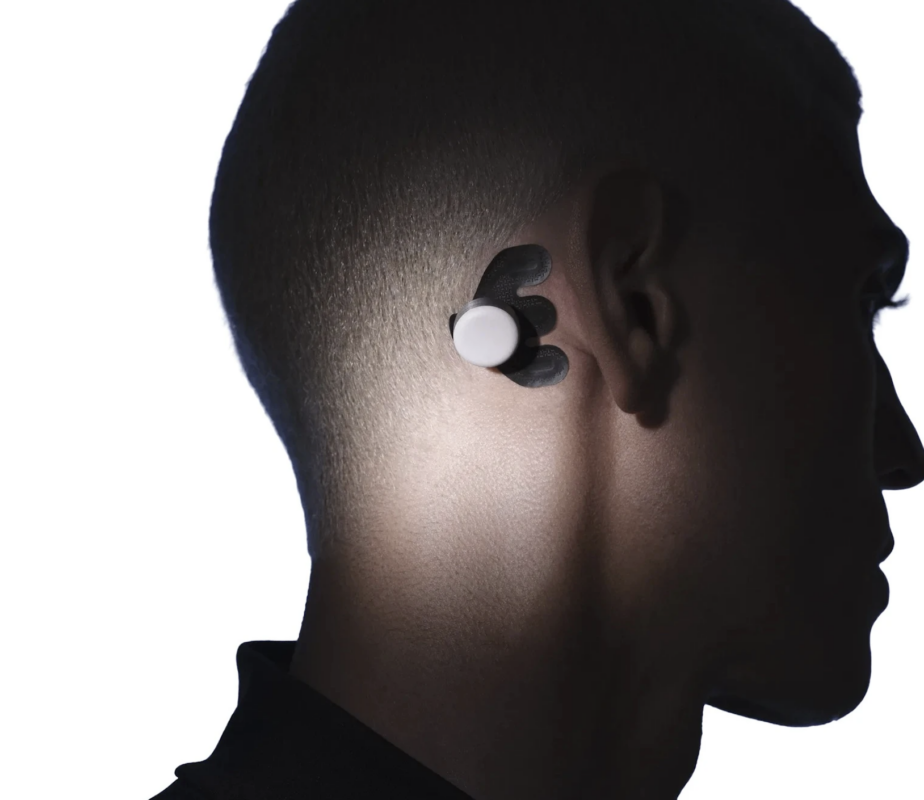
The Atlas 1.0 is a tiny 3.4-gram wearable positioned behind the ear that continuously collects electroencephalography, or EEG, alongside galvanic skin response and motion data.
Instead of giving users another recovery score or readiness number, Atlas translates those signals into three primary metrics:
Presence. Stress. Energy Burn.
The goal is to help users understand how their mental state changes throughout everyday life — during work, exercise, conversations, commuting, recovery and everything in between.
At $499 for its sold-out Pioneer Edition, plus a $29.99 monthly membership, Atlas isn’t positioning itself as another basic fitness tracker.
It is making a much bigger bet:
That brain data could become the next major category of consumer wearable data.
And there is legitimate science behind the broader idea.
Researchers have spent years developing increasingly discreet EEG systems that can collect brain signals from around or inside the ear outside traditional laboratories.
Atlas wants to turn that research direction into a consumer product.
What Is Atlas 1.0?
Atlas describes the Atlas 1.0 as a brain wearable designed to bring neural data into everyday life.
The device itself is remarkably small.
It measures approximately 9.6 x 17.3 x 17.3 millimeters and weighs just 3.4 grams.
Atlas attaches behind the ear and connects magnetically to a thin nanotechnology sensor adhered to the skin.
Inside the system are three primary sensing technologies:
EEG measures electrical activity associated with the brain.
GSR, or galvanic skin response, measures changes in skin conductance associated with physiological arousal.
IMU, or inertial measurement technology, provides motion information that can add physical context to the other signals.
Atlas combines those inputs to create a continuous picture of what the company describes as someone’s changing internal state.
The product isn’t designed to make consumers interpret raw EEG waveforms.
Instead, Atlas translates the information into three understandable metrics.

Atlas Measures Presence, Stress and Energy Burn
Atlas has simplified its enormous stream of physiological information into three primary categories.
Presence
Atlas describes Presence as a measure designed to help users understand where their mind is directed.
Are you engaged with the environment around you?
Are you internally focused?
Is your attention steady?
Or is it becoming fragmented?
Atlas says it analyzes neural activity to identify patterns associated with those changing states.
The idea isn’t simply to give users a "focus score."
It’s to show how attention changes depending on what someone is doing.
Stress
Atlas also generates a Stress metric designed to estimate changing levels of psychological pressure.
That’s an important distinction from many existing consumer wearables.
Most wearable stress features rely heavily on physiological measurements such as heart rate and heart-rate variability.
Atlas is attempting to add information derived from brain activity and skin conductance.
Research into wearable stress detection has expanded considerably. A systematic review published in Frontiers in Computer Science found growing use of wearable sensors and machine-learning approaches for detecting and monitoring stress.
Atlas’s approach is to combine multiple signals rather than rely on one measurement alone.
Energy Burn
The third metric may be the most unusual.
Atlas calls it Energy Burn.
Rather than calories, the company is attempting to describe mental effort.
The basic question is:
How hard is your brain working right now?
Atlas wants users to understand when they are mentally pushing, when that effort appears sustainable and when they may be exhausting their cognitive resources.
It’s effectively an attempt to create something resembling a training-load metric for the brain.
Why Put an EEG Behind the Ear?
Traditional EEG doesn’t exactly look like a consumer wearable.
Clinical and research EEG systems commonly use multiple electrodes positioned across the scalp.
Those systems can produce detailed measurements of electrical brain activity, but they aren’t particularly practical for walking around an office or going out to dinner.
Researchers have therefore spent years trying to shrink EEG technology.
The area around the ear has emerged as one particularly promising location.
A 2023 review of ear-EEG research examined 123 publications and concluded that ear-centered EEG represents a promising direction for wearable EEG technology, while also identifying important limitations compared with conventional scalp systems.
Earlier research using flexible cEEGrid electrodes demonstrated that meaningful EEG signals could be captured using small electrode arrays positioned around the ear.
A 2017 paper on concealed ear-centered EEG described the concept of "transparent EEG": technology designed to make brain monitoring portable, unobtrusive and minimally disruptive to normal daily activities.
That is essentially the technological direction Atlas is trying to commercialize.
Taking EEG Out of the Laboratory
This is where Atlas becomes particularly interesting.
A traditional EEG study might measure someone’s brain activity while they perform a specific task in a controlled environment.
But human life doesn’t happen inside a laboratory.
Stress happens during meetings.
Focus changes while studying.
Mental fatigue accumulates throughout the workday.
Attention shifts during conversations.
Sleep affects cognitive performance the next morning.
Exercise may influence mood and concentration later in the day.
Wearable EEG creates the possibility of studying those changes where they actually happen.
Researchers have already demonstrated that around-the-ear EEG can operate outside conventional lab environments.
One Scientific Reports study had participants wear flexible around-ear EEG systems for at least seven hours and demonstrated that reliable EEG information could be collected using a mobile setup.
More recent research has pushed the technology even further.
A 2024 Nature Communications study demonstrated a wireless ear-EEG system designed for long-term drowsiness monitoring. In a nine-person study, machine-learning models using the system’s signals achieved more than 93% accuracy in detecting drowsy events under the study conditions.
Atlas isn’t the same system, and those results should not be interpreted as validation of Atlas.
But the research demonstrates why companies are increasingly interested in ear-centered brain sensing.
EEG is becoming smaller.
It’s becoming wireless.
And increasingly, it’s leaving the lab.
Atlas Wants to Build a Map of Your Mind
A single stress measurement isn’t necessarily very useful.
Patterns are.
That’s why Atlas’s larger vision is longitudinal.
The device is designed to observe how Presence, Stress and Energy Burn change throughout the day and connect those changes to what was happening at the time.
That could include information about:
Sleep.
Exercise.
Travel.
Calendar events.
People.
Places.
Activities.
And events manually tagged by the user.
Over time, Atlas says the system learns which circumstances reliably change someone’s mental state.
Imagine Atlas noticing that your stress consistently increases during a certain type of meeting.
Or that your Presence is highest during morning work sessions.
Or that poor sleep corresponds with significantly higher Energy Burn the following afternoon.
The individual measurement matters less than the pattern.
That’s the same basic philosophy that helped make products such as Oura and WHOOP valuable.
One night of HRV isn’t necessarily meaningful.
Months of HRV trends can be.
Atlas wants to apply that longitudinal approach to neural information.
This Could Be the Next Evolution of Wearable Data
Wearables have largely focused on the cardiovascular and metabolic systems.
A smartwatch might collect:
Heart rate.
Heart-rate variability.
Blood oxygen.
Temperature.
Movement.
Respiratory rate.
Sleep.
Exercise.
Atlas adds another layer:
Neural activity.
That’s potentially a significant shift.
Instead of inferring someone’s mental state exclusively from downstream physiological signals, brain wearables attempt to collect information closer to the source.
That doesn’t automatically make the interpretation more accurate.
EEG signals are complicated, and wearable systems face challenges involving movement artifacts, electrode placement, signal quality and individual variation.
A recent review of smart wearable EEG systems notes that traditional multi-channel EEG provides broader scalp coverage and high signal fidelity, while smaller wearable systems trade some of those advantages for usability and long-term monitoring.
That’s the central trade-off Atlas has to navigate.
A consumer doesn’t want to wear a laboratory EEG cap all day.
But shrinking the hardware means the software has to work harder to make sense of more limited and potentially noisier signals.
This Is Where AI Becomes Important
Atlas isn’t simply a sensor company.
Its larger proposition depends on software.
Continuous EEG, GSR and motion sensing can generate an enormous amount of information.
Almost none of that raw information would mean much to an average consumer.
AI becomes the translation layer.
Atlas Can Connect With Apple Health, Oura and WHOOP
Atlas becomes more interesting when its brain data isn’t viewed in isolation.
The system integrates with Apple Health.
That potentially gives Atlas access — with the user’s permission — to information generated by a much broader ecosystem of health and fitness devices.
That includes Apple Watch data and information that can flow into Apple Health from platforms such as Oura and WHOOP.
Consider what that could eventually enable.
Atlas detects elevated Stress.
Apple Health shows that the person slept five hours the previous night.
Oura shows declining recovery metrics.
Exercise data shows a particularly demanding workout.
Calendar information shows several consecutive meetings.
Suddenly, the neural signal has context.
This is likely where the future of wearables becomes especially powerful.
Not one device collecting everything.
But different sensors observing different parts of human physiology and software connecting the dots.
Atlas Is Also Opening Its Brain Data to AI
One of the more futuristic aspects of Atlas is its approach to outside AI systems.
The Pioneer Edition includes 12 months of complimentary access to the Atlas API and MCP, which the company says will enable integrations with AI platforms including ChatGPT and Claude.
That creates an interesting possibility.
Instead of opening an Atlas dashboard and manually interpreting a chart, a user could eventually interact conversationally with their own neural information.
Questions could theoretically look something like:
"When was I most focused this week?"
"What activities consistently increase my stress?"
"How does my sleep affect my mental energy the next day?"
"Which meetings appear to be the most mentally demanding?"
That type of interface could make highly complicated data dramatically more approachable.
It also raises major privacy questions.
Brain data is arguably among the most sensitive categories of personal information a consumer could generate.
Atlas says users own their data, can request its deletion and that the company does not sell Atlas data.
As brain wearables become more sophisticated, those privacy protections are going to become increasingly important.
Brain Data Could Become the New Biomarker
The wellness industry has become obsessed with biomarkers.
Consumers track glucose.
They track HRV.
They track sleep stages.
They track body temperature.
They track cardiovascular fitness.
Some are increasingly ordering extensive blood panels.
Now neurotechnology companies are asking whether brain signals could become another routinely tracked biomarker.
As Vital Report recently explored in our coverage of Somnee’s neurostimulation sleep headband, consumer sleep technology is already moving beyond passive tracking toward devices that directly interact with the nervous system.
Atlas represents another side of that movement.
Somnee is focused on sleep and intervention.
Atlas is focused on continuous measurement and interpretation.
But both point toward the same broader trend:
Consumer wellness technology is moving closer to the brain.
The $499 Pioneer Edition Has Already Sold Out
Atlas isn’t cheap.
The Pioneer Edition was priced at $499 and is currently listed as sold out.
There’s also an ongoing membership.
Atlas charges $29.99 per month, which includes access to the Atlas app and automatic replenishment of the nanotechnology sensors every three months.
The initial hardware package includes:
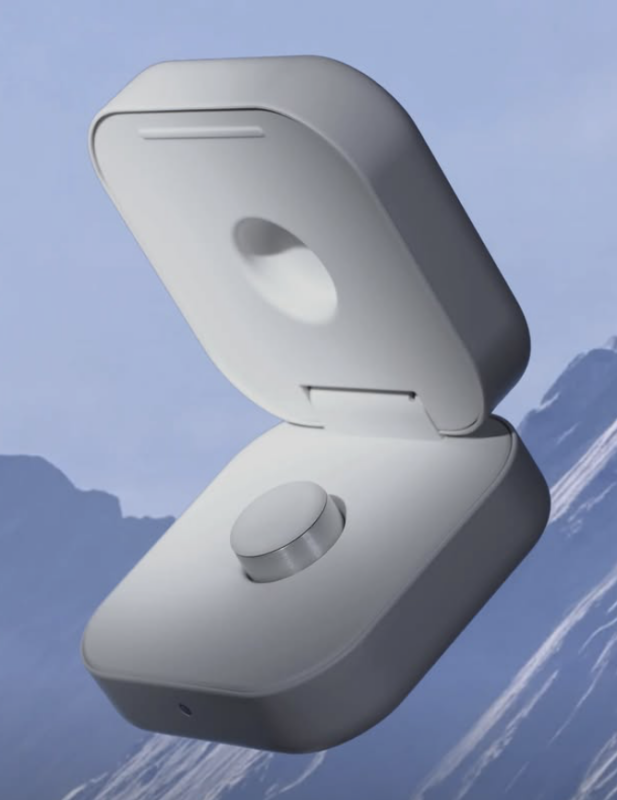
The Atlas 1.0 device.
A portable charging case.
An applicator.
A stencil.
Six nanotechnology sensors.
Ninety adhesives.
A charging cable.
The first three months of membership are included.
That recurring sensor model is notable.
Unlike a smartwatch or ring that consumers simply recharge and continue wearing, Atlas relies on a skin-interface component that needs replenishment.
That means the product is closer to a hardware-plus-consumables platform.
Battery Life Is Two Days
Continuous neural monitoring requires power.
Atlas lists approximately two days of battery life for the device itself.
The portable charging case holds enough power for approximately 10 days of full device charges.
The Atlas device is water resistant but not waterproof, meaning it cannot be submerged.
It’s currently designed for iPhones running iOS 18 or later and requires an iPhone 12 or newer.
Those practical details matter because Atlas’s value proposition depends on continuous use.
The less often someone wears the device, the less longitudinal context the system can build.
For a brain wearable to work as intended, it eventually has to become something users barely think about wearing.
The Science Is Promising — But Consumer Brain Tracking Is Still Early
The concept behind Atlas isn’t science fiction.
EEG has been used for decades.
Ear-centered EEG has an increasingly substantial research literature.
Researchers have demonstrated the ability to collect meaningful EEG signals from electrodes positioned around and inside the ear.
Machine learning has also shown potential for turning those signals into classifications of specific brain states under controlled conditions.
But that doesn’t mean every consumer-facing metric derived from EEG has already been independently validated.
That’s an important distinction.
Atlas’s Presence, Stress and Energy Burn scores are proprietary interpretations created by the company.
Independent research supporting wearable EEG broadly should not automatically be treated as proof that those specific metrics perfectly represent someone’s psychological state.
Real-world EEG also faces significant challenges.
Movement creates noise.
Electrode contact matters.
Different people generate different patterns.
Environmental conditions change.
And psychological states like "stress" or "presence" are more complicated than a single biological measurement.
The most responsible way to view Atlas is therefore not as a device that can literally read someone’s mind.
It’s a wearable collecting physiological signals associated with brain and nervous-system activity and using algorithms to identify patterns within them.
That’s still extremely interesting.
Atlas Isn’t Reading Your Thoughts
This distinction deserves emphasis.
EEG does not provide a transcript of someone’s internal monologue.
Atlas cannot look at your brain activity and determine the exact sentence you’re thinking.
Instead, EEG detects patterns of electrical activity generated by populations of neurons.
Algorithms can analyze characteristics of those signals and attempt to associate them with broader states or responses.
Think less:
"Atlas knows what I’m thinking."
And more:
"Atlas may detect patterns associated with how my brain state is changing."
That may sound less futuristic.
But scientifically, it’s arguably more interesting.
Why the Behind-the-Ear Form Factor Matters
Atlas’s biggest innovation may ultimately be less about any single metric and more about wearability.
The history of consumer health technology repeatedly shows that convenience matters.
A laboratory sleep study can collect enormous amounts of information.
But consumers don’t do laboratory sleep studies every night.
That’s why rings and watches became useful.
A clinical ECG can collect detailed cardiac information.
But consumers aren’t connected to hospital equipment throughout everyday life.
That’s why smartwatches added ECG functionality.
EEG could follow a similar path.
The most sophisticated laboratory EEG will continue to collect more detailed information than a tiny consumer device.
But a 3.4-gram sensor that someone can comfortably wear throughout normal life could collect something laboratory equipment cannot:
Time.
Hours.
Days.
Weeks.
Eventually months of longitudinal information.
That could reveal patterns that short laboratory sessions simply aren’t designed to capture.
The Bigger Picture
Atlas represents an important shift in the wearable industry.
Consumer technology has spent more than a decade mapping the body.
Now companies are beginning to map the brain.
The progression makes sense.
Fitbit: How much did I move?
Apple Watch: How is my cardiovascular system responding?
Oura: How am I sleeping and recovering?
Continuous glucose monitors: How is my glucose changing?
Atlas: How is my brain state changing?
That doesn’t mean Atlas will replace any of those products.
In fact, its integration strategy suggests the opposite.
The future may involve multiple sensors creating different layers of a person’s health profile.
Physical activity.
Sleep.
Cardiovascular health.
Metabolism.
Blood biomarkers.
And now neural activity.
AI becomes the layer connecting all of them.
What Atlas Still Has to Prove
Atlas is ambitious.
Now it has to prove that ambition translates into meaningful everyday information.
The biggest questions aren’t necessarily whether a behind-the-ear sensor can detect EEG.
Research already shows that ear-centered EEG is feasible.
The bigger questions are:
Can Atlas consistently collect clean signals during real-world life?
How reliable are Presence, Stress and Energy Burn across different people?
How much does motion interfere with those metrics?
Can users actually change their behavior based on the information?
Do Atlas insights tell people something they couldn’t already infer themselves?
And most importantly:
Does having continuous access to brain-state information actually improve someone’s wellbeing or performance?
Those questions will require more than impressive hardware.
They’ll require data.
The Bottom Line
Atlas 1.0 is trying to make brain tracking look less like a neuroscience experiment and more like wearing an Oura Ring.
The tiny 3.4-gram device sits behind the ear and continuously combines EEG, skin-conductance and motion data to generate three consumer-facing metrics: Presence, Stress and Energy Burn.
Its $499 Pioneer Edition has already sold out, and the platform carries a $29.99 monthly membership that includes app access and replacement sensors.
The broader science behind ear-centered EEG is promising.
Researchers have demonstrated that meaningful brain signals can be captured from around the ear, that these systems can operate outside laboratories and that machine learning can help identify specific brain states from wearable neural data.
But Atlas is taking that science into relatively unexplored territory.
It isn’t trying to conduct a 30-minute brain test.
It wants to measure the brain throughout everyday life.
If that works — and if Atlas can turn complex EEG signals into insights consumers actually find useful — the wearable industry could be approaching its next major frontier.
We’ve spent years tracking our steps, heartbeats, sleep and recovery.
The next thing we track might be our minds.