

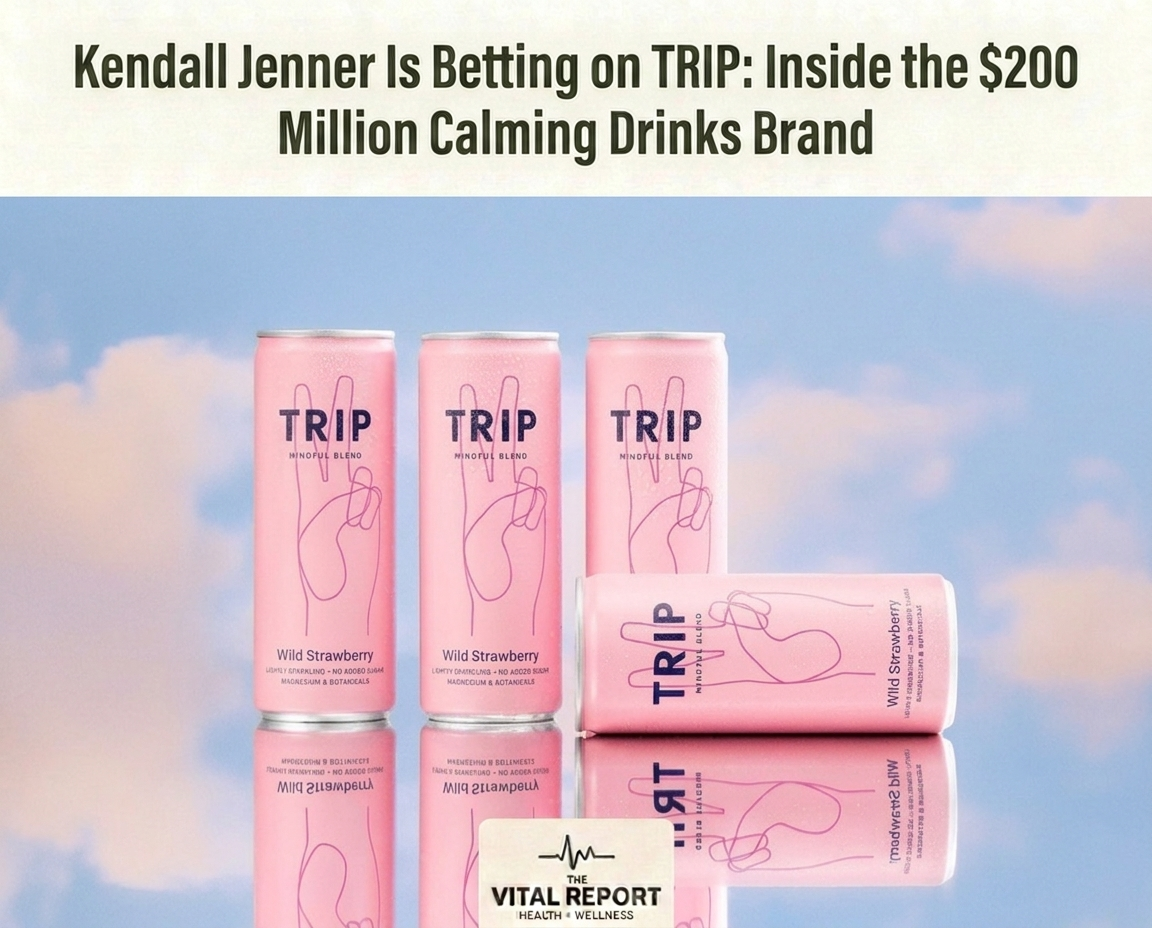
Kendall Jenner has built a beverage business around tequila.
Now she’s investing in something designed to help people calm down.
The model, entrepreneur and founder of 818 Tequila has joined British functional beverage company TRIP as both a global ambassador and equity shareholder, putting one of the world’s most recognizable celebrities behind a rapidly growing category of drinks promising relaxation and mental wellbeing.
The partnership goes significantly further than a traditional celebrity endorsement.
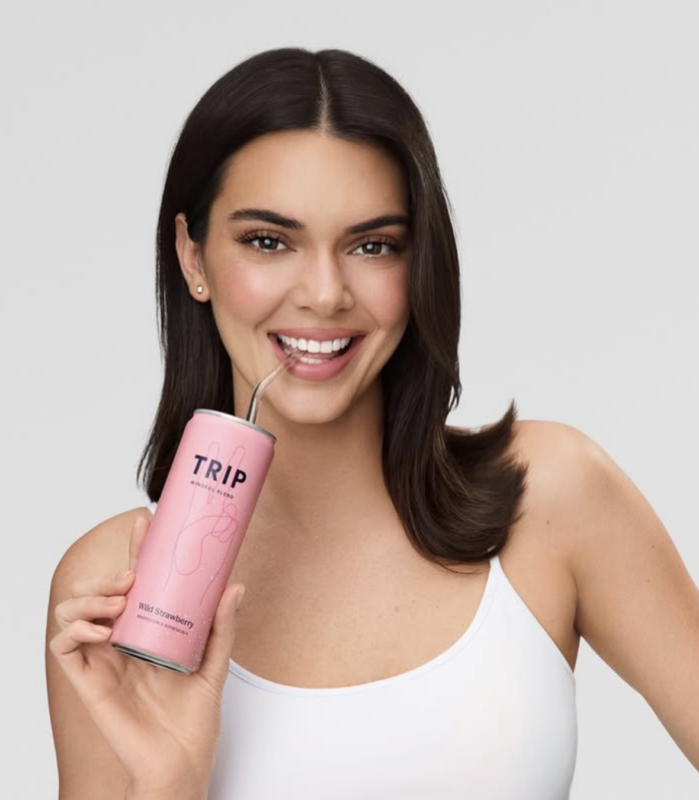
Jenner is becoming the face of TRIP’s new global campaign, but she also has a financial stake in the company.
And she’s joining at an important moment.
Founded in London in 2019, TRIP says it is now available in more than 70,000 retail locations globally, including approximately 25,000 in the U.S., and is on track to generate $200 million in revenue in 2026. The company also says its revenue is expected to double again in 2027.
TRIP’s growth reflects something much bigger than one celebrity partnership.
Consumers increasingly want their drinks to do something.
Energy.
Hydration.
Protein.
Gut health.
Sleep.
And increasingly:
Calm.
Kendall Jenner’s investment is a major bet that relaxation could become one of the next huge functional beverage categories.
Kendall Jenner Isn’t Just an Ambassador
Celebrity beverage partnerships aren’t exactly new.
What’s more notable here is the structure of Jenner’s relationship with TRIP.
She isn’t simply appearing in an advertising campaign.
She’s now an equity shareholder.
TRIP announced Jenner as its new global ambassador on September 8, with Jenner becoming the face of a campaign built around finding moments of calm within the chaos of everyday life.
Jenner says she was already a consumer of the product before the partnership.
"I’ve been obsessed with TRIP for a while."
She described the brand as elevated and intentional and said TRIP had become part of her routine for staying grounded and present.
That preexisting relationship was important to TRIP co-founder Olivia Ferdi.
Ferdi told the Los Angeles Times that Jenner discovered TRIP organically before becoming involved with the company and that making her a shareholder creates a deeper level of alignment around the long-term value of the business.
It’s a meaningful distinction.
Celebrity endorsement: Get paid to promote the product.
Celebrity investment: Benefit financially if the entire company becomes more valuable.
Jenner is betting on the second.
What Is TRIP?
TRIP was founded in 2019 by husband-and-wife team Olivia Ferdi and Daniel Khoury.
The company’s basic proposition is remarkably simple:
"Calm in a can."
Its current sparkling functional drinks are positioned as low-calorie, low-sugar alternatives to traditional soft drinks and alcohol, using ingredients including magnesium and botanicals.
TRIP’s broader product portfolio has also expanded beyond drinks into products including gummies, oils and powders.
The company originally became closely associated with CBD beverages in the U.K., but its expansion increasingly includes non-CBD products designed around relaxation and mental wellbeing.
Its Mindful Blend, for example, incorporates ingredients including magnesium, L-theanine and lion’s mane.
That positions TRIP within a rapidly expanding area of the functional beverage industry:
Mood drinks.
Instead of promising energy like Red Bull or hydration like an electrolyte drink, these beverages are built around a different outcome.
Relaxation.
Functional Drinks Are Moving From the Body to the Mind
For years, the biggest functional beverages primarily targeted physical outcomes.
Energy drinks promised stimulation.
Sports drinks promised hydration.
Protein shakes promised muscle recovery.
Prebiotic sodas promised gut health.
The next battleground may be mental wellbeing.
Industry data increasingly points toward mood support, relaxation, stress management and sleep as major areas of beverage innovation.
SPINS’ 2026 analysis of the natural-products and beverage market identified mood support as one of the strongest emerging functional benefits as consumers increasingly seek products targeting stress, relaxation and sleep.
TRIP says calming drinks have now become the fastest-growing functional beverage category, ahead of categories including gut health, protein and hydration, citing SPINS data.
That’s a remarkable change in what consumers expect from the beverage aisle.
A drink doesn’t just have to taste good anymore.
Increasingly, consumers are asking:
What does this drink do for me?
Why Magnesium Is Suddenly Everywhere
One ingredient sits near the center of the calming-drink movement:
Magnesium.
Magnesium isn’t a new wellness ingredient.
It’s an essential mineral involved in hundreds of biochemical reactions throughout the human body, including processes related to muscle and nerve function.
What’s changed is the way magnesium is being packaged.
Instead of being something consumers primarily encounter in a supplement bottle, magnesium has increasingly entered powders, sleep products and ready-to-drink beverages.
That makes the ingredient much easier to turn into a daily ritual.
TRIP is one of the brands attempting to capitalize on that shift.
Rather than asking someone to take a supplement before bed, the company can position a sparkling drink as something to reach for during an afternoon workday, while relaxing at home or instead of an alcoholic drink.
That changes the consumer behavior entirely.
The product isn’t just a supplement.
It’s an occasion.
What About L-Theanine?
L-theanine has also become a popular ingredient across relaxation and focus products.
The amino acid occurs naturally in tea and has been studied for its potential effects on stress and relaxation.
In a small randomized controlled trial involving 30 healthy adults, researchers found that four weeks of 200 mg per day of L-theanine was associated with improvements in several stress-related and sleep measures. The study is available through PubMed.
Another randomized controlled trial examined a combination containing magnesium, B vitamins, rhodiola and L-theanine in 100 chronically stressed but otherwise healthy adults. The combination produced a modest but statistically significant improvement in stress scores compared with placebo after 28 days. That research is also indexed by PubMed.
Those studies shouldn’t be interpreted as clinical proof that drinking a can of TRIP will eliminate stress.
Dosage matters.
Formulation matters.
Individual ingredients studied under controlled conditions aren’t automatically equivalent to a finished commercial beverage.
But the research helps explain why ingredients like magnesium and L-theanine have moved from the supplement aisle into mainstream functional drinks.
TRIP Is Already Much Bigger Than a Celebrity Wellness Startup
The Kendall announcement could make TRIP look like another celebrity-backed wellness brand.
That’s misleading.
The company had already reached significant scale before Jenner joined.
TRIP says it is now sold through more than 70,000 stores globally.
In the United States, the company’s distribution includes major retailers such as Target, Whole Foods Market, Sprouts, Walmart, Costco, Albertsons, H-E-B, Wegmans, CVS and The Vitamin Shoppe.
That’s an enormous transition for a company that started in London only seven years ago.
TRIP initially built credibility through more lifestyle-oriented retailers and hospitality partners, including Erewhon and Soho House.
Then it went mass-market.
That’s an increasingly familiar playbook in wellness.
Build cultural relevance first.
Then build distribution.
TRIP says its social content generated more than one billion impressions across Instagram and TikTok over the past year, while the company has become one of the most popular beverage brands on TikTok Shop globally.
Now Kendall Jenner adds another enormous layer of cultural distribution.
From $100 Million to $200 Million
The growth numbers make the timing of Jenner’s investment particularly interesting.
TRIP generated approximately $100 million in revenue in 2025 and is on track to reach $200 million in 2026, according to the company.
That’s roughly a doubling of annual revenue.
And TRIP says it expects to double again in 2027.
The company also raised $40 million in a funding round led by consumer-focused investment firm Coefficient Capital, which explicitly lists TRIP among its investments.
Reports surrounding Jenner’s investment put TRIP’s valuation at more than $300 million.
This isn’t a small emerging beverage company looking for celebrity attention.
It’s a rapidly scaling consumer business bringing in one of the world’s most recognizable personalities as it attempts to move into its next stage.
Kendall Jenner Already Understands the Beverage Business
Jenner isn’t entering beverages for the first time.
She founded 818 Tequila, which has built its identity around premium tequila, lifestyle marketing and Jenner’s enormous cultural reach.
That makes her relationship with TRIP more interesting.
On the surface, tequila and calming wellness drinks seem like opposites.
But they’re competing for something very similar:
The drinking occasion.
818 might be something consumers reach for during a night out.
TRIP wants to become something consumers reach for when they don’t necessarily want alcohol.
That’s becoming an increasingly valuable moment.
Consumers are experimenting with sober nights, moderation and alternatives to traditional alcohol, while functional beverage brands are attempting to give those consumers something more compelling than sparkling water.
TRIP’s proposition is essentially:
Don’t just remove the alcohol.
Add a function.
The Rise of the “Outcome Drink”
That may be the best way to understand TRIP.
It’s part of what could be described as the rise of the outcome drink.
Consumers aren’t necessarily buying these beverages because they are thirsty.
They’re buying them because they want a result.
Celsius: energy.
Liquid I.V.: hydration.
Poppi: gut-health positioning.
Protein drinks: muscle and satiety.
TRIP: calm.
Recent functional-beverage innovation increasingly revolves around these highly specific use cases. FoodNavigator reported in August that brands are moving beyond broad "wellness" positioning toward drinks built around specific needs such as focus, calm, protein and recovery.
That is an important shift.
The beverage aisle is increasingly starting to resemble the supplement aisle — just in a much more convenient and culturally appealing format.
Why Calm Could Be a Huge Category
Energy drinks solved an obvious consumer problem.
I’m tired.
Drink caffeine.
Hydration products solved another.
I’m dehydrated.
Drink electrolytes.
Calming drinks are trying to establish a similarly simple behavior.
I’m stressed.
Drink something designed around relaxation.
The challenge is that stress is significantly more complicated than thirst.
But commercially, the opportunity is enormous.
Stress-relief drinks have become one of the fastest-growing areas of functional beverages, with consumers increasingly seeking products positioned around relaxation, mood and emotional wellbeing. Industry reporting has estimated relaxation beverages are growing around 19% annually in some market analyses.
The behavior also creates multiple potential consumption occasions.
After work.
Before bed.
During an afternoon break.
At a party instead of alcohol.
While traveling.
After exercising.
During a stressful workday.
That makes "calm" a surprisingly flexible beverage proposition.
Celebrity Wellness Is Changing Too
Jenner’s investment also reflects a larger evolution in celebrity consumer brands.
The old model was straightforward.
A celebrity appeared in an advertisement.
The company paid them.
Consumers recognized the celebrity.
Hopefully sales increased.
The newer model increasingly involves celebrities taking actual ownership.
That changes the economics.
Instead of simply collecting a campaign fee, the celebrity participates in the upside if the company grows.
TRIP already has other well-known investors and supporters, including Joe Jonas, Ashley Graham and Alessandra Ambrosio.
But Jenner’s profile puts the company on an entirely different cultural scale.
She brings hundreds of millions of social followers, enormous fashion and lifestyle influence, and previous experience building a beverage brand.
For TRIP, that’s distribution you can’t buy through grocery shelves alone.
Wellness Is Becoming a Beverage Occasion
We’ve seen this same broader shift across the wellness industry.
Consumers increasingly want health products that fit seamlessly into behaviors they already have.
Instead of swallowing another capsule, drink something.
Instead of opening another supplement container, grab a can from the refrigerator.
Instead of turning wellness into another task, turn it into a ritual.
That’s part of the reason functional beverages have become such a competitive category.
As Vital Report has covered with the broader rise of functional foods and better-for-you consumer brands, wellness is increasingly being built into familiar products rather than requiring consumers to completely change their routines.
Our recent look at Ferrero’s acquisition of Purely Elizabeth highlighted a similar dynamic in food: major consumer demand is forming around familiar categories rebuilt with a wellness-oriented proposition.
TRIP is doing that with sparkling drinks.
The can looks familiar.
The occasion feels familiar.
The promised outcome is different.
The Science Still Needs Context
There is an important distinction between the growth of calming beverages and evidence that every functional drink produces meaningful physiological relaxation.
Ingredients such as magnesium and L-theanine have legitimate biological roles and scientific research behind them.
But consumer beverages combine different ingredients at different doses.
A clinical trial testing 200 mg of L-theanine isn’t necessarily evidence that every beverage containing L-theanine produces the same result.
The same applies to botanical ingredients.
Functional drinks exist in an interesting space between traditional beverages and supplements.
That’s part of their appeal.
But consumers should still look at the actual formulation rather than assuming words like "calm," "adaptogen" or "mindful" guarantee a specific outcome.
TRIP’s biggest achievement may therefore be as much about behavior and branding as biochemistry.
It has turned the idea of relaxation into a beverage occasion.
Kendall Gives TRIP Something Even More Valuable Than Followers
Jenner obviously brings reach.
But the larger value may be cultural positioning.
Functional drinks can easily look clinical.
Supplements can look medicinal.
TRIP doesn’t want to feel like either.
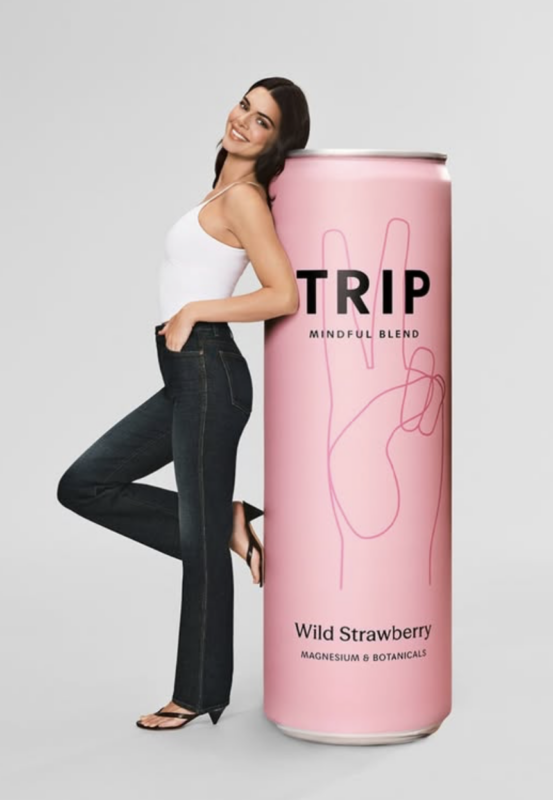
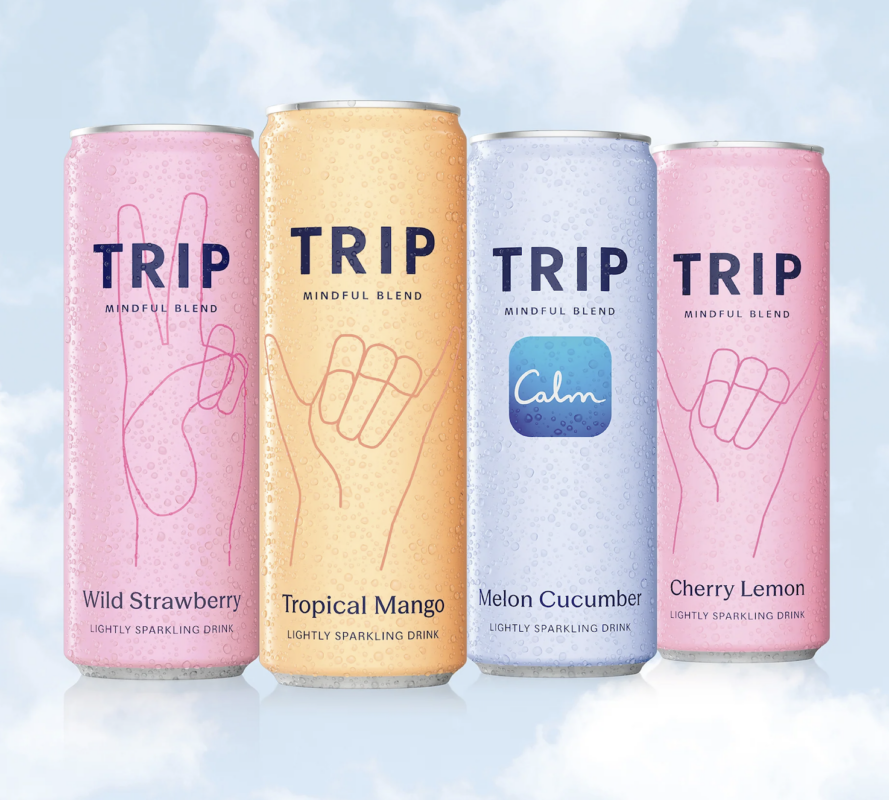
The brand’s pastel cans, social-first marketing, retail strategy and lifestyle positioning make relaxation feel more like fashion or culture than supplementation.
Kendall Jenner fits directly into that strategy.
She doesn’t make TRIP look more scientific.
She makes it look more aspirational.
And in consumer wellness, that distinction can be extremely powerful.
The Bigger Picture
TRIP’s rise says something important about where wellness is heading.
The biggest consumer-health brands of the next decade may not necessarily look like healthcare companies.
They might look like beverage companies.
Food companies.
Beauty companies.
Restaurants.
Wearables.
The underlying consumer desire is similar:
Make feeling better easier to incorporate into everyday life.
TRIP’s proposition is particularly simple.
People are stressed.
People already drink beverages throughout the day.
Put ingredients associated with relaxation into a convenient sparkling drink and create a brand around the idea of calm.
Seven years after launching, that proposition has helped create a business approaching $200 million in annual revenue.
Now Kendall Jenner is betting that it can become much bigger.
The Bottom Line
Kendall Jenner isn’t simply appearing in TRIP’s latest advertisement.
She’s becoming an owner.
The model and 818 Tequila founder has joined the British calming-drinks company as both global ambassador and equity shareholder, becoming the face of TRIP as it accelerates its expansion across the United States and international markets.
The timing is significant.
TRIP says it is on track to reach $200 million in revenue this year, is available in more than 70,000 stores globally, and has become one of the fastest-growing sparkling-drink brands in the U.S.
But the bigger story isn’t Kendall.
It’s the category she’s betting on.
Consumers spent decades buying drinks for taste, caffeine and hydration.
Now they’re increasingly buying beverages for gut health, protein, sleep, focus and mood.
TRIP wants to own one of the biggest outcomes of all:
Calm.
And with Kendall Jenner now financially invested in the business, calming drinks just got one of the biggest celebrity endorsements — and investments — in wellness.