


Hand soap might be one of the most ordinary products in your home.
LeNOSE thinks that is exactly why it is ready for a makeover.
Three former Bubble Skincare executives — Caroline Valentini, Lindsay St. Clair, and Zee Carlstrom — have launched LeNOSE, a new home fragrance brand starting with a collection of $10 hand soaps designed to deliver the fragrance, packaging, and experience associated with significantly more expensive luxury brands.
The premise is straightforward: Why should a bottle of hand soap have to cost $40, $50, or even more to look good on the bathroom counter and smell like a fine fragrance?
LeNOSE calls its debut collection Soap de Parfum, borrowing the language of fragrance to position hand washing as something closer to a beauty ritual than a household chore.
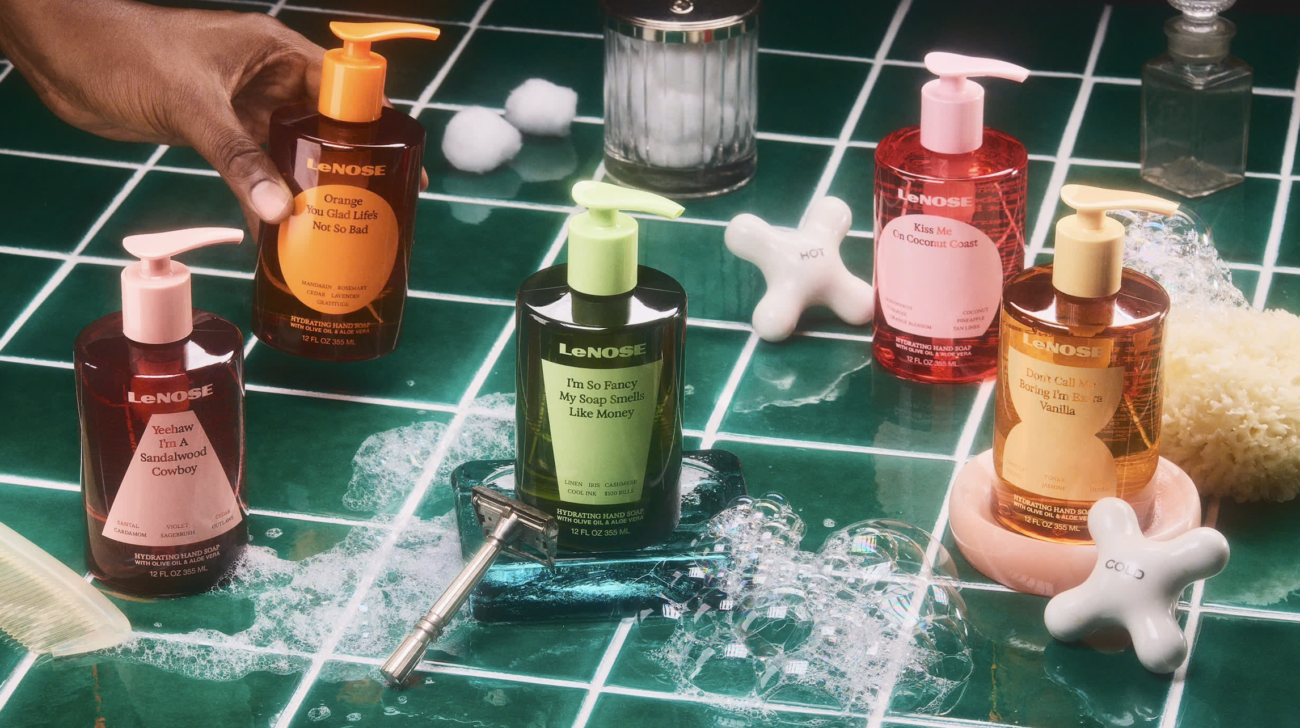
At launch, the company introduced five fragrances ranging from sandalwood and vanilla to a scent designed to evoke money. Each bottle retails for $10.
The company is also leaning into ingredient-conscious positioning. LeNOSE describes its formulas as vegan, cruelty-free, “endocrine conscious,” soft and hydrating, while emphasizing what it calls fine fragrances.
But the most interesting part of LeNOSE may not be the soap itself.
The company represents a larger shift happening across consumer products: brands are taking the design, storytelling, ingredients, and emotional appeal traditionally reserved for beauty and luxury products and applying them to the most basic products in the home.
Soap is no longer just soap.
It can be fragrance.
It can be décor.
It can be skincare.
And increasingly, it can be a status symbol.
LeNOSE wants to deliver all of that without the traditional luxury price.
What Is LeNOSE?
LeNOSE was founded by three executives who previously worked at Gen Z skincare brand Bubble.
Caroline Valentini serves as CEO.
Lindsay St. Clair serves as chief brand officer.
Zee Carlstrom serves as chief marketing officer.
The founders officially introduced LeNOSE in September 2026 after identifying what they saw as a gap between inexpensive mass-market hand soaps and the increasingly expensive fragrance-driven products occupying luxury bathrooms.
As Carlstrom explained to Fashionista, the founders wanted to create a home-fragrance experience with strong packaging, formulas, and scents without charging consumers luxury prices.
That is important because hand soap has quietly become a much more visible consumer category.
A distinctive bottle from a recognizable fragrance or skincare company sitting beside the sink can now function almost like a candle, perfume bottle, or piece of décor.
LeNOSE is essentially asking whether consumers want that experience without spending $50 every time the bottle runs out.
The $10 Price Is the Entire Point
Price is where the company’s strategy becomes particularly interesting.
LeNOSE sells its hand soaps for $10 per bottle.
For comparison, Aesop’s Resurrection Aromatique Hand Wash currently retails for $49 for a 16.9-ounce bottle.
Aesop has become one of the most recognizable examples of hand soap as a lifestyle object.
Its amber bottles have become fixtures in upscale restaurants, hotels, bathrooms, and social-media interiors.
The product itself is only one component of that success.
Consumers are also buying the smell.
The bottle.
The brand.
And the feeling the product creates in a room.
LeNOSE clearly understands that dynamic.
But rather than trying to compete with luxury brands at luxury pricing, it wants to bring the same type of emotional purchase into the mass market.
That creates a very different proposition.
Instead of asking whether someone will spend $50 on soap, LeNOSE is asking whether they will spend $10 to make washing their hands feel slightly more interesting.
That is a much easier impulse purchase.
LeNOSE Is Treating Soap Like Perfume
The name Soap de Parfum says a lot about what the company is trying to build.
Traditional soap marketing tends to emphasize cleanliness.
Kills germs.
Moisturizes hands.
Removes dirt.
LeNOSE starts somewhere else:
How does it smell?
The original lineup consists of five deliberately playful fragrances.
I’m So Fancy, My Soap Smells Like Money combines linen, iris, cashmere, and cool ink in an attempt to evoke the smell of money.
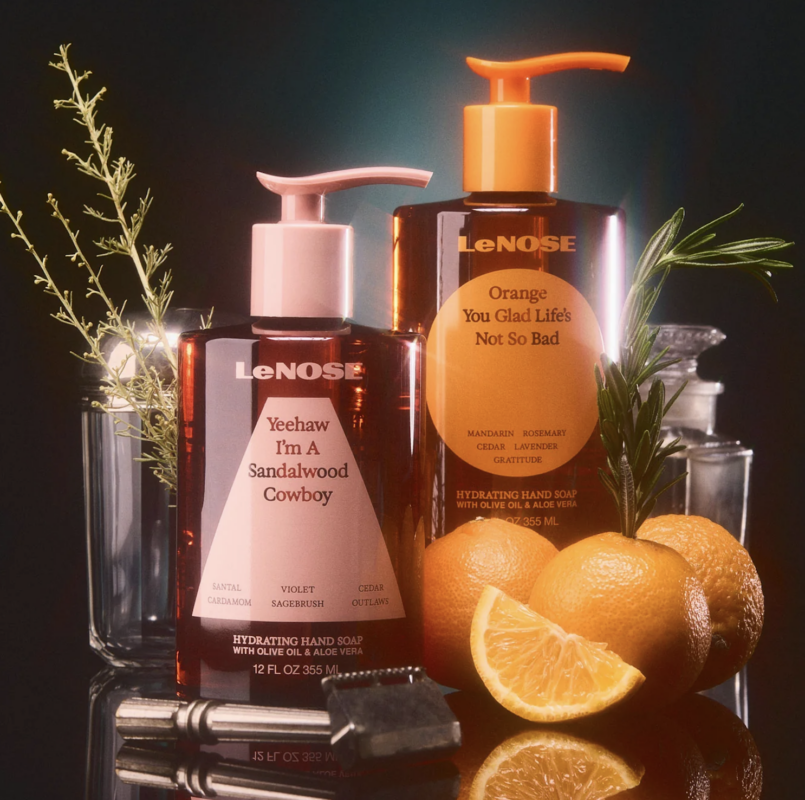
Yeehaw I’m A Sandalwood Cowboy combines santal, violet, cedar, cardamom, and sagebrush.
Orange You Glad Life’s Not So Bad uses mandarin, rosemary, lavender, and cedar.
Don’t Call Me Boring, I’m Extra Vanilla features vanilla, tonka, amber, orchid, and jasmine.
Kiss Me On Coconut Coast combines dragonfruit, coconut, tuberose, pineapple, and orange blossom.
The brand’s current online lineup simplifies those names into fragrances including Cash Money, Desert Sandalwood, Mandarin Rosemary, Vanilla Amber, and Tropical Dragonfruit.
The fragrances are intentionally more complex than the basic “lavender,” “lemon,” or “fresh linen” language historically associated with household soap.
That is the point.
LeNOSE wants its fragrances to sound like something you might find at a perfume counter.
The Brand Is Mixing Luxury With Humor
There is another important distinction.
LeNOSE does not want to look overly serious.
Luxury fragrance can sometimes rely on minimal packaging, abstract names, restrained typography, and intentionally mysterious storytelling.
LeNOSE is going in almost the opposite direction.
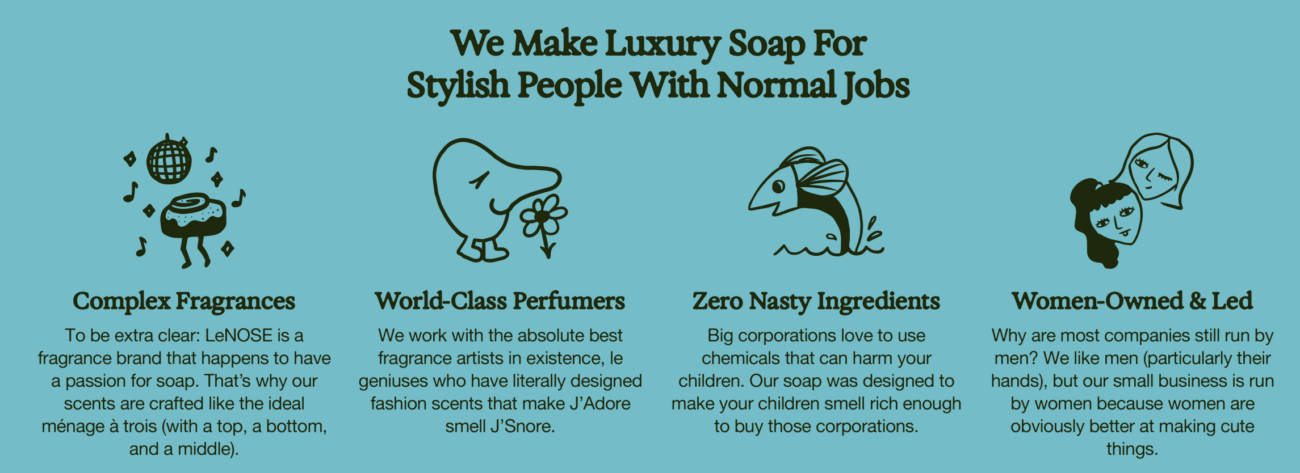
Its packaging combines sophisticated colors and geometric shapes with playful illustrations and intentionally ridiculous product names.
The brand itself says:
“Smells Like Fun.”
Its website includes phrases like:
“Not For Nepo Babies.”
Even the name LeNOSE is a joke about the sometimes overly serious world of fragrance.
That combination could be particularly effective with younger consumers.
The product can still look attractive sitting beside the sink.
It just does not have to take itself so seriously.
Hand Soap Has Quietly Become a Status Symbol
The rise of LeNOSE makes more sense when looking at what has happened to bathrooms and kitchens over the last decade.
Products that were once hidden underneath the sink are increasingly displayed.
Soap bottles.
Cleaning sprays.
Candles.
Dish detergent.
Hand lotion.
Surface cleaners.
Even trash cans.
Consumers increasingly want these objects to fit the aesthetic of their homes.
Social media accelerated that transition.
A bathroom sink is no longer just a sink.
It can appear in an apartment tour, TikTok video, Instagram Story, Airbnb listing, restaurant bathroom selfie, or Pinterest board.
That visibility creates an opportunity for brands.
If the product is going to sit in plain sight, consumers may care more about what it looks like.
And once appearance matters, branding matters.
Once branding matters, companies can charge more.
LeNOSE is trying to break that final part of the equation.
It wants the visual and sensory experience without the extreme markup.
Bubble’s Influence Is Easy to See
The founders’ experience at Bubble also matters.
Bubble helped demonstrate that Gen Z consumers could be reached with affordable products that combined ingredient-conscious formulations with colorful packaging, approachable education, humor, and strong social-media branding.
LeNOSE applies several of those same principles to a different category.
Take an everyday product.
Make the packaging instantly recognizable.
Keep the price accessible.
Speak in the language of younger consumers.
Create something people actually want sitting on their counter.
Then build the brand socially.
The difference is that LeNOSE is moving those principles from skincare into the home.
That could be a significant opportunity.
Gen Z consumers who first encountered brands like Bubble as teenagers and college students are getting older.
They are moving into apartments.
Buying furniture.
Decorating kitchens.
Building bathrooms.
Hosting people.
Buying products for their homes.
The brands targeting them therefore have an opportunity to grow up alongside them.
Ingredients Are Becoming Part of the Home-Fragrance Conversation
LeNOSE is also positioning itself around more than fragrance.
On its website, the company describes its soaps as:
Endocrine conscious
Soft and hydrating
Vegan and cruelty-free
It also emphasizes “No Nasty Chemicals.”
Those phrases reflect another significant shift happening across household products.
Consumers increasingly want to know what is inside products they use repeatedly.
That interest started heavily in food and beauty but has expanded into laundry detergent, dish soap, cleaning sprays, candles, cookware, food storage, and other household categories.
Vital Report has already seen the economic power behind that transition.
As we explored in our coverage of Church & Dwight’s $325 million acquisition of Miss Mouth’s Messy Eater, younger household brands are increasingly winning consumers through a combination of performance, digital-first marketing, ingredient awareness, and modern branding.
LeNOSE fits into the same broader shift, even though its emphasis is fragrance rather than stain removal.
Consumers no longer necessarily separate “wellness products” from “household products.”
The products they interact with every day increasingly fall under the same scrutiny.
What Does “Endocrine Conscious” Actually Mean?
This is also where consumers should maintain some skepticism.
“Endocrine conscious” is a brand term, not a standardized regulatory category.
The endocrine system consists of glands and hormones that regulate processes throughout the body, and scientists have studied whether certain environmental chemicals can interfere with hormonal signaling.
The National Institute of Environmental Health Sciences describes endocrine-disrupting chemicals as substances that may interfere with the body’s endocrine system and notes that potential exposure can occur through food, water, air, skin, and consumer products.
But that does not mean every synthetic ingredient or fragrance ingredient is an endocrine disruptor.
Nor does it mean a product described as “endocrine conscious” automatically provides a measurable health advantage.
Consumers should view the phrase as part of LeNOSE’s formulation philosophy rather than as a medical or regulatory certification.
That distinction is important as “clean” terminology spreads throughout consumer goods.
The more useful questions are usually specific ones:
What ingredients are included?
What ingredients are excluded?
Why?
And what evidence supports those decisions?
The Bigger Trend Is the Premiumization of Boring Products
LeNOSE fits into one of the most interesting consumer trends happening right now:
Everyday products are becoming lifestyle products.
Water bottles became accessories.
Cookware became kitchen décor.
Cleaning products became aesthetically designed countertop objects.
Hand sanitizer became a beauty product.
Laundry detergent became fragrance.
And now hand soap is becoming perfume.
The formula is surprisingly consistent.
Start with a product people already use.
Improve the design.
Add an ingredient story.
Create an emotional experience.
Build a distinctive brand.
Then make the product something consumers are happy to leave visible.
$10 Could Be LeNOSE’s Biggest Advantage
There is also a practical advantage to the price.
Soap gets used up.
Unlike perfume, cookware, or furniture, it is something consumers repeatedly wash down the drain.
That makes extremely expensive hand soap an unusual luxury.
A $50 bottle might look beautiful, but consumers eventually have to buy another one.
LeNOSE’s $10 price potentially changes the psychology of the purchase.
It is expensive enough to feel different from commodity soap.
But it is inexpensive enough that consumers can try multiple fragrances, put different bottles in different bathrooms, or buy replacements without treating each purchase like a luxury splurge.
The company is already leaning into that behavior with bundles.
Its current online store sells two-packs for $20 and a five-bottle House Party Bundle for $50.
That encourages consumers to think of fragrance as something they can rotate rather than commit to.
LeNOSE Is Already Thinking Beyond Soap
Hand soap is also only the beginning.
At launch, LeNOSE said it plans to expand into additional home-fragrance categories.
That could be where the brand becomes particularly interesting.
If consumers associate LeNOSE with accessible fragrance rather than specifically with soap, the company could potentially move into categories such as candles, room sprays, diffusers, body products, cleaning products, or other scent-driven household goods.
The strategy resembles how beauty brands use a hero product to establish an identity before expanding into adjacent categories.
Soap provides LeNOSE with a relatively simple entry point.
Everyone understands it.
Almost everyone uses it.
The price is approachable.
The product sits visibly in the home.
And fragrance provides an emotional reason to care about something consumers previously purchased almost entirely for function.
Distribution Could Be the Real Test
LeNOSE initially launched direct-to-consumer through its own website and TikTok Shop, with Amazon distribution planned for October.
The founders have also indicated that broader retail expansion is part of the plan.
That could ultimately determine whether LeNOSE becomes a meaningful consumer brand.
A $10 soap has an interesting position in physical retail.
It is significantly cheaper than luxury fragrance-driven hand washes but more premium than many mass-market soaps.
That leaves room for a new middle category:
accessible luxury soap.
The question is whether enough consumers see fragrance, design, and ingredients as meaningful reasons to trade up.
If they do, LeNOSE could help bring the premium hand-soap category to a much larger audience.
The Bottom Line
LeNOSE is taking one of the most basic products in the home and asking a surprisingly effective question:
Why can’t hand soap be fun, beautiful, fragrance-forward, and affordable at the same time?
Founded by former Bubble executives Caroline Valentini, Lindsay St. Clair, and Zee Carlstrom, the company launched its Soap de Parfum collection with five $10 fragrances designed to combine fine-fragrance inspiration, playful branding, hydrating formulas, and ingredient-conscious positioning.
But LeNOSE’s larger opportunity goes beyond soap.
It is another example of the line between beauty, wellness, fragrance, and household products disappearing.
Consumers increasingly expect even the most ordinary objects in their homes to look good, smell good, feel good, and align with their preferences around ingredients and values.
Luxury brands proved consumers would pay $50 for beautiful soap.
LeNOSE is making a different bet.
Maybe you don’t need to.