

Athletes have spent years trying to stay cool in increasingly sophisticated ways.
Ice vests.
Cooling towels.
Cold drinks.
Cooling caps.
Portable fans.
And in the case of OMIUS, graphite cooling pieces worn directly against the forehead.
Now the performance-cooling company is targeting another major source of heat:
the sun itself.
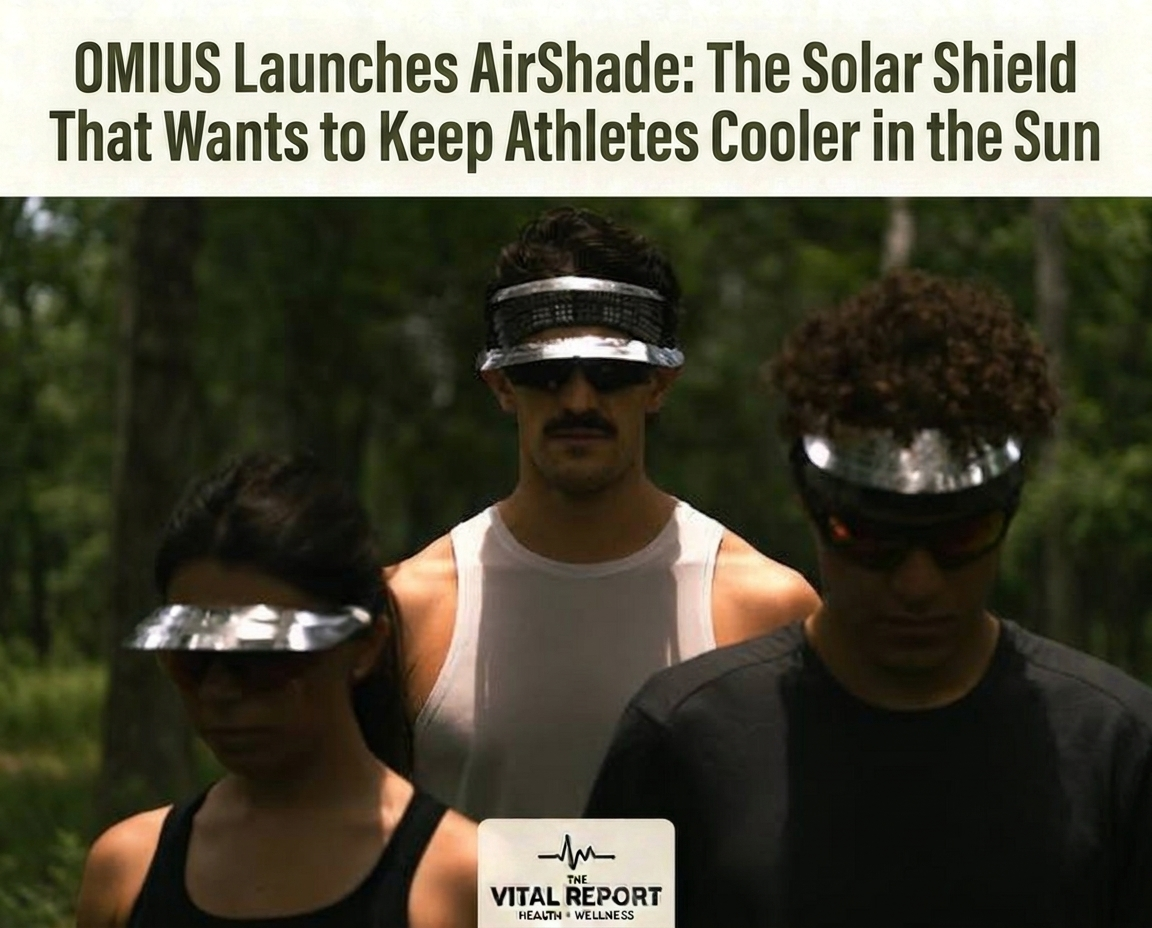
OMIUS has opened preorders for AirShade, a lightweight reflective solar shield that mounts directly onto the sport sunglasses an athlete already wears.
Instead of covering the forehead like a traditional visor, AirShade uses thin reflective louvers designed to block direct solar radiation while leaving space for air to continue moving across the face and forehead.
According to OMIUS, the $99 Founders Edition can be configured with an upper shield, lower shield, or both. The complete setup weighs 50 grams, while the upper and lower sections weigh 30 grams and 25 grams individually.
The company says its thermal modeling suggests that shielding its existing cooling pieces from direct sunlight could improve their cooling performance by roughly 30% to 50% in direct sun. That figure comes from OMIUS’s own modeling, rather than a published clinical trial of AirShade.
That distinction matters.
But the product itself represents an interesting idea in performance technology.
Instead of tracking how an athlete responds to heat, OMIUS is trying to physically change the environment immediately surrounding them.
AirShade Isn’t Actually a Pair of Sunglasses
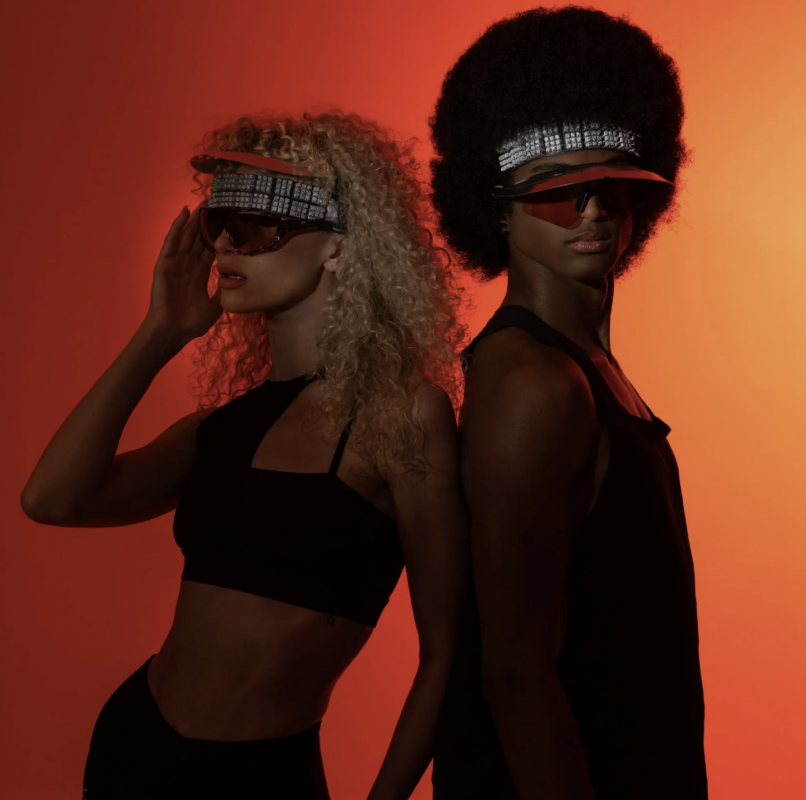
Despite its appearance, AirShade isn’t a new pair of performance sunglasses.
It’s an accessory that attaches to them.
OMIUS designed the system to mount onto most sport sunglasses using what it calls Fit Bands. A small stabilizer attaches around the nose bridge to help keep the structure in position.
The result looks somewhere between sunglasses, a visor, and a piece of futuristic cycling equipment.
But the design is driven by a fairly simple problem.
Traditional visors create shade by placing material directly over the forehead.
That blocks sunlight.
But it can also cover an area where sweat and moving air contribute to evaporative cooling.
OMIUS wanted both.
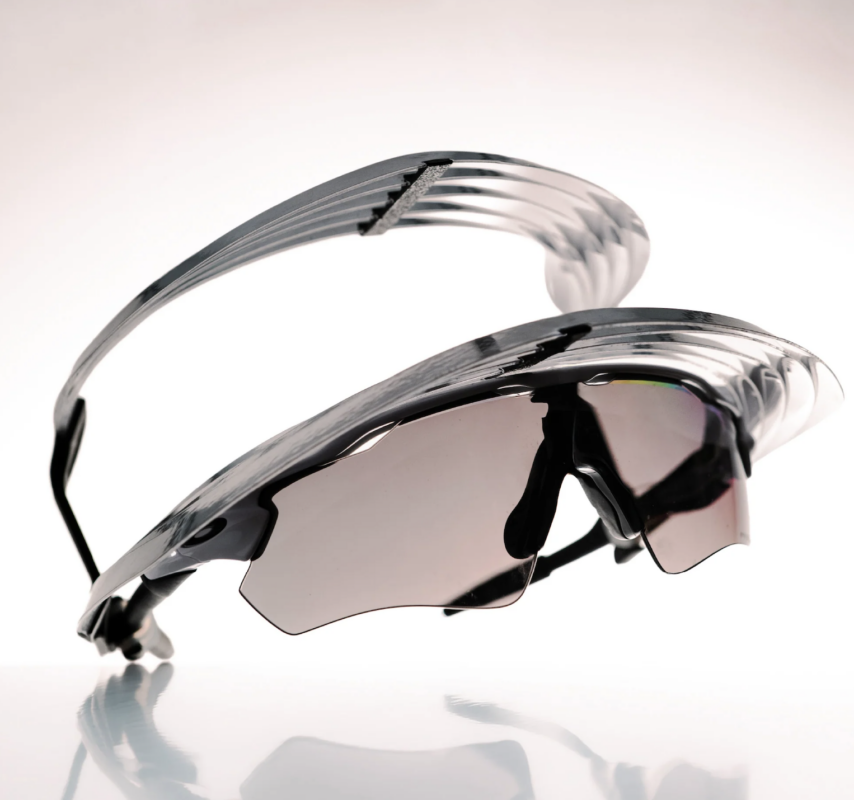
So rather than using one continuous piece of fabric or plastic, AirShade uses rows of reflective blades.
The louvers are intended to intercept sunlight while leaving open space between them for air to move through.
The sunglasses effectively become the chassis holding the entire structure in place.
It’s an unusual approach to a familiar problem:
How do you create shade without trapping more heat?
Why OMIUS Is Focused on Evaporation
To understand AirShade, it helps to understand the technology OMIUS already sells.
The company’s primary products use small pieces of porous graphite positioned directly against the skin.
According to OMIUS’s explanation of its cooling technology, the graphite pieces have a hydrophilic coating designed to absorb water and spread it across a much larger surface area. As that water evaporates, it absorbs heat.
The principle isn’t unique to OMIUS.
Sweating is one of the body’s primary mechanisms for dissipating heat during exercise.
The innovation is in trying to give that water more surface area from which to evaporate.
OMIUS says its original SF5 pieces provide roughly five times the evaporative surface area of the skin underneath them. Its newer SF7 pieces increase that to seven times the surface area, or about 40% more evaporative surface than SF5.
But evaporation depends on the environment.
The cooling pieces need to remain wet.
And they need airflow.
OMIUS specifically advises users not to cover the pieces and says movement from walking, running, or cycling can provide the airflow needed to support evaporation.
AirShade essentially adds another variable to that equation:
solar radiation.
The Upper and Lower Shields Do Different Jobs
One of the more interesting parts of AirShade is that athletes don’t have to wear the entire system.
There are three configurations.
The upper shield weighs 30 grams and is primarily designed to shade the forehead and OMIUS cooling pieces.
The lower shield weighs 25 grams and provides additional shade across the face and eyes.
Using both creates the full 50-gram AirShade setup.
That modularity could matter for endurance athletes.
A runner may want the lightest possible setup and only use the upper portion.
Someone spending several hours cycling or competing under intense sunlight may prefer more coverage.
The sections can be swapped using an included screwdriver, although this isn’t designed as something athletes would necessarily change in the middle of a race.
OMIUS also says AirShade can be used without its cooling pieces.
In that configuration, the product functions more like a highly ventilated sun visor mounted to sunglasses.
Add the company’s Headband or Reverse Cap, however, and the upper shield also helps prevent direct sunlight from heating the graphite cooling pieces.
That’s where OMIUS sees the larger performance opportunity.
The Sun Can Add to the Heat Problem
Hot-weather performance isn’t simply about air temperature.
Athletes can also be exposed to radiant heat from direct sunlight.
That means two runs at the same air temperature can potentially feel very different depending on cloud cover, shade, wind, humidity, and solar exposure.
The body then has to balance the heat generated internally through exercise with the heat gained from the environment and the heat it can dissipate through mechanisms including evaporation.
That becomes increasingly difficult as conditions get hotter and more humid.
For endurance athletes, the consequences can include greater cardiovascular strain, higher perceived effort, and reduced performance.
This is why OMIUS’s approach is interesting.
Instead of only trying to increase cooling, AirShade tries to reduce some of the incoming heat in the first place.
Reflect sunlight.
Preserve airflow.
Keep the forehead exposed.
Then, optionally, combine that setup with evaporative cooling technology.
It’s a different philosophy from simply putting more material between the athlete and the sun.
What Does the Research on OMIUS Actually Show?
This is where some context is important.
OMIUS has attracted attention among endurance athletes, but research specifically evaluating its cooling technology remains limited.
A 2024 randomized crossover study published in the Journal of Thermal Biology tested the OMIUS cooling headband in 10 trained male athletes exercising in hot and humid conditions.
Participants completed 70 minutes of submaximal running followed by a 5K time trial.
The headband reduced forehead temperature and improved forehead thermal comfort during the submaximal portion of the test.
But it did not significantly reduce core temperature, heart rate, perceived exertion, or improve 5K time-trial performance compared with the sham condition.
That’s an important distinction.
There is evidence that the existing OMIUS headband can make the forehead cooler and more comfortable under certain conditions.
There is not yet strong evidence showing that it necessarily translates into better endurance performance or lower core body temperature.
And AirShade itself is newer still.
OMIUS’s claim that AirShade could improve cooling-piece performance by 30% to 50% in direct sun is currently based on the company’s thermal modeling, not a published human performance trial.
So the technology may have a plausible physical mechanism, but its real-world performance benefits still need more independent study.
This Is Really a New Kind of Performance Wearable
AirShade is also interesting because it doesn’t fit neatly into the traditional definition of a wearable.
There’s no heart-rate sensor.
No GPS.
No battery.
No Bluetooth.
No app.
And no recovery score waiting for you after the workout.
It is entirely passive.
That’s increasingly unusual in a sports technology industry obsessed with collecting more data.
Smartwatches measure physiology.
Running pods measure movement.
Smart insoles measure biomechanics.
Continuous glucose monitors measure glucose.
AirShade measures nothing.
Instead, it’s designed to do something physically while the athlete is exercising.
That connects with a larger shift Vital Report has been following across performance technology. As we explored in our story on the Nike x Hyperice Air Zoom Hyperslide and the rise of active performance wearables, wearable technology is increasingly moving beyond monitoring the body toward products designed to actively influence the athlete’s experience.
OMIUS is doing that without electronics.
Its intervention is simply shade, airflow, water, graphite, and evaporation.
Endurance Sports Are the Obvious Market
The AirShade design isn’t going to appeal to everyone.
It’s visually aggressive.
It adds hardware to an athlete’s sunglasses.
And the full system adds another 50 grams before accounting for the glasses or any separate OMIUS cooling gear.
But for someone spending hours exercising under direct sunlight, aesthetics may matter less than comfort.
That makes triathlon, cycling, ultrarunning, trail running, and other endurance sports obvious targets.
The launch timing reinforces that positioning.
OMIUS says the first AirShade units are expected to begin shipping in late September, with pickup available in Kona around the IRONMAN World Championship in early October.
That’s about as targeted as a product launch gets.
Kona is synonymous with endurance racing in heat.
And AirShade looks like a product built specifically for athletes willing to experiment with almost anything that might make hours of racing under the sun more manageable.
AirShade Doesn’t Replace Sun Protection
There’s also an important limitation that OMIUS makes clear.
AirShade isn’t sunscreen.
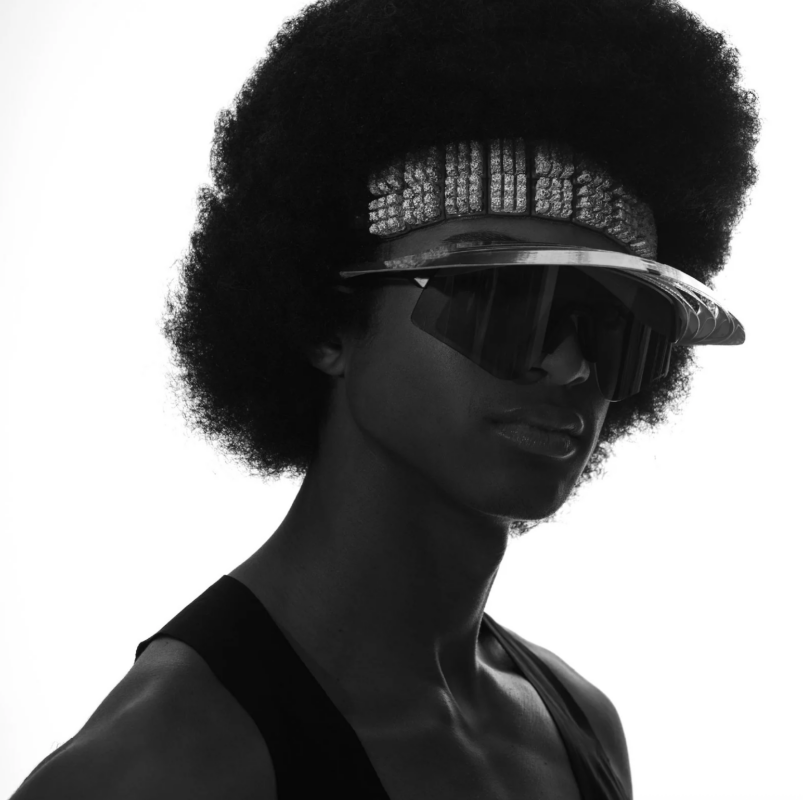
The open louver design intentionally allows airflow, which also means it doesn’t create a completely sealed barrier against sunlight from every angle.
OMIUS recommends continuing to apply sunscreen below the eyebrows because certain sun angles can still reach exposed skin.
The system also doesn’t protect the top of the head or back of the neck unless it is paired with other headwear, such as the company’s Reverse Cap.
That makes AirShade better understood as a performance-oriented shade system, rather than complete sun protection.
It’s designed around balancing shade and ventilation—not creating maximum UV coverage.
The Bigger Opportunity Is Environmental Performance Tech
For years, sports wearables have focused almost entirely on the athlete.
Measure the body.
Collect the data.
Analyze the workout.
Recommend what happens next.
But there’s another side of performance:
the environment.
Temperature.
Humidity.
Sunlight.
Air quality.
Altitude.
Wind.
All of those factors can change how the exact same workout feels.
OMIUS is essentially betting that performance technology can target those conditions directly.
The AirShade doesn’t need to know your heart rate to reduce the amount of sunlight reaching your forehead.
It doesn’t need an algorithm to create airflow.
And it doesn’t need a battery to support evaporation.
That simplicity could be its biggest strength.
The Bottom Line
OMIUS AirShade is one of the stranger-looking performance products to arrive this year.
But underneath the futuristic appearance is a relatively straightforward idea.
Block sunlight without blocking airflow.
The $99 solar shield attaches to existing sport sunglasses and uses reflective open louvers to shade the face and forehead while leaving air free to move between them. Athletes can wear the 30-gram upper shield, 25-gram lower shield, or combine them into the 50-gram full setup.
Pair it with OMIUS’s graphite cooling technology and the company says its thermal modeling suggests shielding the cooling pieces from direct sunlight could improve their cooling performance by roughly 30% to 50% in direct sun. That claim still needs validation in published human testing.
Existing independent research on the OMIUS headband offers a similarly nuanced picture: it has been shown to lower forehead temperature and improve local thermal comfort during submaximal running in the heat, but it did not significantly improve core temperature or 5K performance in a small randomized study.
So AirShade shouldn’t be viewed as a proven shortcut to faster race times.
It’s something more interesting:
a new attempt to treat the environment itself as part of performance technology.
For athletes who spend hours racing under direct sunlight, the next performance wearable may not need another sensor.
It might just need to keep the sun off your face.